
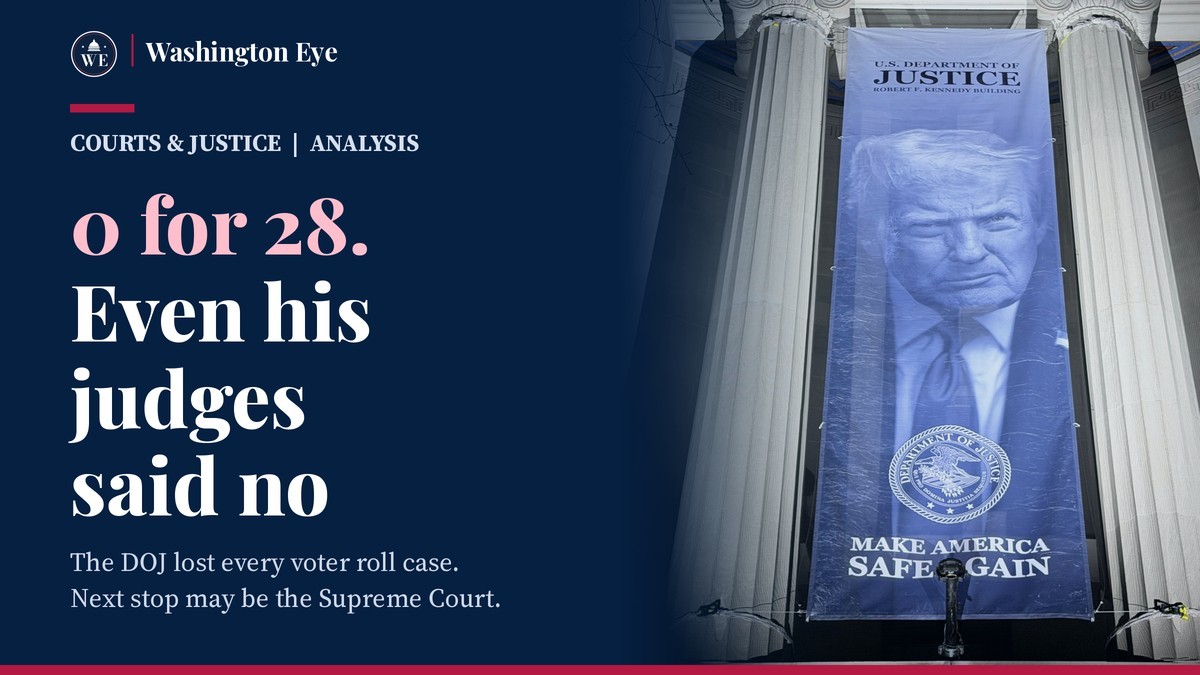
The Justice Department has now asked 28 federal trial courts for the same thing and heard the same answer 28 times. On Tuesday, Senior Judge Richard G. Andrews of the federal district court in Delaware dismissed the department's lawsuit seeking the state's complete, unredacted voter registration list. It was the last of the department's district court cases to be decided. The government did not win one.
The losing streak matters less as a scorecard than as a signal. Since the summer of 2025 the administration has tried to assemble something no federal agency has ever held: the full voter files of nearly every state, complete with dates of birth, driver's licence numbers and partial Social Security numbers. The plan, according to the department's own filings and statements, was to run those names against Homeland Security databases to look for noncitizens, people registered in more than one state and voters who have died. Without the lists, a central plank of the president's election integrity agenda has stalled. Whether it stays stalled now depends on a decision the solicitor general must make by 11 December.
The Delaware case shows the pattern. On 11 July 2025 the department wrote to the state's election commissioner, Anthony Albence, asking how Delaware maintained its rolls and requesting an electronic copy of its statewide list. Albence answered most of the questions and offered the list minus the portions protected under state law. On 14 August the department sent a sharper demand under Title III of the Civil Rights Act of 1960. It wanted every field, including each registrant's full name, date of birth, home address and either a driver's licence number or the last four digits of a Social Security number, and it wanted the file within seven days. Delaware refused, arguing that the 1960 law did not reach the list and that federal and state privacy laws barred handing it over. The department sued on 2 December 2025, one of roughly 30 nearly identical suits filed against states and localities.
Delaware's attorney general, Kathy Jennings, called the demand "illegal" and an example of "federal overreach." Michigan's attorney general had earlier described the department's requests as "invasive" and "a transparent attempt to intimidate and spread fear among voters." The administration, for its part, has framed the campaign as basic law enforcement. "We're not going to stop doing what I think every American should expect us to do, which is make sure that we have elections that are fair," Attorney General Todd Blanche said in a Sunday television interview in August.
The legal fight turns on a few words written at the height of the civil rights movement. Title III requires election officers to preserve for 22 months all records and papers that "come into" their possession relating to registration and voting, and it lets the attorney general demand those records. The provision was designed to let federal investigators see the registration files that Southern officials were using to turn away Black applicants.
Most judges have read "come into" possession to mean documents that arrive from outside, such as the forms voters fill in, rather than a database that state officials build themselves. Judge Andrews put the point plainly. "Title III was passed in 1960. The 'records' that existed at the time were paper records," he wrote. He said he agreed with the Sixth Circuit and other district courts that reading the law to cover documents received from outside sources, rather than internally created ones, "prevents conflicts" between the 1960 statute and later federal election laws such as the Help America Vote Act and the National Voter Registration Act.
Other judges have rested on a second ground: that the department never properly explained the basis and purpose of its demand, as the statute requires. Some have used both. A few went further. Judge David Carter in California wrote that the department "seeks to use civil rights legislation which was enacted for an entirely different purpose to amass and retain an unprecedented amount of confidential voter data." In Pennsylvania, Judge Cathy Bissoon wrote that "concerns regarding widespread voting by non-citizens simply are not borne out by reality."
What makes the record striking is who wrote it. By one count published this week, the 28 district court losses came from six judges appointed by Barack Obama, nine by Joe Biden, eight by Donald Trump, four by George W. Bush and one by Bill Clinton. This is not a story of one ideological wing of the bench closing ranks against the president. Judges he chose himself have read the statute the same way as judges chosen by his opponents.
The only appeals court to rule so far is the Sixth Circuit, and it is where the department sees its opening. In June a panel ruled 2 to 1 that Michigan's Secretary of State, Jocelyn Benson, did not have to hand over the unredacted file. Benson had already provided the public version of the list. The majority opinion was written by Judge Andre Mathis and joined by Judge R. Guy Cole. Judge John Nalbandian, a Trump appointee, dissented, arguing that the voter file is simply a compilation of individual records that each satisfy the statute.
In August the full court declined to rehear the case, but the votes were close enough to keep the dispute alive. Five judges publicly said the court should have taken it up. In the sharpest dissent, Judge Amul Thapar retold how, in the late 1950s, a state court judge in Alabama impounded voter registration records and told reporters that federal investigators "are not going to get the records." Congress wrote Title III to end that kind of defiance, Thapar argued, and the panel's reading now means the attorney general "will have no way of knowing whether ineligible individuals are on the state's voter rolls." He pointed to a software error that added thousands of noncitizens to one state's registry and to another state's discovery of tens of thousands of dead people on its rolls.
Yet the judges who voted against rehearing did not simply side with Michigan. Judge Eric Murphy, joined by Chief Judge Jeffrey Sutton and Judge Joan Larsen, said the government "serves a compelling interest" in election integrity and that inflated rolls can erode public confidence. He suggested a narrower route: nothing in the panel decision, he wrote, "prevents the DOJ from sending a fresh letter" that clearly demands the "individual voter records used to create the voter list." In other words, a majority of that court did not say the government can never see the underlying data. It said this demand, aimed at this compiled list, did not fit the 1960 statute.
Department officials read the Sixth Circuit dissents as a road map. "We just got a ruling in the Sixth Circuit that had some very good language in the en banc from several very respected judges," Assistant Attorney General Harmeet Dhillon said before the midterms. "And so you may see us making a next stop at the Supreme Court on that." Her deputy, Jesus Osete, wrote online that "nine judges believe that decision is deeply flawed," a count that added the four judges who voted against rehearing but wrote separately to the five who openly dissented.
The formal filings are more cautious. The department's deadline to ask the justices to hear the Michigan case was 12 November. On 2 November the solicitor general asked for more time, telling the Court that he "has not yet determined whether to file a petition" and needed to consult within the executive branch and "assess the legal and practical impact" of the ruling. Justice Brett Kavanaugh granted the request two days later, moving the deadline to 11 December.
The choice is not obvious. The Supreme Court usually takes cases where appeals courts disagree, and so far none do. Cases against Hawaii and Idaho are on hold while the Ninth Circuit weighs the issue, and appeals are pending in other circuits, several of them due for argument in the coming months. A single win anywhere would create the kind of split the justices like to resolve. A petition now would ask the Court to step in on the strength of dissents alone, with a record in which judges of every stripe have ruled the other way.
The political ground has also shifted. Last week's elections handed Democrats control of both the House and the Senate from January. A Democratic Congress is unlikely to amend Title III to give the department what the courts have denied it, and Democratic committee chairs may well ask why the department pursued roughly 30 lawsuits that produced no wins. Supporters of the effort will argue the opposite lesson: that the 1960 law is outdated, that federal list maintenance requirements under the 1993 and 2002 election laws lack teeth, and that the courts have left Washington unable to check what states do with their rolls.
Both readings contain something real. The government has a legitimate interest in accurate voter rolls, and even judges who ruled against it have said so. States, meanwhile, run elections under the Constitution and have their own privacy laws covering exactly the data the department sought. Blanche acknowledged that tension in August. The federal role, he said, is not nothing, but "whether we should be playing the role that we're playing, and that's really what we're litigating."
For now, that litigation has produced a clear answer at the trial level and a narrow opening at the appellate level. The department can try to persuade nine justices that 28 district judges and two appeals judges misread a 66-year-old statute. It can send the kind of narrower, record-by-record request that Judge Murphy described. Or it can let the matter rest. The next signal will come by 11 December, when the solicitor general must either file in the Michigan case or let the deadline pass.