
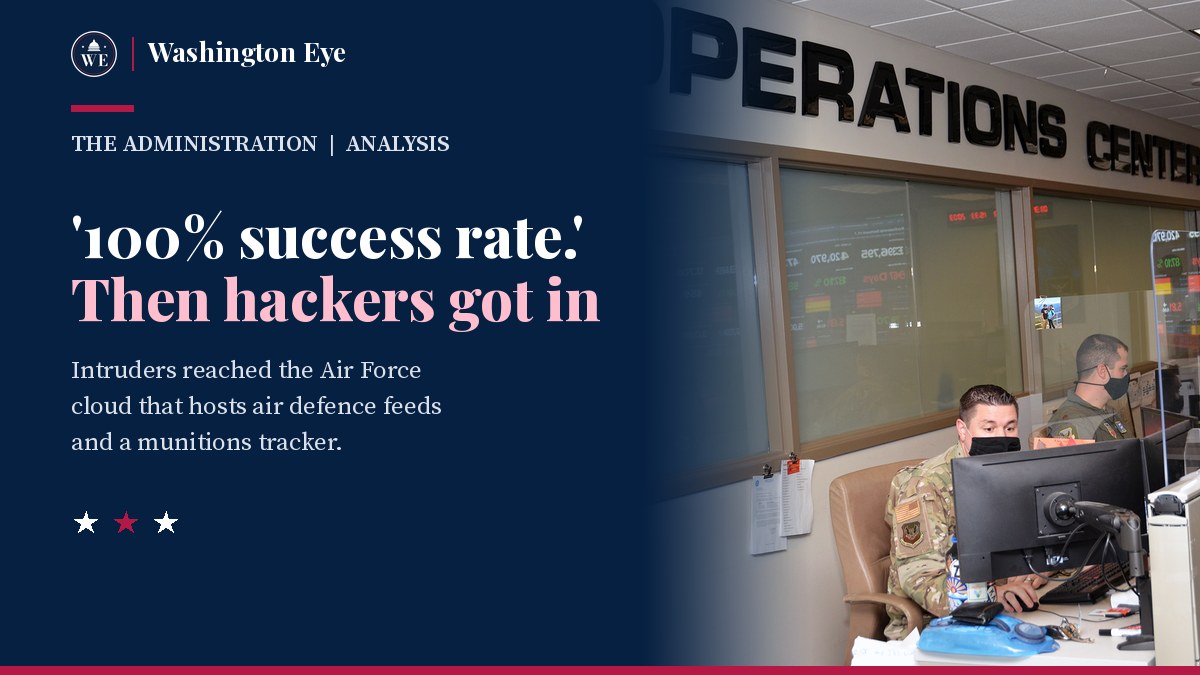
Two years ago, the engineers who run the Air Force's main cloud platform made a boast that few people in cybersecurity ever put in writing. "We have a 100% success rate," the program's lead engineer, Lt. Col. Beau Brantley, said in an official Air Force article in September 2024, describing the guardrails meant to stop adversaries from exploiting the move of military software into commercial data centres. A year earlier, the platform's leadership had written that there was "no room for error when it comes to security."
On Friday, that record appeared to end. Hackers have breached Cloud One, the Air Force's flagship cloud computing system, according to a wire service report citing three people familiar with the matter. The intrusion was discovered within roughly the past month, during work to upgrade the system. Nobody outside the investigation can yet say who did it, how much they saw, or whether anything was taken. What is already clear is that the breach has disrupted one of the largest cloud platforms in the American military, and that it lands in the middle of the worst run of government hacks in years.
What Cloud One actually is
Cloud One began in 2017 as a simple idea: instead of every Air Force program building and securing its own servers, the service would offer one hardened, pre-approved environment that any mission application could move into. It runs on four commercial providers at once, Microsoft, Amazon, Oracle and Alphabet's Google, and is chartered by the Air Force Life Cycle Management Center at Hanscom Air Force Base in Massachusetts. In June 2021, the Air Force's then chief information officer, Lauren Knausenberger, signed a memorandum making Cloud One the mandated route for moving workloads into the cloud.
The platform grew quickly. By September 2024 the program had celebrated its 150th application migration, and its managers said they wanted to accelerate to between 100 and 150 migrations a year. "Cloud One can host any application with secret and below workloads," Brantley said at the time. The pitch to program offices was efficiency: an application that moved onto Cloud One could inherit a large share of its cybersecurity paperwork, because the platform itself had already been certified.
That design is exactly what makes a breach so serious. Concentrating hundreds of systems in one place makes them cheaper and easier to defend. It also means that a single weakness in the shared layer can expose far more than any one program would have on its own.
Why this one matters
According to the people who described the breach, Cloud One hosts applications that manage personnel records and pay, along with logistics and maintenance. Two systems stand out. The first is the Cloud-Based Command and Control system, known as CBC2, which pulls together air defence radar and other data feeds from across North America. The Air Force began fielding it in October 2023, starting with the North American Aerospace Defense Command's eastern sector, as a replacement for the ageing Battle Control System-Fixed. By September 2024 it had been delivered to every NORAD air defence sector in the United States and Canada. Officials have described it as integrating hundreds of critical radar and data feeds under a single interface.
The second is the Theater Integrated Combat Munitions System, which tracks bombs and missiles across more than 200 Air Force locations around the world. In plain terms, one platform holds software that helps the United States watch its own skies and software that keeps count of the weapons it would use in a war.
"A breach here is a big deal," one of the sources said.
One person familiar with the investigation said the intruders exploited a software vulnerability to reach the platform's control plane, the management layer that sits above individual applications. That person compared it to a universal remote. In theory, access at that level could let an intruder check the operational status of military aircraft or follow the movement of spare parts. It is not known whether the hackers did anything of the kind, and the specific vulnerability has not been identified publicly.
What we know, and what we do not
The confirmed picture is narrow. The Air Force has not acknowledged the breach. In a statement, it said it "does not comment on the security posture, vulnerabilities or operational status of specific networks and systems," and added: "We continuously take prudent measures to protect Department (of the Air Force) information, systems and mission capabilities." All five people who described the incident spoke on condition of anonymity.
According to those sources, investigators have called in US Cyber Command, the military's cyber force, to assess the damage. Cyber Command did not respond to requests for comment. Science Applications International Corp, known as SAIC, was Cloud One's prime contractor until 2025, when Leidos took over. SAIC did not respond to a request for comment, and Leidos referred questions to the Air Force.
The unanswered questions are the important ones. Was this a state intelligence service quietly mapping American military logistics, or a criminal group looking for something to sell? Did the intruders move from the control plane into the applications themselves, including the air defence and munitions systems? How long were they inside before the upgrade work turned them up? And was any classified data reachable, given that the platform is cleared for workloads up to the secret level? None of that has been answered on the record.
The damage that is already visible
Even without a full damage assessment, the response itself has costs. Two of the sources, and a fourth person familiar with the matter, said efforts to migrate back-office applications onto Cloud One, a longstanding military priority, have been paused. Updates to applications already running on the platform were blocked. A fifth source said some users had their administrator rights revoked.
The timing of the update freeze is awkward. It leaves Air Force personnel unable to apply fixes just as a new batch of serious software vulnerabilities has been disclosed across the technology industry. In 2024, one of the program's own managers, Lt. Col. Matthew Kauffmann, described Cloud One's defences this way: "We have a block at the boundary providing time to patch issues and keep applications running." For now, the patching itself is on hold.
The pause on migrations matters for a different reason. For years, Pentagon leaders have argued that moving software out of scattered on-premises servers and into managed cloud environments makes the military safer, faster and cheaper. A high-profile breach of the flagship environment does not disprove that argument, but it hands ammunition to sceptics inside the services who never liked giving up control of their own systems.
Part of a pattern
Cloud One is not an isolated case. The federal government has been dealing with at least six other recently disclosed cyber incidents. The FBI is investigating an apparent breach of its National Crime Information Center, the database that links federal, state and local police, after a separate hack in September in which a group claimed to have stolen data on agents through the bureau's jobs portal. Personnel data on more than 40,000 Homeland Security employees, including border and immigration agents, was published online in October after a hacker said it came from the department's single sign-on system. The CIA and the Office of the Director of National Intelligence recently discovered an apparent intrusion into unclassified but sensitive networks. And this week the Treasury's financial intelligence unit took systems offline after unauthorized access.
Earlier this month, the Agriculture Department told employees that a system it uses to pay farmers had been targeted, and a classified network used by the National Security Agency suffered a multiday outage that people familiar with it said showed no sign of a cyberattack. Around the same time, a White House official confirmed that the National Cyber Director, Sean Cairncross, was leaving his post.
Running through all of it is a new anxiety about artificial intelligence. Cloud networks are especially exposed because modern AI models can scan a huge surface area for weaknesses far faster than human attackers. Sen. Mark Warner of Virginia, the top Democrat on the Senate Intelligence Committee, said this month that evidence showed recent outages were not caused by cyberattacks, but warned that AI could have played a role in the vulnerabilities behind them.
What to watch
Three things will shape how big this story becomes. The first is attribution. If investigators tie the intrusion to a foreign intelligence service, the breach becomes a national security confrontation rather than an IT failure, and pressure for a public response will grow quickly.
The second is scope. A control plane compromise that never reached the mission applications is serious but containable. Evidence that intruders touched air defence data or munitions records would be a different order of problem, with consequences for allies such as Canada that share the NORAD picture.
The third is Congress. Democrats take control of both chambers in January, and a string of breaches across the FBI, Homeland Security, the intelligence agencies, the Treasury and now the Air Force gives the incoming majority an obvious subject for oversight hearings. Republicans on the armed services committees have their own reasons to ask hard questions, since cloud migration has been a bipartisan Pentagon priority and contractors have been paid to secure it.
For now, the most striking fact is the gap between the promise and the outcome. A platform built to be the safest place for Air Force software to live was, by its own managers' account, undefeated. Someone has now found a way in, and the Air Force is not yet saying who, or what they saw.