
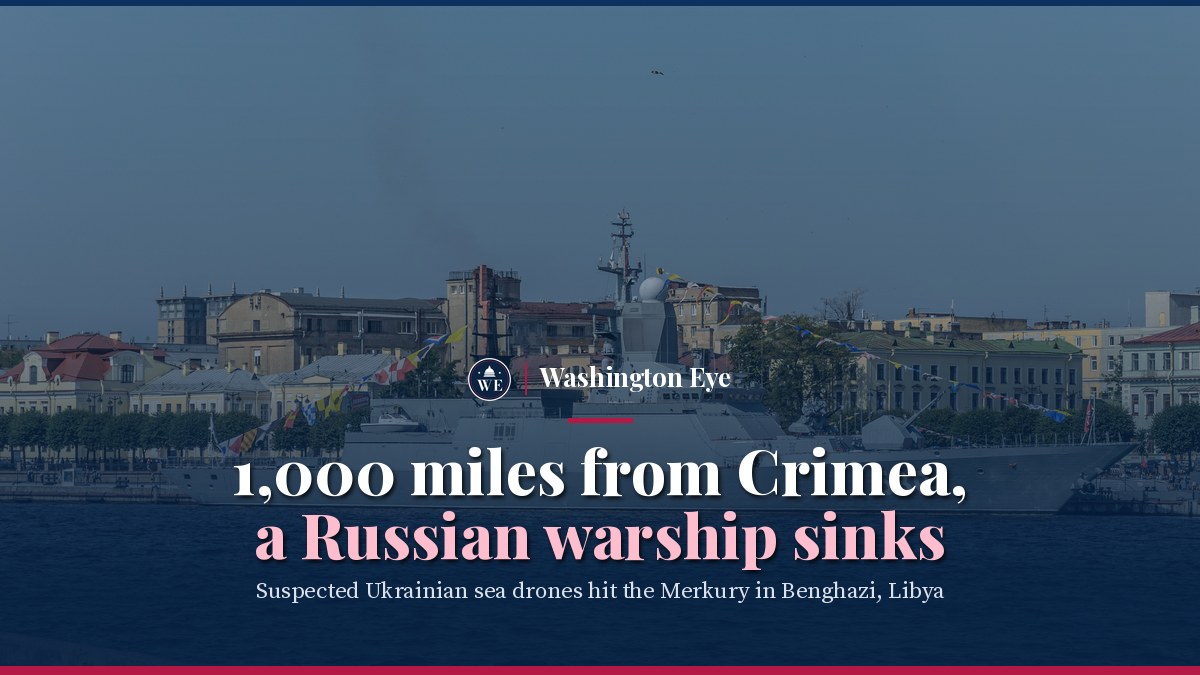
For most of this war, the place to watch Russia's navy bleed was the Black Sea. On Sunday it was a pier in eastern Libya. In the early hours of the morning, an explosion tore through the Merkury, a modern Russian navy corvette that had tied up at the Benghazi Naval Base to refuel and take on supplies on its way home. By daylight, commercial satellite images showed a ship that had capsized and gone down at its berth, only its bow still above the water, smoke rising from what was left of the superstructure and debris strewn along the quay.
Two Libyan military officials said an initial investigation pointed to Ukrainian sea drones. Several were launched at the ship, they said, from a base run by Ukrainian forces in western Libya. At least four were intercepted and destroyed. Two got through. Medical sources in Benghazi said ten people, Russian and Libyan nationals among them, were treated for minor injuries.
Nobody has claimed the attack. Moscow had not commented publicly by Monday morning, and Kyiv has said nothing on the record. A Ukrainian source told an American defence publication that the strike was the work of the Security Service of Ukraine, which has not commented. But the shape of the thing is already clear. If the Libyan account holds, Ukraine has sunk a front line Russian warship in a friendly foreign port more than 1,000 miles from its own southern coast. That is one of the most striking naval blows of a war that is now close to its fifth year, and it moves the fighting onto a new continent.
A ship that should have been safe
The Merkury was not an old hull pulled out of reserve. It is a Project 20380 corvette of the Steregushchiy class, one of the Russian navy's workhorse small combatants, and it entered service in 2023. Ukrainian state backed media put its crew at about 90. Although formally assigned to the Black Sea Fleet, it had been operating from Northern Fleet bases in the Arctic, because the Black Sea itself had become too dangerous for Russian ships.
That is the first lesson of Sunday. Ukraine began the full scale war in 2022 with almost no navy to speak of. It built one out of explosive laden uncrewed boats instead, and used them so effectively that Russia's Black Sea Fleet pulled back from Sevastopol in occupied Crimea to the port of Novorossiysk further east. The Merkury, kept away from that fight, was sunk anyway, on the far side of the Mediterranean, in a harbour run by a government that calls Moscow a partner.
Benghazi is controlled by the self styled Libyan National Army of General Khalifa Haftar, which dominates the east and south of the country and has long been aligned with Russia. The eastern administration said the Merkury had docked under maritime cooperation agreements between the two sides. For the Kremlin, that relationship has grown more valuable, not less. Since losing its bases in Syria, Russia has used eastern Libya as a staging post in the Mediterranean and as a supply line for its mercenary forces operating across Africa. A warship stopping in Benghazi was supposed to be the safest kind of port call there is.
One night, two strikes, twenty more boats
Sunday did not end with the corvette. Hours later, a Maltese flagged commercial ship was hit by a sea drone off Benghazi, according to two Libyan military sources. Open source analysts identified the vessel as the Ascalon, a sanctioned Russia linked bulk carrier said to be carrying military supplies. Video of the attack appeared to show a drone running straight at one end of the hull before a large explosion. Libyan naval forces rescued the crew, and the eastern health ministry said some had minor injuries and were in stable condition.
The same military sources said Libyan naval and air forces intercepted more than 20 drone boats off Benghazi that evening. If that figure is accurate, Sunday was not a single lucky shot. It was a sustained operation against Russian shipping in and around one of Moscow's few remaining Mediterranean footholds.
A naval analyst, H I Sutton, said a photograph of a sea drone that emerged apparently from off the Libyan coast was "also likely the type used in the subsequent attack", which would link the two strikes to the same campaign.
Libya says it is not a party to this war
Both of Libya's rival governments reacted with alarm, and for once they sounded almost identical. The eastern administration condemned the strike as a violation of sovereignty and a threat to maritime safety, and promised legal and diplomatic action against whoever was responsible. "The Libyan government will not allow Libyan ports, territory or territorial waters to be turned into an arena for settling scores or exporting international conflicts," it said.
In Tripoli, the internationally recognised government issued its own statement. It "categorically rejects the transformation of Libya into an arena for international conflicts or a theater for foreign powers to settle scores," it said, and opposed the use of Libyan territory, ports or waters for military or logistical activity that could endanger Libyans.
The eastern prime minister, Osama Hamad, went further. He said his government had formally asked the UN General Assembly and Security Council to investigate the attacks, including the suspicion that the drones were launched from western Libya. He also called for an inquiry into the possible presence of Ukrainian military experts in the country and asked Kyiv to explain their activities. The UN mission in Libya expressed "serious concern" and called for "an immediate, independent and transparent investigation".
Those suspicions did not come from nowhere. Libyan officials have previously said Ukrainian drone specialists were operating from facilities in western Libya, including an air base at Misrata and sites in Tripoli and Zawiya. A small unit of Ukrainian special forces is believed to have been based at Misrata and to have coordinated drone attacks on Russian tankers and transport ships over the past year. In December 2025, Ukraine said it had hit a Russia linked oil tanker in the Mediterranean with aerial drones. In March this year, Russia accused Ukraine of attacking a Russian liquefied natural gas tanker with naval drones launched from the Libyan coast.
Seen that way, Sunday is less a bolt from the blue than the moment a quiet campaign became impossible to ignore.
The war's map keeps getting bigger
The Benghazi attack came a day after another one, roughly 2,000 miles to the north. On Saturday, a Russian cargo ship with military links, the Sparta II, was hit by drones and set ablaze in the Gulf of Finland while bound for the Russian exclave of Kaliningrad. Finland's military said the strike was probably carried out by Ukraine. The ship drifted into Finnish waters, its 16 crew were taken off by a nearby Russian vessel, and emergency teams from Finland, Russia and Estonia were still working on Sunday to cool its containers and stabilise it. Estonia's navy commander, Ivo Värk, said further attacks in the narrow waterway could not be ruled out.
Put the two weekends' events side by side and a pattern emerges. Ukraine is no longer only defending its own coast or striking Russian ports. It is going after the logistics that keep Russia's military reach alive far from the front: the ships that supply Kaliningrad, the vessels that carry cargo to Africa, the warships that use friendly harbours abroad. For Kyiv, the logic is simple. Russia has spent years hitting Ukrainian cities and ports, and on Sunday overnight attacks on the Kyiv region left a partly collapsed apartment block and a search for people trapped under the rubble. Ukraine's answer is to make every Russian hull a target, wherever it sails.
Why Washington should care
The risks of that answer are not Ukraine's alone. A war fought with cheap, hard to trace sea drones in the central Mediterranean is a war on one of the busiest shipping corridors in the world. It already shares the headlines with a separate crisis further east, where attacks on tankers in the Gulf and near the Strait of Hormuz have kept oil markets on edge. Brent crude was trading at about $92 a barrel on Monday. A second front for maritime insecurity, close to southern Europe's ports and energy routes, is the last thing shippers and insurers want.
For the United States, Libya is also an old and unfinished problem. The country has been split since the NATO backed uprising that toppled Moammar Gadhafi in 2011, and American officials have spent years warning about Russia's growing military presence in the east. US Africa Command accused Moscow in 2020 of sending fighter jets to Libya to support Russian mercenaries there. Washington has wanted Russia out of eastern Libya for a long time. It did not necessarily want Ukraine to be the one to make the point, in a port where Libyan workers and civilians were also put at risk.
There is a diplomatic dimension too. Moscow said on Sunday that European countries could join Ukraine peace talks if they showed "readiness to contribute". A dramatic Ukrainian strike in a third country hands Russian diplomats a ready complaint about escalation, even as it reminds them that their navy is vulnerable far from home. How Washington, which has pushed both sides towards talks, responds to a strike in Libya will be watched closely in Kyiv, Moscow and Tripoli alike.
What to watch
Three things will decide whether Benghazi is remembered as a turning point or a one off. The first is attribution. If Ukraine confirms the strike, or if the joint investigation launched by eastern Libya and Russia produces evidence, pressure on the Tripoli government over any Ukrainian presence on its soil will rise sharply. The second is Russia's response, both in rhetoric and in how it protects ships that now cannot assume any port is safe. The third is the Security Council, where Libya's request for an inquiry will force members, including the United States, to say on the record what they think about a war that has just spread to Africa's shore.
For now, the image that matters is the one taken from orbit: a modern Russian warship lying on its side in a Libyan harbour, a long way from the sea it was built to fight in.