
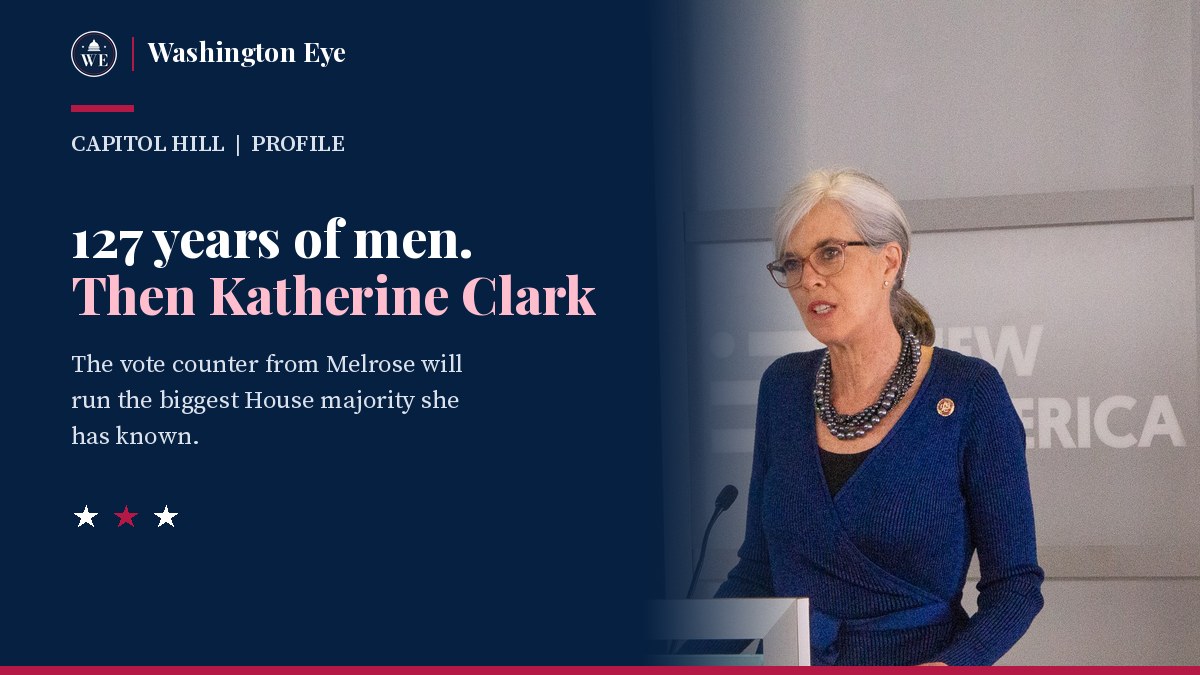
For 127 years the job has belonged to men. Twenty six of them have served as majority leader of the House of Representatives, every one a white man, from the post's creation at the end of the nineteenth century to Steve Scalise, who holds it today. On January 3, when the 120th Congress convenes, the twenty seventh will be Katherine Clark, a 63 year old former school committee chair from Revere, Massachusetts.
House Democrats chose her on November 18 by unanimous voice vote, in the same closed door session that nominated Hakeem Jeffries for speaker by 251 votes to 11 and made Pete Aguilar the first Latino majority whip. Clark ran unopposed. That last detail says a good deal about how she has risen: not by toppling anyone, but by being the person already standing in the right place when the door opened.
Her elevation has been overshadowed by the historic nature of Mr Jeffries' likely election as the first Black speaker. But the majority leader is the one who will run the House floor day to day and set its legislative calendar. If the new Democratic majority is going to turn a midterm landslide into laws, investigations and budgets, much of that machinery will pass through Clark's office.
From Melrose to the leadership table
Clark was born in New Haven, Connecticut, in 1963 and studied at St. Lawrence University, Cornell Law School and Harvard's Kennedy School of Government. She practised law in Chicago, clerked for a federal district judge in Colorado and worked as a staff attorney for the Colorado District Attorneys' Council before moving to Massachusetts in 1995, where she became general counsel for the state's Office of Child Care Services.
Her political career began at the most local level imaginable. She won a seat on the Melrose School Committee in 2001 and became its chair in 2005. Her first bid for higher office, a state Senate race in 2004, ended in defeat by the Republican incumbent, Richard Tisei. She won a special election to the state House in 2008, then took Mr Tisei's old Senate seat in 2010 by 52% to 48%, one of the few close races of her career.
In the state legislature she built a reputation as a policy workhorse rather than a firebrand. She was lead author of the Senate version of a municipal pension overhaul in 2011, which won her awards from both the Massachusetts Municipal Association and the Massachusetts Police Association, and she wrote a 2012 law aimed at getting every student in the state reading at grade level by third grade.
Then came the break. When Ed Markey left the House for the Senate in 2013, Clark entered a crowded Democratic primary for his seat and won with just 32% of the vote, ahead of the Middlesex County sheriff, Peter Koutoujian, on 22%. In a district that stretches from Framingham to Revere and Winthrop, the primary was the real contest. She has not had a close general election since.
The climb
Clark's ascent inside the Democratic caucus has been steady and almost entirely methodical. After the 2018 wave she defeated Mr Aguilar, now her fellow leader, to become vice chair of the caucus. In 2020 she beat David Cicilline of Rhode Island 135 to 92 to become assistant speaker, the number four post. When Nancy Pelosi, Steny Hoyer and Jim Clyburn stepped back from leadership after the 2022 midterms, she ran unopposed for whip and has served as Mr Jeffries' second in command ever since.
Each step came when a vacancy appeared, and each time she had already assembled the votes. A whip's job is to count, to know before a vote which members are wavering and why. For four years she has done that for a minority party that rarely controlled the outcome. From January she will do something harder: manage a majority large enough to pass almost anything, and diverse enough to fracture over almost everything.
What she stands for
Clark is generally described as a progressive Democrat. She sits on the Appropriations Committee, including its subcommittee on labour, health and education, and has spent much of her congressional career on child care, family economics and online safety. Her work on internet harassment began in response to the abuse campaign against women in the video game industry known as Gamergate. After she introduced legislation to criminalise "swatting", the practice of making a fake emergency call to send armed police to someone's home, she was herself targeted with a false report of an active shooter at her house.
She has not avoided confrontation with Donald Trump. In January 2017 she was among a small group of lawmakers who boycotted his first inauguration, saying she did not want to "normalize" what she called his promotion of bigoted and misogynist claims. Yet on some of the questions that divide her party she has stayed closer to the centre than her activist critics would like. She does not support abolishing Immigration and Customs Enforcement, arguing instead for oversight and reform. In August 2025, at a town hall, she described Israel's actions in Gaza as a genocide, then quickly walked the remark back: "I want to be clear I am not accusing Israel of genocide."
That episode is a reminder of the tension she will have to manage. This year, for the first time in twelve years, she faced primary challengers, two candidates running to her left. She won with 74% of the vote, a comfortable margin but a signal that even a safe seat in suburban Boston is no longer immune to the insurgent energy in the party's base.
The caucus she inherits
That energy was visible on the day she was chosen. Eleven Democrats voted against Mr Jeffries in the secret ballot. Seven newly elected progressives said in a joint statement that "there is still work to be done to ensure that the direction our party takes this coming Congress reflects what our constituents are demanding of leadership." Another incoming member said her constituents were "demanding transformative change." None of them has said whether they will oppose Mr Jeffries on the floor in January, where he needs 218 votes.
The arithmetic is generous. Democrats will hold at least 257 seats, a margin of more than 80 over Republicans, compared with the two vote cushion Speaker Mike Johnson has worked with. But big majorities bring their own problems. With little fear of losing a vote to the other side, factions within the majority gain leverage, and the floor leader becomes the referee between them. Clark will decide which bills come up, in what order and under what rules, and she will absorb the blame when progressives feel sidelined or moderates from swing districts feel exposed.
Clark, for her part, has leaned into the breadth of the caucus rather than its divisions. In a radio interview the day after the vote she said the new members, "people who have been sent to Congress from all walks of life", gave her "the optimism and the energy that we can really deliver for the American people." She noted that the incoming House will include a record 120 Democratic women, a number she called "fittingly" matched to the 120th Congress.
The first tests
Her first big decisions will be shaped by the lame duck that is now under way. Government funding expires on December 11, and the White House has signalled support for a stopgap running to March 31, which would hand the incoming Democratic majorities the task of writing the rest of the year's budget. As an appropriator, Clark knows that terrain better than most. How the new leadership handles that spring deadline, and the pressure from its own left to use funding bills to force an end to the war with Iran, will be the first real measure of whether she can hold a sprawling majority together.
Her own words after the vote framed the ambition. "This is the beginning of a new bargain, a new politics where hard work is honored and where people's voice is paramount, and where we have more confidence in the future than nostalgia for the past," she said. In a statement online she was blunter: "The American people sent us to Washington to deliver. Now it's time to lower costs and build a future where every family can thrive."
She will be the highest ranking House member from Massachusetts since Tip O'Neill, who held the same post from 1973 to 1977 before a decade as speaker. That precedent will invite speculation about her future. For now, though, the more immediate question is a practical one that no history making headline can answer: whether the quiet vote counter from Melrose can make a majority this large actually work.