
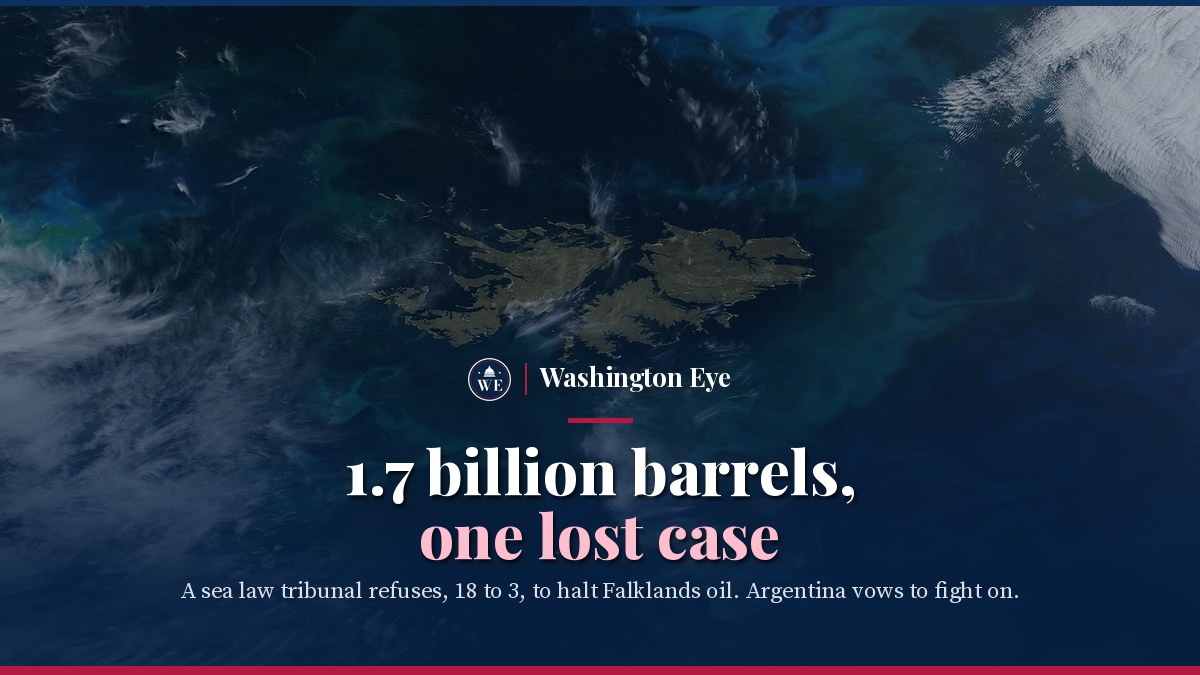
Argentina went to Hamburg hoping a court of maritime judges would freeze one of the most valuable projects in the South Atlantic. On Saturday it came away with almost nothing. By 18 votes to 3, the International Tribunal for the Law of the Sea rejected Argentina's request for emergency measures to halt Sea Lion, the oil development north of the Falkland Islands, which Argentina calls the Malvinas. The drilling rig can keep coming.
The ruling is preliminary. It does not settle who owns the islands, and it does not end the case. But it goes to the heart of the strategy Buenos Aires chose this autumn: to fight a sovereignty dispute that is almost two centuries old through the narrower door of the law of the sea. The judges said that door does not open onto the question Argentina most wants answered.
For a project that could put billions of dollars into a territory of roughly 3,500 people, and for a government in Buenos Aires that has made the islands a matter of national honour, the stakes are hard to overstate.
Sea Lion is an oilfield in the waters north of the Falklands, within 200 nautical miles of the islands and, according to the United Kingdom, about 500 kilometres east of the South American mainland. British reporting puts it around 130 miles, or 209 kilometres, from the islands and estimates the field holds about 1.7 billion barrels of oil. It is run by Navitas Petroleum, an Israeli company with a 65 percent stake, alongside the British firm Rockhopper Exploration, which holds the other 35 percent.
The partners took their final investment decision in December 2025, after the Falkland Islands Government approved the development plan for the first phases. That approval moved the licences into what Rockhopper called an exploitation phase lasting 35 years. In August the companies said work on the islands was on plan, with the drilling rig due to arrive and drilling to begin in early 2027, and first oil expected in the first quarter of 2028.
Argentina protested each step through formal diplomatic notes, calling the activity part of "a succession of illegal acts" in its territory. On 28 September it opened arbitration against Britain under the United Nations Convention on the Law of the Sea. Because the arbitral panel that will hear the full case has not yet been formed, Argentina turned on 13 October to the Hamburg tribunal, which can order temporary measures in the meantime.
It asked for four things: that Britain stop the Sea Lion project from starting or continuing, that it not use information from exploration against Argentina's rights, that it stop preventing Argentina from protecting the marine environment of the disputed waters, and that it grant no new permits that could aggravate the dispute.
The tribunal did not weigh whether the oil project would cause irreparable harm or whether the matter was urgent. It never had to. To order temporary measures, the judges must first be satisfied that the arbitral panel would at least appear to have jurisdiction. They found it would not, on any of Argentina's four claims.
The reasoning was blunt. A dispute "which requires the determination of a question of territorial sovereignty" is not a dispute about how the convention is interpreted or applied, the tribunal said. Argentina's first claim, that Britain had violated its sovereign rights over the surrounding seas, could not be decided without first deciding which country owns the islands. The same logic sank the others. Even the environmental claim, the tribunal found, would "necessarily entail a decision on sovereignty", because deciding which state must protect those waters means deciding whose waters they are.
Argentina's lawyers had tried hard to avoid exactly that trap. "Argentina did not ask the court to rule on sovereignty," the government said after the ruling, insisting it had asked only that the law of the sea be applied to Britain's "exploitation of our resources." Eighteen of the 21 judges did not accept the distinction. Two judges, Horinouchi and Patel, and one judge ad hoc, Vinuesa, dissented, and several others appended separate opinions and declarations that will be read closely as the case continues.
Argentina did not leave entirely empty handed. The tribunal formally placed on record three British assurances given during the hearing: that drilling will not start before 21 March 2027, that extraction will not start before March 2028, and that "no further licenses will be granted as the licensing regime is suspended." Those promises are now part of an international court order, which makes them harder to walk back.
The judges also stressed that the convention "is applicable in the maritime areas in dispute" and said they expected both sides to "act accordingly." They urged the two governments to keep cooperating so the arbitral panel can be formed quickly. Britain told the court it expected that panel to be constituted before the end of this year, or by January 2027 at the latest, and Argentina said it would be happy to proceed quickly. The order, the tribunal noted, "in no way prejudges" whether that panel will have jurisdiction over the merits.
London read the result as a decisive win. Foreign Secretary Ed Miliband and Attorney General Ellie Reeves, who argued the British case in Hamburg this month, said in a joint statement that they welcomed the decision and that Britain "has no doubt" of its sovereignty over the Falklands, its rights over the surrounding waters and "the right of self-determination of the Falkland Islanders." Ms Reeves called the outcome "a clear win for the UK government" and said "Argentina sought to stop the Falkland Islanders making their own sovereign decisions and failed in this attempt." The statement urged Argentina to "end its wider economic pressure" on the territory.
Buenos Aires answered with defiance. "This decision is not the final word," President Javier Milei said, declaring that "the Falkland Islands are Argentine" and promising to pursue the country's rights "through all diplomatic, legal and administrative channels at its disposal." He described the oil project as a "clear and present danger" to Argentina's claim. His government said five individuals would face sanctions over their role in the venture, without naming them. "The message is clear: those who participate in the illegal exploitation of our resources will face the consequences," it said.
Independent lawyers were less charitable to Argentina's chances. Marc Weller, a professor of international law at a London foreign affairs institute, said the challenge had "provisionally, but spectacularly, fallen at its first hurdle," adding that the outcome "casts doubts on the viability" of Argentina's claim in the full arbitration.
For Milei, the ruling lands awkwardly. He is a free market president who courts foreign investors and has spent much of his term trying to persuade the world that Argentina is open for business. Yet he is also a nationalist on the Malvinas, a cause that unites Argentines across the political spectrum. Punishing companies and individuals tied to a lawful project, while losing in court, risks sending investors the kind of mixed signal his economic programme can least afford. Backing down, on the other hand, is politically unthinkable at home.
For the islanders, the arithmetic runs the other way. A field of this size could transform the finances of a territory with roughly the population of a small town. In a 2013 referendum, 99.8 percent of voters chose to remain a British overseas territory, with just three voting against. Argentina rejects that result, arguing that self determination does not apply to a population it regards as having been placed there by Britain after 1833.
The history hangs over every step. Britain has governed the islands since 1833. In 1965 the United Nations General Assembly invited the two countries to negotiate a peaceful solution, and the territory remains one of 17 on the United Nations list of non self governing territories. In 1982 Argentina's military junta invaded, and a 74 day war followed that killed 649 Argentine troops, 255 British service members and three islanders.
Why should anyone outside the South Atlantic care? Partly because of oil. The world is watching supply nervously as the confrontation around the Strait of Hormuz disrupts shipping, and a new non OPEC field opening in 2028 in a stable jurisdiction is the kind of barrel traders and governments value. Partly because of law. Around the world, territorial quarrels are increasingly dressed up as arguments about seabeds, fishing rights and exclusive economic zones, because maritime courts offer a forum that land disputes often lack. Saturday's order is a clear signal that the law of the sea will not be used as a back door to settle who owns land.
What comes next is the full arbitration, likely to begin in earnest early next year. Argentina will try to reframe its claims so they can be decided without a ruling on sovereignty. Britain will argue, as it did in Hamburg, that this is impossible. The rig, meanwhile, is scheduled to start drilling no earlier than 21 March 2027. Argentina has lost the first round. The fight over the oil beneath the South Atlantic has only just begun.