
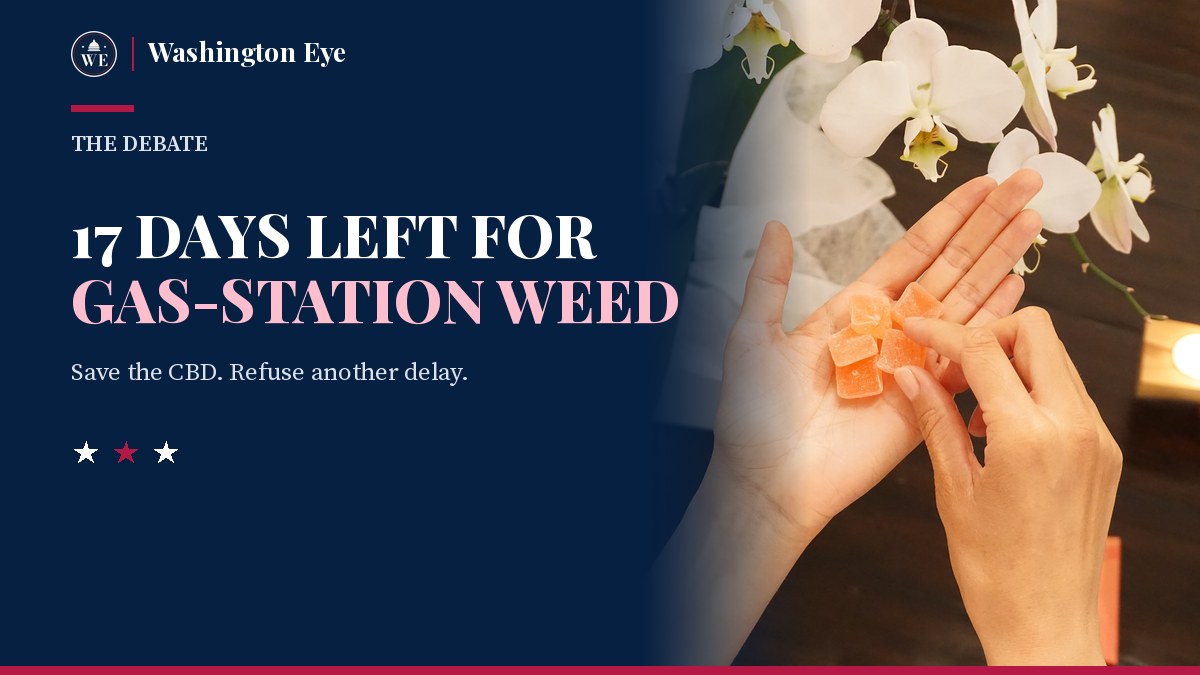
Seventeen days. That is how long the gummies, the hemp seltzers and the brightly wrapped THC candy in America's convenience stores have left on the federal clock. On December 11 a law that Congress passed and President Donald Trump signed a year ago finally bites, and almost every intoxicating hemp product on the market becomes illegal under federal law. The same day, government funding runs out. Washington has managed to tie a drug policy deadline to a shutdown deadline, and now the White House wants to reopen the drug policy.
On Monday night the administration sent lawmakers its list of "anomalies", the special exceptions it wants written into a stopgap spending bill. Most of the twelve pages deal with money: wildfire and infectious disease programmes, defence needs, even funding to begin work on a new class of Navy battleship. Tucked under the Agriculture Department heading is a line labelled "Hemp Definition". It asks Congress to rewrite the law so that Americans can keep buying "non-intoxicating full-spectrum CBD products", with guardrails to keep them from children, while preserving what it calls Congress's intent to restrict products that pose serious health risks.
Senator Tom Cotton of Arkansas read it differently. The request, he wrote in a post online, "proposes to keep gas-station candy marijuana on the shelves." He added that it contained many urgent needs for national security and the troops, "but gas-station weed isn't one of them," and warned that another delay "will threaten the entire bill."
Our view is simple. Conservatives should give the President the narrow thing he has asked for in public and refuse the wide thing the hemp lobby wants in private. Fix CBD, in plain numbers, or not at all. No more delays. No last-minute "framework". And no hemp language that puts the funding bill, and the troops it pays for, at risk.
How a farm bill built a drug market
The mess began with good intentions. The 2018 Farm Bill legalised hemp, defined as cannabis with no more than 0.3 per cent delta-9 THC by dry weight. The idea was rope, fibre, seed and the non-intoxicating CBD oils many older Americans now rub on sore knees. What Congress did not foresee was chemistry. Manufacturers learned to convert hemp extracts into delta-8 THC and other compounds, or to pack enough delta-9 into a gummy to match a dispensary edible while staying under the dry-weight limit. A product that would be sold only in a licensed shop in a legal marijuana state, or not at all in the rest, turned up next to the chewing gum at the gas station.
Last November, in the bill that ended a record 43-day shutdown, Congress closed the loophole. It redefined finished hemp products so that only those with no more than 0.4 milligrams of total THC per container stay legal. The ban was due to take effect this month. Late this summer a funding bill pushed the start date for most products back to December 11, reportedly at the urging of the White House chief of staff at the time, Susie Wiles, who has since been replaced. Synthetic cannabinoids that cannot be produced naturally by the plant were banned on schedule in November.
Fourteen Republican senators, led by Ted Budd of North Carolina and Pete Ricketts of Nebraska and including Mr Cotton, Mitch McConnell, Chuck Grassley, John Cornyn and Joni Ernst, wrote to the President on Friday. They reminded him that when the administration sought the last delay, it "made clear at the time that there would be no further extensions. We ask that you hold to that commitment." Every extension, they wrote, "is only a victory for the companies selling these products but a loss for the families who are paying the price." Mr Budd and Mr Ricketts have said they will not vote for any funding bill that reverses the ban. Senator James Lankford of Oklahoma has told colleagues that extending it again would amount to "nationwide legalization of marijuana."
Where the President has a point
It would be easy to stop there and call the White House request a betrayal. It is not, and conservatives should be honest about why.
The 0.4 milligram cap is a blunt instrument. Aimed at intoxicating candy, it also sweeps in many full-spectrum CBD tinctures and creams that contain only trace amounts of naturally occurring THC and that nobody buys to get high. The President has been consistent on this for a year. He signed an executive order last December on research into hemp-derived CBD. In April he urged Congress in a post online to update the law "to ensure that Americans can continue to access the full-spectrum CBD products they have come to rely on," while "preserving Congress's intent to restrict the sale of products that pose Health risks." He wrote that one in five adults had used CBD in the past year. His health officials have launched a Medicare model that covers up to $500 a year of hemp-derived products for eligible seniors, mostly CBD, with up to 3 milligrams of THC per serving.
Read the anomalies line closely and it says the same thing. It asks for "non-intoxicating" products and protections for children. It does not, on its face, ask to keep THC drinks or delta-8 gummies legal, and it sets out no delay. A grandmother's CBD balm and a high-dose THC gummy shaped like a cartoon bear are not the same product, and a conservative drug policy should be able to tell them apart.
So write the difference into law. Set a hard ceiling on THC per serving and per container for full-spectrum CBD, low enough that no one could mistake it for a recreational product. Require child-resistant packaging and an age limit. Let the December 11 ban take effect for everything above that line. If negotiators cannot agree that much language in the next two weeks, drop it, let the ban land and come back to CBD in the new year. What they must not do is buy time with yet another delay, because every delay so far has been sold as the last one.
Why the framework is the wrong answer
The hemp industry has a better offer on the table, or so it says. Last Tuesday Senators Tim Sheehy, a Montana Republican, and Amy Klobuchar, a Minnesota Democrat, introduced the Hemp Guardrails Act. It would stop the ban and replace it with rules: a national age limit of 21, child-resistant packaging, Food and Drug Administration oversight of labels and testing, a ban on delta-8, delta-10 and THC-O, a ban on smokable hemp flower, and a requirement that products be grown and made in the United States. It would also raise the legal threshold for hemp cultivation to one per cent total THC. Its backers say it would protect a $30 billion industry that supports 350,000 jobs.
Some of that is sensible, and some of it, like the domestic sourcing rule and the ban on synthetics, conservatives should want anyway. But look at what it really does. It turns a loophole into a licence. The 14 senators put it bluntly: a federal framework "is a permanent legal license for an industry that has spent years marketing drugs to kids." It would create a second national THC market, regulated by an agency that has not yet done the job Congress already gave it. The Congressional Research Service noted recently that the Food and Drug Administration is more than nine months late in publishing the list of cannabinoids and the guidance on containers that last year's law required.
There is a process for deciding whether the United States should have a federally sanctioned market in intoxicating hemp. It runs through committee hearings, open votes and a law that says what it is. The Sheehy and Klobuchar bill has been referred to the Senate health committee, with no hearing yet. That is where it belongs. Stuffing it, or a delay that does the same job, into a must-pass stopgap is precisely the kind of governing by deadline that conservatives say they oppose.
The strongest case on the other side
Fairness demands the other side's best argument, and it is a serious one. Farmers and small businesses followed the law as it was written in 2018. In Minnesota, which allows hemp THC products and already sets a minimum age of 21, brewers have built a real trade in hemp drinks. Bob Galligan of the Minnesota Craft Brewers Guild says a ban would cost thousands of jobs and warns that the damage is already done: "The deadline is not Dec. 11. The deadline was back in May when farmers were starting to plant hemp in the ground." Prohibition, he argues, "just does not work."
Those are real costs, and nobody should cheer them. But two things are true at once. The industry has known about this deadline for a full year, and it was granted an extra month on top. And states keep their own powers. If Minnesota wants to license and tax THC seltzers inside its borders, the ban does not stop it from writing state rules. What a federal ban stops is the quiet nationalisation of a product that most states never voted for, sold through a gap in a farm bill.
Do not let hemp sink the budget
There is a larger reason for discipline. The funding fight this year is not about hemp. It is about whether Congress keeps the government open while arguing over the war with Iran. Senate negotiators are sketching a deal that would refill depleted weapons stockpiles while limiting money for the conflict itself. Democrats, fresh from sweeping midterm wins and due to take control of both chambers in January, are divided, and their Senate leader, Chuck Schumer, faces a leadership challenge from Senator Chris Van Hollen in a vote on December 1. Majority Leader John Thune said before the recess that there were "some good conversations happening. No deals yet."
A deal that fragile cannot carry a culture war over gummies. Representative James Comer of Kentucky has said openly that the best way to save hemp products is to attach them to the stopgap, because it is "the only bill that I think that absolutely, positively has to pass." That is exactly why it should not happen. Riders that cannot pass on their own should not ride on the bill that keeps paychecks flowing to soldiers and air traffic controllers.
Promises are a policy too
In the end this is a test of whether a promise in Washington means anything. Congress voted for the ban. The President signed it. His staff asked for one more month and said it would be the last. A conservative movement that talks about family, about children and about making America healthy again should not flinch because a lobby that profits from intoxicating candy has found a new deadline to work.
Give seniors their CBD in clear language. Let the gummies go. And keep the government open. Seventeen days is enough time to do all three.