
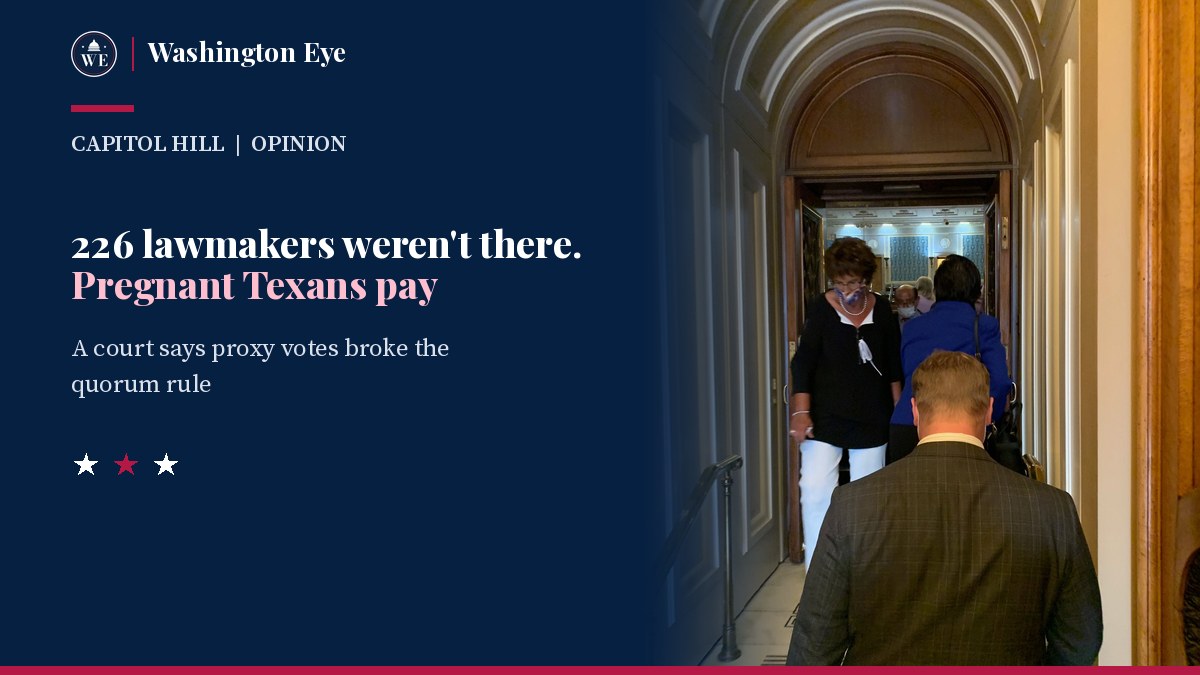
On 23 December 2022, two days before Christmas, the House of Representatives passed a $1.7 trillion bill to keep the federal government running. The tally was 225 to 201. What the scoreboard did not show was who was actually in the room. According to the congressional record, 205 votes were cast by members standing in the chamber. The other 226 were cast by colleagues holding their proxies, under a pandemic rule that let absent lawmakers be counted as present.
Almost four years later, that arithmetic has come due. On Friday the full Fifth Circuit Court of Appeals ruled, by nine votes to eight, that the House broke the Constitution when it counted those absent members toward a quorum. The case, Texas v. Blanche, was brought by the outgoing Texas attorney general, Ken Paxton. And the ruling lands in a week when the Speaker of the House is pleading with his own members simply to turn up for work.
Our view is this: the court has a serious point about presence, and it has reached a remedy that makes very little sense. Both things can be true. Congress, not just the Supreme Court, now needs to fix the mess.
What the court actually held
The Constitution says that a majority of each chamber “shall constitute a Quorum to do Business.” In May 2020, as the coronavirus spread, the House adopted a resolution allowing a member to designate a colleague to cast his or her vote or record his or her presence. Any member recorded that way, the rule said, “shall be counted for the purpose of establishing a quorum.” The practice was renewed in 2021 and dropped once Republicans took the majority in January 2023.
Writing for the majority, Judge Cory Wilson concluded that “the Quorum Clause does not allow proxies to be included when establishing a quorum.” The clause’s text, original understanding and history, he wrote, all point the same way, and the Supreme Court said as much more than 125 years ago. “While the chambers of the legislature have much discretion regarding their rules of procedure,” he added, “the Quorum Clause’s constraints on congressional power cannot be circumvented by congressional fiat.”
The court also brushed aside the government’s main defence, the old enrolled bill rule, which treats a bill signed by the presiding officers of both chambers as conclusive proof that it passed. Because nobody disputes how the vote happened, the majority said, the only question is what the Constitution means, and courts may answer that.
Judge James Graves, writing for seven dissenters, called the result “illogical, inexplicable, and invalid.” In his reading, the majority grafted a physical presence requirement onto a clause that never mentions one. An eighth dissenter, Judge Catharina Haynes, added a single line: she did not think it appropriate for the court “to throw out the Federal House of Representatives in this arena.”
The principle deserves a hearing
It is tempting to dismiss the ruling as partisan, and the lineup splits largely along the lines of the presidents who appointed the judges, though three Republican appointees joined the dissenters. But the core idea is not absurd. A quorum rule exists for a reason: to stop a small group from doing the business of the whole while everyone else is somewhere else. If a member can be “present” from a kitchen table two thousand miles away by signing a letter, the word starts to lose its meaning.
Nor was the objection invented after the fact. On the night of the vote, Representative Chip Roy of Texas rose to point out that a physical quorum was not present and reserved his right to object. The presiding officer replied that members voting by proxy were counted for quorum purposes under the House rules. The question was asked in real time. It simply was not answered by a court until now.
And the habit of absence did not end with the pandemic. This week House leaders had to pull a scheduled procedural vote because 14 Republicans were missing. On Thursday, 21 Republicans, 10 Democrats and one independent failed to vote before the chamber left for Thanksgiving. Speaker Mike Johnson wrote to colleagues on Friday that “barring any serious medical issue, we need every Republican to be here,” reminding them that the Twentieth Amendment keeps their term running until noon on 3 January. Representative Greg Murphy of North Carolina, who lost his seat this month, put it more bluntly in a television interview: “If they aren’t here, they shouldn’t get paid.”
A court telling Congress that showing up is part of the job is, in that light, not the strangest message of the week.
Where the ruling falls apart
The trouble is what the court did next. If the House never validly passed the 2022 spending law, then logically none of it is law. Yet Texas did not ask the court to strike down the whole package, and it did not offer to return the federal money it has collected under it. It asked to be excused from a single provision: the Pregnant Workers Fairness Act, which requires employers to make reasonable accommodations for pregnant workers, from extra breaks and access to water to changes in duties. The court obliged, barring the Justice Department and the federal employment discrimination agency from enforcing that law against the state of Texas.
Judge Graves put his finger on the problem. If the entire law was unconstitutionally passed, he asked, why should the ruling be limited “only to one small sliver of the multitrillion dollar bill”? There is no good answer. A doctrine that lets one state keep the parts of a statute it likes and void the parts it dislikes is not a quorum rule. It is a line item veto handed to a state attorney general.
The practical result is perverse. Women who work for the Texas state government now have weaker federal protection than pregnant workers almost everywhere else, while the state keeps the rest of what the same vote delivered. That cannot be what the framers had in mind when they wrote about quorums.
Jonathan Adler, a conservative law professor who writes widely on the courts, noted that while the court claimed to offer narrow relief, its reasoning “places a bullseye on broad legislation.” The 2022 package was enormous. It carried the government’s funding for a year, a ban on a Chinese-owned video app on federal devices, and the Electoral Count Reform and Presidential Transition Improvement Act, the post-6 January law that rewrote how Congress counts presidential electoral votes. Adler wrote that he doubts the decision will stand. He may be right. But until a higher court says so, any litigant in the three states of the Fifth Circuit can now cite it.
The stakes for 2028
That last item should worry everyone, whatever they think of proxy voting. The Electoral Count Reform Act is the rulebook for the joint session that will count the votes of the 2028 presidential election in January 2029. It raised the threshold for objecting to a state’s electors and made clear that the vice president’s role is ministerial. A cloud over its validity, however thin, is exactly the kind of uncertainty that bad actors exploit when a count is close.
The same logic reaches other laws passed by proxy between 2020 and 2022. Nobody yet knows how far this goes, which is the point. Legal certainty about which laws are actually laws is not a luxury.
What should happen now
First, the Supreme Court should take the case and decide it quickly. Whether the Quorum Clause can be enforced by courts at all, how the enrolled bill rule applies, and whether relief can be carved into slivers are questions only the justices can settle for the whole country. The Justice Department, which defended the law under a Republican administration, has every reason to seek review.
Second, there is a political wild card. Mr Paxton lost his race for the Senate and leaves office in January. His successor, the Democrat Nathan Johnson, takes over on 12 January 2027 and has promised a back to basics approach to the office. He may choose not to keep pressing the case. That would not erase the precedent, but it could change what reaches the Supreme Court and how.
Third, and most important, Congress should not wait for either. It has a simple tool: pass the vulnerable laws again, with a real quorum physically in the chamber. Re-enacting the pregnant workers protections and the electoral count rules would take one recorded vote in each chamber. Both measures drew support across party lines the first time. Doing it now, before the new Congress arrives, would also be a useful test of whether the current House can still muster a majority of its members in the same room.
The judges in the majority are right that presence matters. The members who skipped votes this week prove it. But the answer to an empty chamber is a full one, not a court ruling that lets a single state pick which parts of federal law apply to it. Congress made this problem by not showing up. It can unmake it by showing up.