
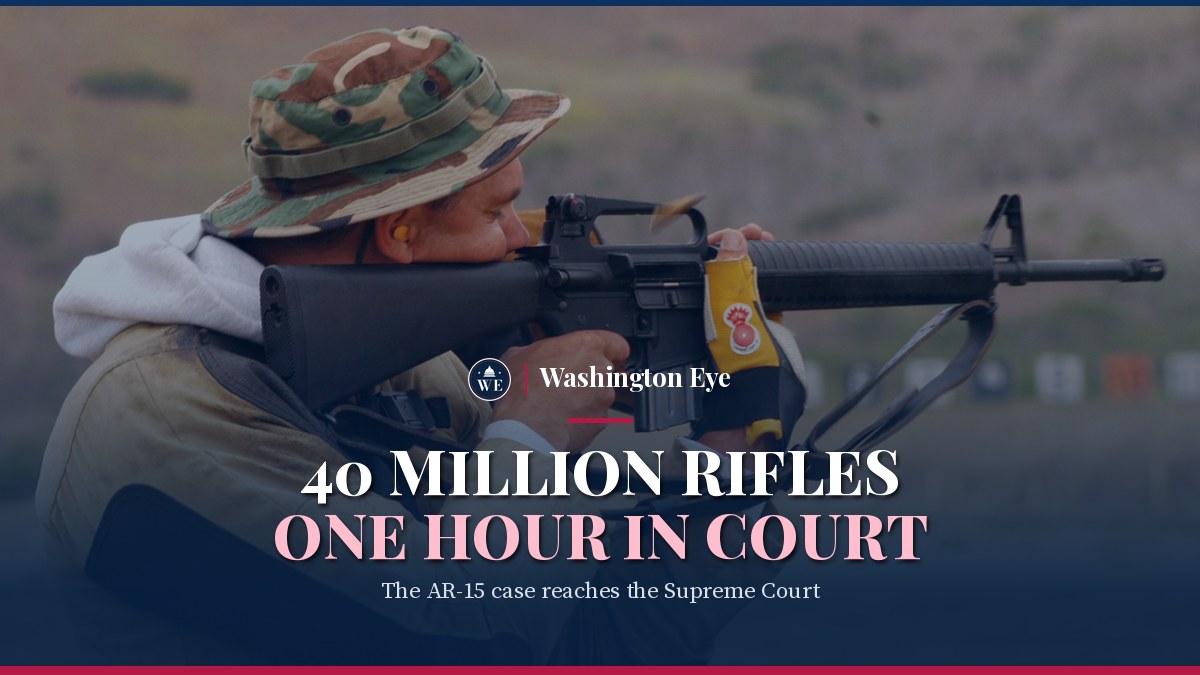
On 29 October, the man whose name sits at the top of one of the most important gun cases in years filed a short motion asking the Supreme Court to let him go. Cutberto Viramontes gave no reason. His motion said only that it applied to him alone, that no other petitioner was seeking dismissal and that the case remained pending for everyone else. A week later Cook County, Illinois, seized the opening. If Mr Viramontes walks away, the county told the justices, the Court should dismiss the case as moot or as improvidently granted.
That request is still sitting on the docket, unanswered. Argument is still set for 10 a.m. on Wednesday, 2 December, with one hour on the clock. The question the justices agreed to decide on 30 June is short enough to fit on an index card: whether the Second and Fourteenth Amendments guarantee the right to possess AR-15 platform and similar semiautomatic rifles.
Our view is just as short. The Court should refuse the exit, hear the case and answer the question. And on the law as the Court itself has written it, the answer should be yes.
A procedural off ramp, offered at the last minute
Cook County's ordinance prohibits the possession, acquisition and transfer of what it calls assault weapons. It covers semiautomatic rifles that can accept large capacity magazines and have certain features, and it names some 125 rifles outright, the AR-15 among them. Mr Viramontes and a second resident, Christopher Khaya, sued in 2021 alongside two gun rights groups, the Firearms Policy Coalition and the Second Amendment Foundation. They lost in the district court and again in the Seventh Circuit, which in June 2025 affirmed in a short nonprecedential order. That panel said the challenge "falters for want of an adequate record" and leaned on its own 2023 ruling that had already upheld the same ordinance, at least preliminarily.
The county's new argument is clever. It says Mr Khaya's preferred rifle, an IMI Galil, is based on the AK-47 design rather than the AR-15, so he has no stake in a question about "AR-15 platform and similar" rifles. It quotes him admitting he would most likely use the Galil "at the range, to be honest." And it notes that the two groups identified only two members in all of Cook County: Mr Viramontes and Mr Khaya.
The challengers' reply, filed on 11 November, makes the obvious point. If anything is similar to an AR-15, an AK-47 style rifle is, and Cook County's own ordinance lumps the two together as assault weapons. The reply attaches a declaration from Mr Khaya saying he would also buy and keep an AR-15 in the county if it were lawful, and another from a member of both groups who says he has owned an AR-15 since 2011, stores it outside the county, and would keep it at home if the law allowed.
More telling is a footnote both sides share. Cook County concedes that its jurisdictional objection "would not prevent the Court from deciding the question presented," because the Connecticut case, Grant v. Higgins, was consolidated with this one. The challengers agree. In other words, even the county admits the escape hatch leads nowhere. The only thing a dismissal of the Illinois case would achieve is to muddy the record and invite another year of lower court confusion over a law that covers millions of people in and around Chicago.
The Court has already written the test
This is not a case that requires the justices to invent anything. In District of Columbia v. Heller in 2008, the Court held that the Second Amendment protects weapons in "common use" by law abiding citizens, and struck down a ban on handguns for that reason. In New York State Rifle and Pistol Association v. Bruen in 2022, it told lower courts to judge gun laws by the text of the amendment and the nation's historical tradition of firearm regulation, not by a judge's own weighing of costs and benefits.
Justice Brett Kavanaugh applied that framework to the AR-15 in June 2025, when the Court declined to hear a challenge to Maryland's ban. In a statement attached to that denial, he wrote that Americans possess an estimated 20 to 30 million AR-15s, that the rifles are legal in 41 of the 50 states, and that states banning them are "something of an outlier." He added that it can be "analytically difficult" to distinguish the AR-15 from the handguns protected in Heller, since most handguns are semiautomatic too, and that handguns, not rifles, are used in the vast majority of gun murders in America. He called the appeals court ruling upholding Maryland's law "questionable" and predicted the Court "should and presumably will address the AR-15 issue soon, in the next Term or two." Justices Clarence Thomas, Samuel Alito and Neil Gorsuch would have taken that case on the spot.
Seventeen months later, the prediction has come true. The Court considered the Cook County petition at 22 separate conferences before granting it. It has drawn nearly 90 friend of the court briefs. A 2026 survey cited in one of them puts the number of AR-15 type rifles in private hands at roughly 40 million, and about 60 million counting similar rifles. Whatever the exact figure, no serious party disputes that this is one of the most commonly owned rifles in the country. Under the test the Court itself laid down, that should settle a great deal.
Connecticut's case deserves a serious answer
None of this means the other side has nothing to say. It has a great deal, and it says it with real moral force. Connecticut's brief, filed under the name of former Solicitor General Elizabeth Prelogar, opens on 14 December 2012, when a gunman with an AR-15 style rifle murdered twenty first graders and six educators at Sandy Hook Elementary School in Newtown in less than five minutes, before police could respond. Within months, a bipartisan legislature added the AR-15 to the state's banned list and defined banned rifles by features such as folding stocks, forward grips and flash suppressors, so manufacturers could not rename their way around the law.
The state argues that the ban fits an old tradition. From fourteenth century England onwards, it says, governments have restricted weapons that were unusually dangerous for their time: the launcegay, the Bowie knife, the Tommy gun. It argues that the AR-15 can inflict fatal wounds on a scale close to its military cousin, the M-16, and it points out that such rifles were used in many of this century's worst massacres, from Sandy Hook to Las Vegas, Parkland and Uvalde, and in the ambush that killed two police officers in Bristol, Connecticut.
We do not wave those facts away. Anyone who remembers the photographs from Newtown understands why Connecticut acted. But the constitutional question is not whether a weapon can be misused. Handguns are misused every day, in far greater numbers, and Heller still protects them. The question is whether a state may ban outright a class of arms that tens of millions of law abiding Americans already own and use lawfully. Many of the historical laws in that story regulated how and where weapons were carried rather than banning ownership of a common arm outright. The Tommy gun is a fully automatic weapon, and federal law has tightly controlled machine guns since 1934. The AR-15 sold to civilians is semiautomatic: it fires once per pull of the trigger. Kavanaugh himself drew that line in 2025, noting that semiautomatic rifles are distinct from automatic military weapons such as the M-16.
Why ducking would be the worst outcome
The federal government has now joined the challengers. Solicitor General D. John Sauer filed a brief in September arguing that a ban like Cook County's is unconstitutional, and on 9 November the Court granted his request to argue, asking for 20 minutes for the challengers, 10 for the United States and 30 for the two defending governments. That arrangement alone shows how far this case has travelled. It is no longer a local quarrel about one county ordinance. It is the vehicle the Court chose, after a year of waiting, to resolve a split that touches every state with a similar law.
Those laws are not going away on their own. Other petitions raising rifle and magazine questions are already queued behind this one, including one from New Jersey. Only last Monday the Court turned away a separate dispute over Maryland's ban on carrying guns in so called sensitive places. Each time the justices decline to act, lower courts read the silence as permission, and gun owners in a handful of states live under rules that would be unthinkable in the other 41.
A dismissal on a technicality would be worse than a loss for either side. It would tell the country that a question the Court openly promised to answer can be dodged because one plaintiff, for reasons he never explained, decided to step away. It would leave the Seventh Circuit's thin, nonprecedential order standing over a county of five million people. And it would hand every future defendant a playbook: when the Court takes your case, go looking for a reason it should not.
What we want to hear on 2 December
We want to hear the justices press Cook County on why a rifle owned by tens of millions of Americans is not in common use. We want to hear them press the challengers, too, on where the line sits, because a ruling that protects the AR-15 should say clearly that it does not touch the machine gun rules that have stood for nine decades or the Court's own 2024 decision allowing the government to disarm people under domestic violence restraining orders. A careful opinion can protect the right and keep the tools that actually target dangerous people.
The Court does not set decision dates, and its term usually runs until late June or early July. That gives the justices seven months to write something durable. They should use it. The text is the same, the precedents are written, and the question has been waiting on their desk since Heller. The only wrong answer now is no answer at all.