
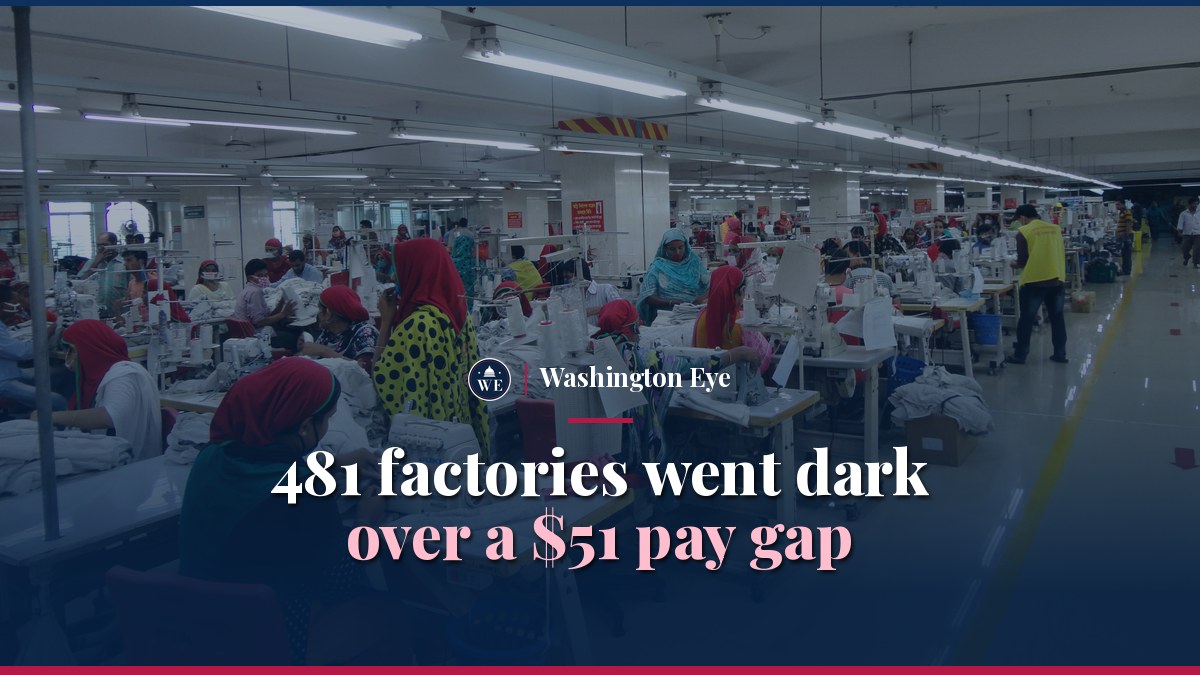
By Tuesday evening in Dhaka, the distance between Bangladesh's garment bosses and the people who sew for them had narrowed to a sum that would barely cover a family pizza night in an American suburb. Factory owners were offering a minimum wage of 15,700 taka a month. Worker representatives wanted 22,000. The gap, 6,300 taka, is worth roughly $51 at the exchange rates used in recent reporting. On the same day, according to the country's main manufacturers' association, production was halted at around 481 garment factories.
That is the paradox at the heart of the world's second largest clothing exporter after China. An industry that employs more than four million people and earns more than 80 per cent of Bangladesh's export income is being switched off, one industrial belt at a time, over amounts that look trivial from a shopping mall in Ohio and enormous from a rented room in Gazipur.
How the talks moved
The current minimum for the lowest grade of garment worker, set in 2023, is 12,500 taka, about $100 a month. The scale tops out at 15,035 taka for Grade I. Workers began protesting in October and the unrest spread sharply from the start of November, with demonstrators demanding 30,000 taka, more than double the floor. The government formed a six member Minimum Wage Board on 1 November. At its first meeting on 4 November the board agreed that whatever scale it chose would apply from December, with the first new pay packets arriving in January.
The bargaining that followed was slow, then suddenly fast. At the board's second meeting on 9 November, worker representatives tabled a formal demand of 32,000 taka for the bottom grade. The employers' first offer came only on Monday, 23 November: 15,000 taka. Across a session of nearly nine hours on Monday and a resumed round on Tuesday afternoon, the two sides traded figures. Workers came down to 25,000 and then 22,000. Owners rose to 15,500 and then 15,700, according to the board's chairman, Syed Azad Subhani, who briefed reporters on Tuesday evening and said the board hoped to finalise the new structure that night.
Several Bangladeshi news outlets, citing sources at the board, reported on Tuesday that the sides had settled on 16,000 taka, a rise of 28 per cent. At the time of writing that figure had not been formally announced, and the chairman's own on the record numbers still showed a gap. If 16,000 is confirmed, workers will have secured far less than the doubling they marched for, but well above the 15 per cent that industry leaders had earlier called the most they could sustain. Owners, in other words, have already moved further than they said they could. The question is whether workers will accept that they have moved far enough.
Why the owners say they cannot pay more
The employers' case is not invented. The Bangladesh Garment Manufacturers and Exporters Association, known as BGMEA, says a survey of 317 member factories found $428 million in production lost between 1 and 18 November, and a further $254 million in confirmed orders, some 59 million garments, moved by buyers to other countries. It says more than 600 member factories were hit and that the true cost is higher, because factories are paying for air freight, offering discounts and absorbing cancellations to keep the customers they still have. One owners' representative on the board, ABM Shamsuzzaman, reached for a fable to make the point. "When the duck falls ill," he asked reporters, "can you still expect it to lay one golden egg every day?"
Then there is America. The United States is Bangladesh's largest single export market, taking roughly a fifth of its garment exports, and last year Bangladesh shipped about $8.2 billion of ready-made clothing there. But in the first seven months of 2026, according to US government textile data cited by local analysts, the value of those shipments fell 6.5 per cent, volumes fell 4.3 per cent and average prices fell 2.26 per cent, as exporters swallowed part of Washington's tariff bill to hold on to orders. Mohammad Hatem, who leads the country's knitwear exporters, put it plainly: "Production costs are rising continuously, but instead of increasing, product prices have declined."
The tariff picture itself has whipsawed. After the Supreme Court struck down the president's reciprocal tariffs in February, the administration imposed a temporary 10 per cent levy on imports from every country under a 1974 trade law. In July it followed with new duties on dozens of countries it accused of weak enforcement against goods made with forced labour. Bangladesh landed in the 10 per cent group, while Vietnam and China were hit with 12.5 per cent. For once, that handed Dhaka a small edge over its fiercest rival in the American market. "We now have a 2.5 percentage-point tariff advantage," one Bangladeshi factory boss, Shovon Islam, said this summer, adding that two large American orders were already moving his way from Vietnam. Weeks of shuttered factories threaten to hand that edge straight back.
Why the workers say they cannot live on less
Workers answer that the 2023 scale has been eaten alive by prices. Bangladeshi garment workers are among the lowest paid in the world, taking home around 13,000 taka a month. "Food prices, cooking gas and electricity bills have all gone up," a 28 year old factory worker named Mamun said early in the protests. "The government must either bring down the prices of essential commodities or raise our wages." A female worker told a reporter that the government should also instruct landlords not to raise rent and keep essential goods affordable, a reminder that for many families a pay rise can vanish into the next lease.
Their anger is sharpened by a legal tool. Section 13(1) of the Bangladesh Labour Act lets owners close a factory during unrest under a "no work, no pay" rule. On Tuesday alone, 84 factories announced indefinite closures under that section, on top of 397 that suspended operations. For a worker earning 12,500 taka, a locked gate is not a bargaining position. It is the rent.
The streets have stayed tense. On Tuesday in Gazipur, the industrial belt on the edge of Dhaka where more than 400 factories were affected, workers blocked a major highway and set fires after a rumour spread that a colleague had been killed. Police fired tear gas and sound grenades. "No worker died," the local industrial police superintendent, Mohammad Amjad Hossain, said.
The politics behind the picket lines
For the government of Prime Minister Tarique Rahman, this is a major test. When the unrest exploded at the start of November, Rahman held an emergency meeting with ministers and the wage board was set up within days. But ministers have also framed the protests as something more sinister. The home minister, Salahuddin Ahmed, threatened action against people trying to "destabilise the country" under the guise of labour protests. Authorities have accused the banned Awami League of the deposed prime minister Sheikh Hasina of exploiting the movement, without providing evidence. BGMEA's president, Mahmud Hasan Khan, said unrest after the board was formed could not be justified and asked: "If we call this incitement and say political elements have entered the scene, would that be wrong?" A junior foreign minister, Shama Obaed Islam, said a particular group was trying to damage the country and the industry by hiding behind labour unrest.
The calendar makes that argument tempting and also risky. Hasina, in self-imposed exile in India, plans to return home on 16 December, and a senior minister has said she would be arrested and jailed if she does. A government that blames every blocked highway on a banned party may find it harder to convince millions of workers that their grievances are being heard on their own terms.
Why this matters far from Dhaka
For American shoppers and companies, the stakes are not abstract. Bangladeshi factories make clothes for global retailers including H&M, Gap, Walmart, Primark and Uniqlo. The $254 million in orders that have already left went to rival producers, and the likeliest winners are the countries that were already gaining ground: in the first half of this year, US garment imports from Vietnam, Cambodia and Indonesia rose while those from Bangladesh fell. Buyers planning their 2027 ranges now have a fresh reason to spread their risk, and orders that move rarely come back quickly.
There is a policy question for Washington too. The administration justified its July duties on Bangladesh in the language of labour standards. A visible pay rise, negotiated through a board with workers at the table, is exactly the kind of evidence a trade official could weigh. Yet local experts have warned exporters not to expect the surcharge to disappear, even after Democrats won both chambers of Congress, because the president keeps broad trade powers under existing law. Bangladeshi owners are therefore being asked to pay more at home while getting no promise of relief abroad. That squeeze explains why they fought so hard over a few hundred taka.
The other side of the argument
There is a fair case that the owners are crying wolf. Their earlier line that anything above 15 per cent was unsustainable has already given way to an offer of more than 25 per cent, which suggests the real limit was always higher than advertised. Wage rises in Bangladesh also come years apart, so a modest increase now locks in a low floor for a long time. On the other hand, an industry that competes largely on cost, with longer lead times than Vietnam and limited capacity in synthetic fabrics, cannot price itself out of a shrinking American market without losing jobs. Both things can be true at once, which is precisely why the board has struggled.
What to watch
First, the formal announcement and the official gazette. The workers' representative on the board, Babul Akhtar, has said workers intend to keep up their movement until the final wage gazette is published, so even a confirmed deal may not clear the highways overnight. Second, whether the 481 halted factories reopen this week, and whether owners keep using the "no work, no pay" clause. Third, the next round of industry figures on lost orders, which will show whether buyers have stopped leaving. Fourth, 16 December, the date Hasina has set for her return. And finally Washington, where any change to the July surcharge would matter more to these factories than almost anything decided in Dhaka.
A gap of about $51 a month sounds small. Multiplied across four million workers, a nation's export earnings and a retail supply chain that stretches to American malls, it is anything but.