
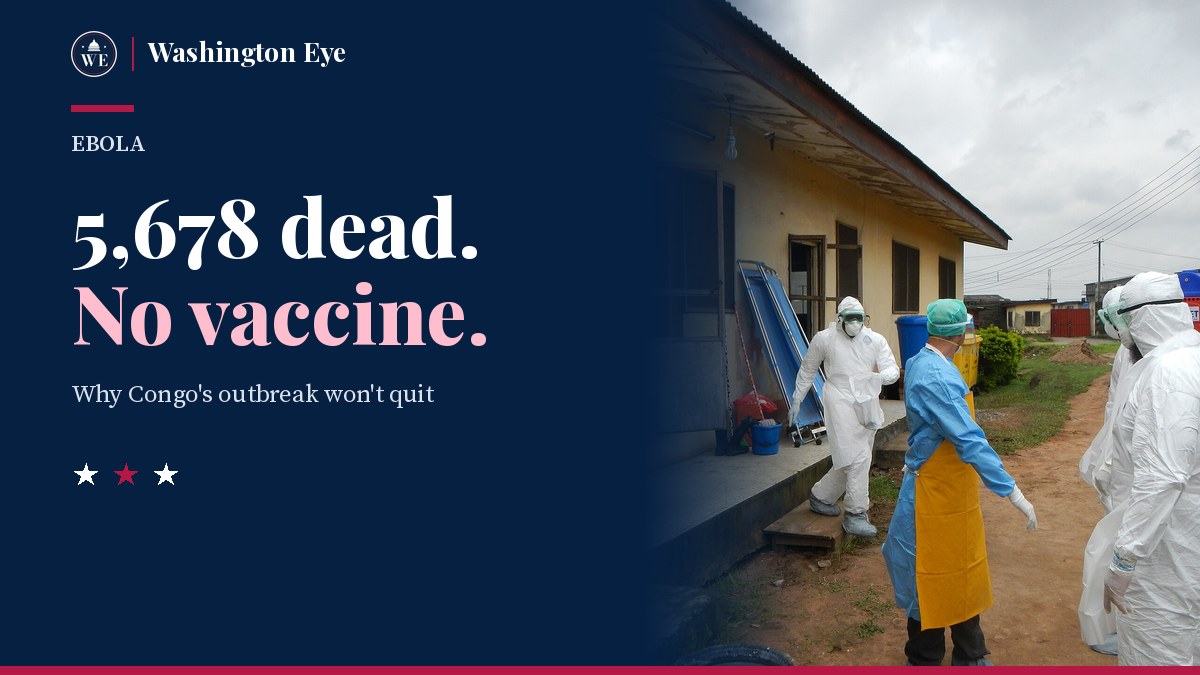
Six months after it was declared, the Ebola outbreak in the Democratic Republic of the Congo is no longer a single emergency. It is several at once: a medical crisis caused by a strain of the virus for which no approved vaccine or treatment exists, a security crisis in provinces where armed groups attack villages and clinics, and a test of how a world without American membership of the World Health Organization responds to a killer disease.
On 18 November the organisation's Director-General, acting on the advice of its emergency committee, ruled that the outbreak remains a public health emergency of international concern, the highest alarm in global health law. The figures behind that decision are stark. As of 17 November, health authorities had confirmed 11,613 cases and 5,678 deaths, a crude fatality rate of 48.9 percent, across 68 health zones in eight provinces. Here is what readers need to know.
What kind of Ebola is this?
The outbreak is caused by Bundibugyo virus, one of several species in the Ebola family. It is far less familiar than the Zaire species behind the West African epidemic of 2014 to 2016 and most of Congo's earlier outbreaks. Before this year it had caused only two documented outbreaks, in Uganda in 2007 and in Congo in 2012, which killed about 30 and 50 percent of patients respectively.
That history matters because the tools that transformed Ebola response over the past decade were built for Zaire. The licensed Ebola vaccine and the antibody treatments that sharply cut deaths in Congo's 2018 to 2020 outbreak target that species. Against Bundibugyo, the World Health Organization says plainly, no approved vaccines or specific treatments currently exist. Control depends on older methods: finding cases quickly, isolating and treating them, tracing their contacts, and making burials safe.
How big is it compared with past outbreaks?
It is now the largest Ebola outbreak ever recorded in Congo, whatever the species, and the second largest anywhere, behind only the West African epidemic, which recorded more than 28,000 cases and more than 11,000 deaths. Congo's total has risen steadily since the outbreak was declared on 15 May. In the three weeks to 17 November alone, 1,417 new cases were confirmed.
Ituri province, where the outbreak was first detected, remains the worst hit, with 7,946 confirmed cases and 3,751 deaths. North Kivu has recorded 2,996 cases and 1,654 deaths and has the highest provincial fatality rate, 55 percent. The trend there is worrying: North Kivu logged 235 cases in the seven days to 17 November, a 40 percent rise on the week before. A new health zone, Watsa in Haut-Uélé province, reported its first cases this month.
There is a little good news. Some areas have seen slight declines, and two provinces, South Kivu and Sud-Ubangi, have gone more than 42 days without a case. Nationally, though, the World Health Organization describes transmission as sustained and high level, with a seven day average stuck at roughly 62 to 65 new cases a day.
Why is the death rate so high?
Partly because many patients never reach care. Of the 720 deaths reported in the three weeks from 28 October, 452 happened in communities rather than treatment centres, with young children especially affected. Early symptoms such as fever, fatigue and headache look like malaria and other common illnesses, so people often seek help late or not at all. Counting only cases whose outcome is known, regional health officials put the fatality rate at about 64 percent.
Contact tracing is also falling short. Over the two weeks to 17 November, teams reached on average 81 percent of known contacts each day, against a target of 95 percent. In North Kivu the figure was 77 percent. Every contact who slips through is a potential new chain of infection.
What role is violence playing?
A central one. The epicentre lies in a region long torn by armed conflict, and the Allied Democratic Forces, a militia that pledged allegiance to the Islamic State group in 2019, has stepped up attacks. Earlier this month the group killed at least 66 people, including three health workers fighting the epidemic, and burned three health facilities in an attack in North Kivu. Days later, raids in Ituri's Mambasa territory left at least 44 civilians dead, according to security sources. A nurse was killed responding to an Ebola alert in Tshopo province in late October.
The World Health Organization's chief, Tedros Adhanom Ghebreyesus, has called the region's chronic instability "one of the greatest obstacles to the Ebola response." Insecurity keeps vaccinators and tracers out of villages, frightens patients away from clinics, and pushes displaced families across the very areas where the virus is spreading. The agency's latest update calls rising insecurity the single greatest obstacle to expanding operations.
Is a vaccine coming?
Possibly, but not quickly. On 23 October researchers in Bunia, the capital of Ituri, gave the first doses in a trial called Tumaini, Swahili for hope. It began with the existing Zaire vaccine to test whether it offers any cross protection against Bundibugyo. Two vaccines designed specifically for Bundibugyo are due to join: one developed at the University of Oxford with the Serum Institute of India, the other an mRNA shot from the American company Moderna. Both have passed small early stage safety trials.
A senior official at the World Health Organization said second phase testing of the two new candidates was scheduled to start in Bunia on 26 or 27 November. More than 140 people had enrolled in the trial so far, with thousands of contacts ultimately expected. The trial uses ring vaccination, immunising the contacts of confirmed cases, the approach that helped end earlier outbreaks. If the new candidates prove safe and generate an immune response, they can move to a full efficacy trial. That process takes time the outbreak is not giving.
Has it spread beyond Congo?
Yes, but so far it has been contained wherever it has landed outside the country. Cases have been recorded in five countries. Uganda's outbreak, 20 confirmed cases and two deaths, and a single case in France were controlled by August. Kenya recorded nine cases and two deaths in one cluster linked to an imported case; its last patient was discharged on 11 November and a 42 day countdown to declare the outbreak over is under way. Nigeria reported one imported case in Abuja in October; the patient was flown to Switzerland and recovered. Patients medically evacuated to Britain, Germany and the Netherlands have also been treated there.
The Kenyan experience is instructive. All eight secondary cases there were already in quarantine as known contacts when they fell ill. That is what effective tracing looks like, and it is exactly what conflict makes so hard inside Congo.
What is the United States doing?
Washington is fighting this outbreak from outside the World Health Organization. The United States completed its withdrawal from the agency on 22 January, months before the outbreak was declared. Instead it has worked through the State Department, the Centers for Disease Control and Prevention and direct agreements with affected governments.
The money is substantial. By 23 September the State Department had announced $887 million in direct health and humanitarian assistance, including a $267 million package unveiled during the United Nations General Assembly, and said the United States remained the largest provider of aid for the outbreak. The department says its funding has helped operate 23 specialised Ebola treatment centres and support 8.6 million health screenings. The disease control agency has drawn $107 million from its rapid response reserve fund and deployed more than 120 staff to the region, according to the Congressional Research Service.
In June the administration asked Congress for $1.44 billion in emergency Ebola funding as part of a larger supplemental request. The Congressional Research Service noted that no legislation had been introduced to provide it. Critics, including aid workers and health policy researchers, argue that earlier cuts to foreign aid and the break with the World Health Organization weakened surveillance and coordination just when they were needed. Supporters of the administration's approach point to the scale of the money and the speed of the response, which the State Department calls the fastest American response to Ebola.
Can travellers bring it to America?
Federal health officials say the overall risk to the American public remains low, and no American cases have been linked to this outbreak. But the travel rules are among the toughest ever applied to an outbreak. Since 3 November everyone boarding a flight to the United States must sign a statement that they have not been in Congo in the previous 21 days. Travellers who have been there, American citizens included, may not board.
A separate order, renewed on 10 November and running until 10 December, bars foreign nationals, including green card holders, who have been in Congo, Uganda or South Sudan within 21 days. American citizens arriving from Uganda or South Sudan are routed through designated airports for screening. The order says it will be reviewed as an ongoing risk assessment continues.
What should we watch next?
Three things. First, the vaccine trial: whether the Bundibugyo specific candidates start on schedule in late November and how quickly they can be offered to contacts. Second, North Kivu, where cases are rising and the fatality rate is highest; if the outbreak gains ground in its larger towns, the numbers could climb fast. Third, money and access. The World Health Organization says the next phase must focus on quality, reach and community trust, backed by sustained funding and security. None of those can be supplied by a laboratory.
Half a year in, the outbreak has outlasted early hopes that it would burn out. It is killing roughly half of those it infects, it is concentrated where governments and aid groups can least easily reach, and the best medical tools are still in trials. That is why a crisis in the forests of eastern Congo still sits at the top of the global health agenda, and why Kenya's 42 day countdown may be the most hopeful clock in Africa right now.