
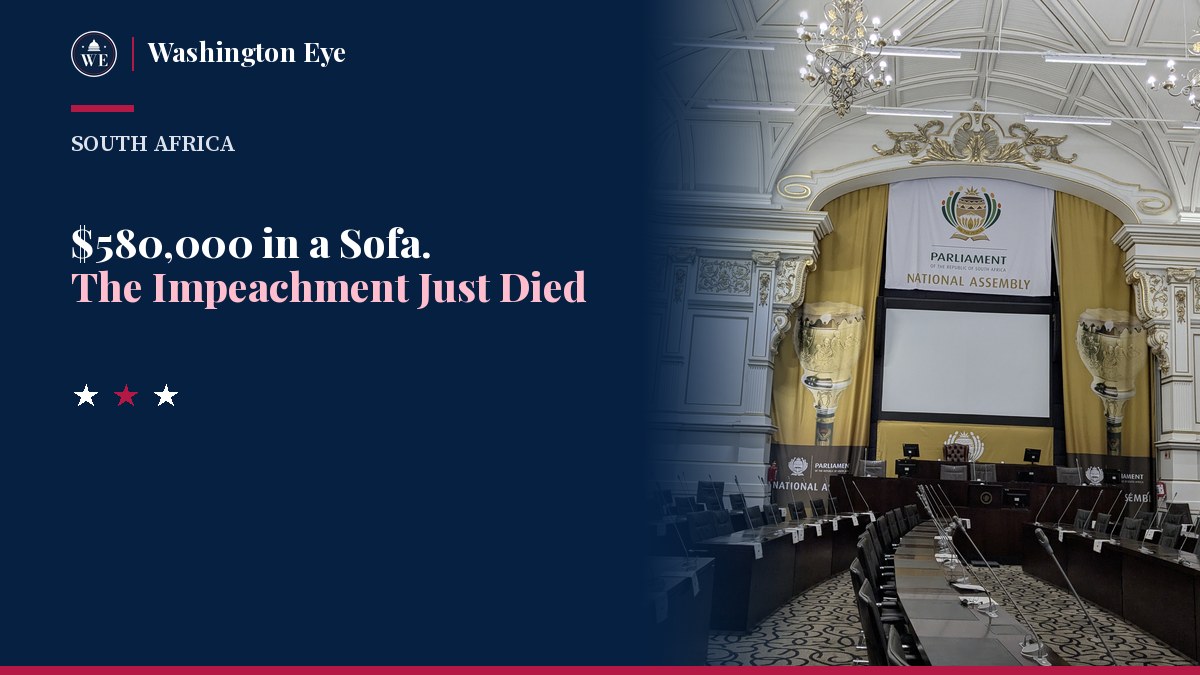
For more than four years, the strangest corruption story in modern South African politics has hung over its president like weather. In February 2020, thieves broke into Phala Phala, Cyril Ramaphosa's game farm in Limpopo province, and took US dollar bills that had been tucked inside a sofa. The sum later put on the record was $580,000. On Wednesday, a full bench of the Western Cape High Court took away the one instrument that could have turned that story into the removal of a sitting head of state.
In a unanimous judgment, the court declared unlawful the report of the independent panel that had found, in late 2022, that Ramaphosa may have a case to answer. It set the report aside "in its entirety" and, in the same order, voided every step the National Assembly had taken on the strength of it. That includes the impeachment committee Parliament set up on 1 June this year. Unless the ruling is overturned on appeal, the process is over.
It is a significant moment for Africa's most industrialised economy, for the governing coalition that has run it since 2024, and for anyone in Washington trying to read where Pretoria goes next. It is also, crucially, not an acquittal. The court said nothing about whether Ramaphosa did anything wrong. It said that the body Parliament asked to sift the evidence asked itself the wrong questions.
The story begins on 9 February 2020, when a burglary took place at Phala Phala. It did not become public until June 2022, when Arthur Fraser, the former director-general of the State Security Agency and an ally of former president Jacob Zuma, filed a complaint with the police. Fraser accused Ramaphosa of concealing the theft from the police and the tax authorities, and of running an unofficial operation to track down the thieves.
Ramaphosa has always admitted that a robbery happened. His explanation is that the money came from the legitimate sale of buffalo by his livestock business, and that he reported the matter to the head of his protection unit. Several official investigations later cleared him. Earlier this month, two people were found guilty of the theft itself.
Parliament nonetheless used the constitutional route reserved for exactly this kind of allegation. Section 89 of the Constitution allows the National Assembly to remove a president for a serious violation of the Constitution or the law, serious misconduct, or inability to perform the functions of office. Rules adopted in 2018 put a filter in front of that power: an independent panel first decides whether there is enough evidence to justify a full inquiry. Ramaphosa is the first president to face proceedings under those rules.
The panel, chaired by former chief justice Sandile Ngcobo, reported in November 2022. Its findings were damaging. It said there was "substantial doubt about the legitimacy of the source of the currency that was stolen" and concluded that the president "has a case to answer". For a few days it looked as if Ramaphosa might resign. Instead, in December 2022, the African National Congress used its majority to vote down a motion to send the report to an impeachment committee, by 214 votes to 148.
That might have been the end. It was not. In May this year, the Constitutional Court ruled that Parliament had acted unconstitutionally in blocking the process and ordered the report to go to an impeachment committee without another vote. Ramaphosa, who had dropped an earlier court challenge to the panel's report once Parliament shelved it, revived that challenge 18 days later, on 26 May.
Wednesday's judgment turns on a distinction that sounds technical but goes to the heart of how removal is supposed to work. The National Assembly's rules required the panel to find "sufficient evidence" that the president had committed a serious violation or serious misconduct. The panel instead asked whether the information before it disclosed a prima facie case, "irrespective of its merit or sufficiency", in the court's description.
Judge President Nolwazi Mabindla-Boqwana, sitting with judges Mark Sher and Ncumisa Mayosi, called that a material error. "The panel did not state in its report that there was sufficient evidence showing that the president committed a serious violation or serious misconduct, only that the information before it prima facie disclosed a case to answer," she said. In doing so, it treated the two standards as the same thing.
The court went further. It found that the panel had strayed beyond the four charges actually laid against the president, drawing on extra material submitted by opposition parties to pronounce on matters he was never charged with. It also found that the panel leaned on Fraser's 2022 affidavit to the police even though Fraser had no personal knowledge of the burglary and did not disclose his sources. Much of that material, the judges said, amounted to "hearsay, or mere say-so".
The bottom line was blunt. The panel, the court said, had "misconstrued its function, the nature of the inquiry it was to conduct and the recommendation it was required to make". It "went beyond its lawful remit" and made "several material errors of law". Each side was ordered to pay its own costs.
Four opposition parties fought the review: the African Transformation Movement, the Economic Freedom Fighters, the uMkhonto weSizwe party led by Zuma, and United Africans Transformation. Their central argument was that a court should not interrupt a seven-stage parliamentary process at its first step, and that the gap between "prima facie" and "sufficient" evidence was, in the words of one party's filing, "a distinction without a difference". They also pointed to the president's delay of more than three years in pressing his challenge.
The court rejected both points. It said the challenge only became necessary after the Constitutional Court's May ruling, so filing in late May was reasonable. And while judges are normally slow to step into a process midway, they can when the harm could not be undone later, and forcing a president through an impeachment inquiry without a lawful basis would be that kind of harm. The court was careful to add that it was not saying Ramaphosa should escape impeachment, only that any process must rest on a lawful foundation.
The opposition is not convinced. Vuyo Zungula, the African Transformation Movement's leader, said his party would speak to its lawyers about an appeal and to other parties about seeking a fresh Section 89 panel. "We can't accept that you are going to have one law for the rest and another law for Ramaphosa," he told reporters at the court. "The courts are with Ramaphosa and this is the clearest indication of that." ActionSA said it would pursue "every available avenue".
The Presidency was restrained. Ramaphosa would "study the decision of the court", its statement said, adding that in seeking the review he had "exercised a constitutional right".
Legal scholars were less restrained. Richard Calland, a constitutional law professor, told a British broadcaster the process was now "dead in the water" and that any party hoping to revive it "would have to come up with a whole new basis". He expected opposition parties to appeal but thought it unlikely Parliament itself would. Political analyst Khanyi Magubane called the ruling a source of "political and constitutional credibility" for the president, while warning that "there will always be the shadow of the Phala Phala report".
Even if an appeal succeeded, the arithmetic of removal would not change. Removing a president under Section 89 needs a two-thirds majority of the National Assembly. The ANC, although it lost its outright majority in 2024 and now governs in a coalition with the pro-business Democratic Alliance, still holds enough seats to block that on its own. The realistic stakes were always political damage rather than eviction from office.
That is exactly why Wednesday matters. An impeachment committee of 31 members drawn from 16 parties, chaired by Rise Mzansi's Makashule Gana, would have spent months airing the sofa, the dollars and the buffalo in public. That spectacle has now been switched off. The ruling hands Ramaphosa something he has lacked since 2022: a period in which he can govern, bargain with coalition partners and manage his own succession inside the ANC without the word "impeachment" attached to his name.
For Washington, the result is a more settled counterpart in Pretoria at an awkward time. Relations between the two governments have been strained under the Trump administration, which expelled South Africa's ambassador last year and skipped the G20 leaders' summit that South Africa hosted in Johannesburg. A president fighting for survival at home has little room to make concessions abroad. One freed from that fight has more, though it also has less reason to look as if it is bending to outside pressure.
For South Africans, the deeper question has not moved an inch. Nobody has yet explained, to the satisfaction of the president's critics, why that much foreign currency was sitting in a piece of furniture on a working farm. The court did not answer that, and was never asked to. Zungula put it simply: "It is the duty of Parliament to establish those facts."
The ruling leaves South Africa with an uncomfortable result. Its courts have now told Parliament twice in six months that it got the process wrong: first by refusing to hold an impeachment inquiry at all, and now by starting one on a faulty report. Each judgment can be defended on its own terms. Together, they show how hard it is to make a constitutional accountability tool work when the person being held to account leads the largest party in the chamber that has to use it.
What happens next depends on whether the opposition can find a new legal footing quickly or decides to take the fight to voters instead. For now, the $580,000 that was hidden in a sofa remains the most famous unanswered question in South African politics. It just no longer comes with a timetable.