
On Monday, standing among the lift trucks of a factory in upstate New York that has built them since 1922, Chuck Schumer made a promise with a date attached. "In January, one of my very first actions as the next Senate Majority Leader will be to lift these costly tariffs, lower costs, and end the trade war," he said during a visit to The Raymond Corporation in Greene, a company that employs more than 2,000 people at its headquarters there.
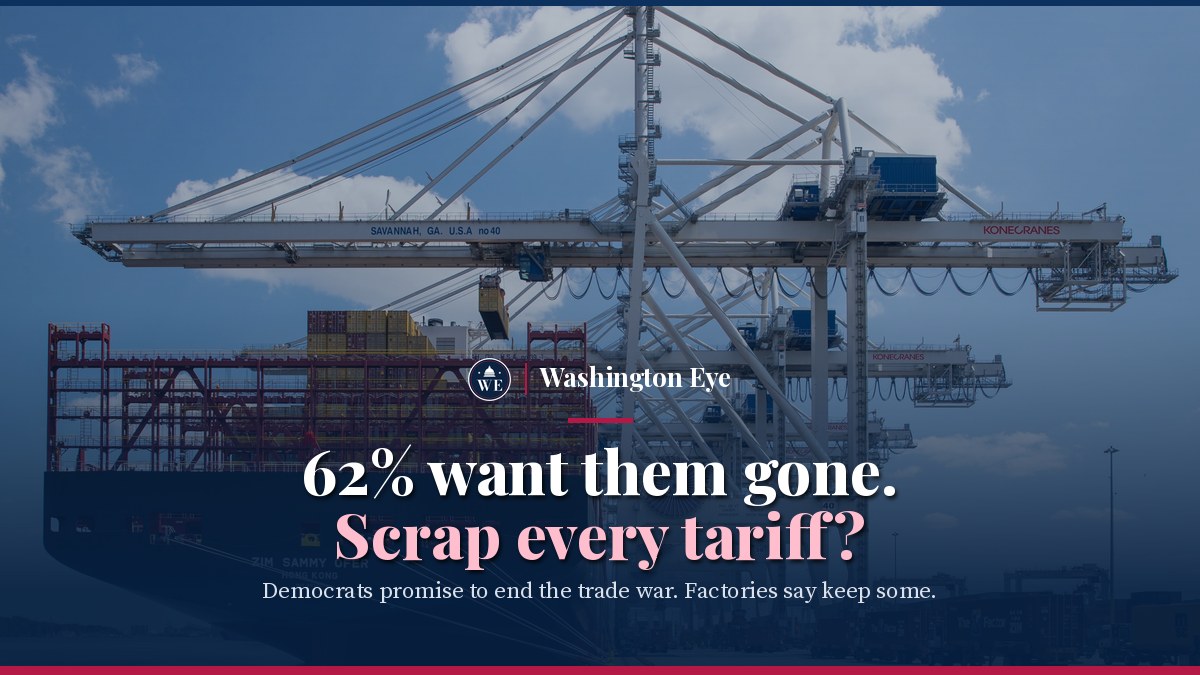
The politics behind that pledge look simple. A national poll taken in the days after this month's midterm elections found that 62% of Americans supported repealing President Donald Trump's tariffs, while just 21% approved of his handling of the cost of living. Voters handed Democrats both chambers of Congress, and the party's leaders in each have put tariffs near the top of the list. "We need to stop the Trump tariffs that have increased costs on everyday Americans by thousands of dollars," Hakeem Jeffries, the House Democratic leader, told reporters after the election.
The economics are messier. The same autumn that turned voters against tariffs also delivered a real pickup in factory hiring. Manufacturers added 19,000 jobs in October, according to the Bureau of Labor Statistics, with 25,000 gained in durable goods. For the first time since January 2025, the number of Americans working in manufacturing edged back above where it stood when Trump returned to office. A leading pro manufacturing group is now warning the incoming majority that "there would be downsides in stripping away all of the tariffs now in place."
So the real question for January is not whether Democrats can pass a repeal bill. With majorities this large, they almost certainly can. The question is what they should repeal, and whether a party that campaigned on prices is ready to own the consequences either way. Below we set out the strongest case on each side, and the arithmetic that may decide it.
What is actually on the table
The tariff wall Americans pay today is not the one Trump built in 2025. On 20 February the Supreme Court ruled that he could not use the International Emergency Economic Powers Act to impose tariffs, wiping out the legal basis for a large share of his 2025 duties. The administration rebuilt the wall from older statutes.
First came a 10% global tariff under Section 122 of the Trade Act of 1974, a balance of payments power that lasts no more than 150 days without congressional approval. The Court of International Trade ruled that tariff unlawful in May for the three importers who sued, though an appeals court paused that ruling in June. When the 150 days ran out in late July, the administration replaced the global tariff with duties of 10% or 12.5% on 60 economies under Section 301, based on a finding that those countries had failed to ban and enforce bans on goods made with forced labour. Trade lawyers estimate those duties reach goods accounting for 99.4% of American imports, and they carry no end date.
Then came Canada. In August Trump imposed 50% tariffs on selected Canadian goods, from dairy and alcohol to wood products, furniture and motorboats, under Section 338 of the Tariff Act of 1930. According to the Congressional Research Service, it was the first time a president had expressly cited that statute to impose tariffs. Ottawa answered with retaliatory tariffs on C$27.6 billion of American goods from 8 September. Running alongside all of this are the Section 232 national security tariffs on steel, aluminium and other products, which predate the court ruling and were untouched by it.
Schumer's vehicle is the End Trump's Tariff Tax Act, S. 5390, which he introduced on 14 September with 28 cosponsors. Read the text and it is narrower than the rhetoric. It would cancel the forced labour duties, repeal Section 122 and Section 338 outright, and order Customs to refund the duties with interest within 30 days, automatically and with small businesses first. It does not mention Section 232 or the older China tariffs from Trump's first term. When Schumer asked for unanimous consent to pass it on 16 September, Senator Mike Crapo of Idaho objected. Yet speaking to a Canadian newspaper after the election, Schumer said "the whole tariff picture" was under review, including steel, autos and aluminium.
That gap between the bill and the promise is where the debate begins.
The case for scrapping them all
Supporters of a full repeal start with the voters. Tariffs were one of the clearest issues of the midterms, and a party that wins on a promise and then hedges invites the same backlash that just swept Republicans out. Senate Democrats argue the tariffs cost the average family nearly $2,000 in a single year, with Americans bearing 96% of the burden. Those are the party's own figures, but even many Republicans now concede the direction. "Clearly the tariffs were a drag on the economy and on the affordability," said Senator John Cornyn of Texas. "The election should inform our decision making and see if we can peel some back."
Second, they say the factory boom is smaller than it looks. Rethink Trade, a group that favours trade reform, calculates that manufacturing employment fell throughout 2025, with 89,000 industrial jobs lost in Trump's first year back, before recovering in 2026. October's total of 12,681,000 factory jobs only returned the country to roughly where it started, and remains well below the January 2023 peak of 12,903,000. Investment in new manufacturing capacity, including factory construction, is still 32% below January 2025 levels. The manufactured goods trade deficit for the first three quarters of 2026 is substantially larger than in the same period of 2024. On that reading, two years of tariffs bought a round trip.
Third, the costs are still landing on producers. Susan Spence, who chairs the manufacturing survey committee of the Institute for Supply Management, put it bluntly this month: "It's really all about the inflationary pressures and the constraint in availability of raw materials, made worse by the ongoing Iran war and the tariff trade wars." Farmers have it worse. New York's governor is paying up to $23 million in tariff relief to more than 1,300 farms, and her office says the state's wine exports fell 77% last year. Canada is the largest foreign market for American wine.
Finally, there is the constitution. Taxes are Congress's job. The current global tariff rests on a forced labour finding stretched across 60 economies to replace a tariff the courts had already narrowed. Ron Wyden, the Oregon Democrat expected to chair the Senate Finance Committee, has said he will fight to take control of trade policy back from the White House. A piecemeal repeal, the purists argue, simply invites every industry to lobby for its own exemption.
The case for keeping some
The other side does not defend Trump's tariff chaos. It defends a handful of tariffs inside it. "Durable goods manufacturing is benefiting from the steel and China tariffs," said Scott Paul, president of the Alliance for American Manufacturing, after the October jobs report. In a report published after the election, Paul warned incoming lawmakers that rolling back trade enforcement "simply because of who advanced them" would be "a serious mistake."
The October numbers give him material. The biggest gains came in computer and electronic products, with 6,700 jobs, followed by machinery, transportation equipment and primary metals, each adding between 3,700 and 3,900. Those are the sectors most exposed to competition from subsidised Chinese production. Paul's group cites findings that China accounted for nearly 60% of the American manufacturing jobs lost between 2001 and 2019, a period when Washington rarely used the enforcement tools it had. Steelmakers including U.S. Steel and Cleveland-Cliffs have posted record earnings on tariff supported prices, which is either proof the policy works or proof that buyers of steel are paying for it, depending on where you sit.
Even the critics concede part of this point. The same Rethink Trade analysis that dismisses Trump's claim of a manufacturing renaissance also found that once tariff rates "largely settled," the relative predictability appeared to help, and that "some tariffs that remain in place appear to be contributing to U.S. manufacturing gains." Business groups mostly ask for something different from repeal. "Predictable and balanced trade policies are essential to maintaining competitiveness," said Michael Field, a senior executive at Raymond's parent group, at Schumer's own event.
There is a political argument too. Paul points out that the Section 232 tariffs from Trump's first term were kept, with modifications, under President Biden, and later renewed and expanded. Democrats from industrial states have long backed tougher trade enforcement, and a full repeal would split the party at the moment it needs to look united. Erica York, a senior economist at the Tax Foundation, has predicted "tension" between the party's free trade and protectionist wings once it takes power.
The veto arithmetic
Whatever Democrats choose, Trump keeps his veto, and he has reminded Washington of it repeatedly since the election. Overriding it takes two thirds of both chambers, which means 67 senators and, with every seat filled, 290 House members. Democrats cannot reach either number alone. Several of the Republicans most openly critical of tariffs, including Senators Susan Collins of Maine and Thom Tillis of North Carolina and Representative Don Bacon of Nebraska, will not be in the new Congress.
That pushes the strategy toward targets. Arun Venkataraman, a trade lawyer who previously held senior roles at the Commerce Department, expects Democrats to win more support "for specific tariff actions than they are to do a broadside against underlying" authorities. Pierre Yared, who served on the White House Council of Economic Advisers in Trump's second term, expects tariff policy "to continue to remain largely under the president's control." A bill that ends the Canada duties might draw the Republicans who represent border and farm states. A bill that also guts the steel tariffs probably would not.
What to watch in January
The first signal will be the bill itself. If Democrats reintroduce S. 5390 as written, they are choosing the narrow path while talking about the broad one: the global and Canadian tariffs go, steel and the first term China duties stay. If they widen it to Section 232, they are betting voters will reward ambition over a likely veto. Watch Wyden's Finance Committee, which will write the details, and watch whether the Canada tariffs are split off as a stand alone vote designed to attract Republicans. Watch the appeals court, too, because a ruling on the Section 122 refunds could hand importers money before Congress acts.
The deeper choice is about what the midterms meant. If voters rejected tariffs as such, a clean repeal honours the mandate. If they rejected higher prices and erratic policy, a smaller, steadier tariff regime aimed at China and subsidised steel might serve them better, and might even survive a veto. Democrats promised to end the trade war. In January they will have to decide whether that means disarming entirely or simply ending the chaos.