
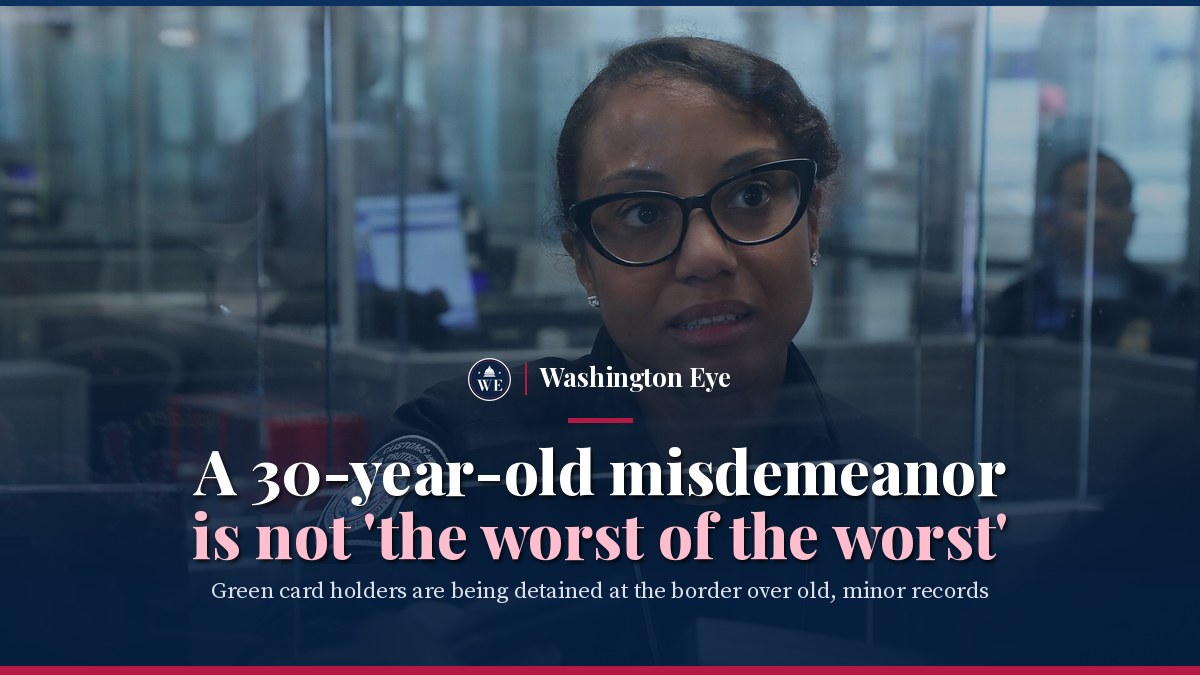
On Tuesday the Department of Homeland Security put out another of its daily releases under a familiar banner: "Worst of the Worst." It listed people arrested the day before after convictions for aggravated assault, drug importation and repeat burglary. "Every arrest of a criminal illegal alien saves American lives," Homeland Security Secretary Markwayne Mullin said. Conservatives can and should applaud arrests like those. That is what voters asked for when they sent President Trump back to the White House.
The same morning, a major American newspaper published a very different kind of enforcement story. San Juanita Guerra, a green card holder, had crossed into Mexico for three decades to fill prescriptions. Last March, at a port of entry in South Texas, officers took her fingerprints and found a weapons conviction roughly 30 years old. It was a misdemeanor. She had no criminal record in the years since. The old charge had not stopped her from renewing her status three times, and it had never come up on hundreds of earlier trips, her attorney, Wendoli Rodriguez, told the paper. She was 74 when she was detained.
Ms Guerra is not an isolated case, and she is not a criminal illegal alien. She is a lawful permanent resident. The government that is now holding her old misdemeanor against her is the same government that looked at her file and renewed her green card again and again. We believe in enforcing immigration law, firmly and without apology. That is exactly why we think this is the wrong way to do it.
A pattern, not an anecdote
The numbers suggest a real shift in practice rather than a few unlucky travellers. A nonprofit newsroom in Wisconsin, working from federal detention records, reported in May that immigration authorities detained an average of at least 100 lawful permanent residents a month between January 2025 and February 2026. That was five times the monthly average in the last two years of the previous administration, the only part of that term for which the data exist. At least 66 percent of the green card holders detained under the current administration had prior criminal convictions, compared with at least 75 percent in the late Biden years. In other words, the net is getting wider, and a larger share of the people caught in it have no conviction at all.
The same report described Everlee Wihongi, a 37-year-old green card holder from Hortonville, Wisconsin, who had held permanent residency since childhood. Returning in April from a family trip to New Zealand, her native country, she was pulled aside at Los Angeles International Airport and taken to detention over a 2014 felony marijuana possession plea. She had made the same trip at least half a dozen times since that plea without incident. Her lawyer said the conviction was not grounds for deportation and that she could have stayed and become a citizen. Once she crossed the border, though, she was judged under the stricter rules of admissibility.
A Madison immigration attorney, Aissa Olivarez, put the change plainly: customs officers have "a lot of discretion at the port of entry," she said. "They have given none lately." She described another client, a longtime Milwaukee resident detained on his way home from his wife's funeral in Egypt because of an earlier felony. He eventually accepted a deportation order rather than face a long stay in custody.
The law allows it. The Supreme Court made sure
Let us be clear about the legal position, because the critics of this policy often are not. Federal law says a returning green card holder generally "shall not be regarded as seeking an admission" to the United States. But there are exceptions, and one of them covers a permanent resident who "has committed" certain offences, including a crime involving moral turpitude. Someone in that category can be treated at the border like a new arrival, which means detention or parole and, later, removal proceedings on grounds of inadmissibility.
In June, in Blanche v. Lau, the Supreme Court ruled six to three that a border officer does not need clear and convincing evidence of such a crime before treating a green card holder that way. Justice Clarence Thomas, writing for the majority, said the Court would not add a burden "nowhere in the statute" to officers who must make "quick judgments on the spot." On the text, we think the majority was right. Judges should not invent standards Congress never wrote.
Justice Ketanji Brown Jackson's dissent, joined by Justices Sonia Sotomayor and Elena Kagan, warned that the ruling lets the exceptions "swallow the default rule." She pointed out that once a permanent resident is treated as seeking admission, the burden flips: in deportation proceedings the government must prove its case, but in inadmissibility proceedings the immigrant must defeat the charge. In the case before the Court, the man at the centre had lived for 14 years on a temporary paper document after officers took his green card at the airport. One does not have to accept her reading of the statute to see that she described the practical stakes accurately.
So the administration has the power. The question conservatives should ask is the one we ask of every other arm of government: is this power being used well?
Priorities are a conservative idea
Enforcement is not free, and pretending otherwise is the kind of thinking we criticise in every other department. The Department of Homeland Security reported last year that the average cost to arrest, detain and deport one person was roughly $17,000, though costs vary widely. Detention beds, officer hours, government lawyers and immigration judges are finite. Every one of them spent on a grandmother with a three-decade-old misdemeanor is not spent on a drug trafficker or a repeat burglar of the kind the department lists in its own press releases.
That is the real contradiction here. The administration sells its programme, correctly, as a campaign against dangerous people. Then its officers at the ports of entry spend time and money on green card holders whose offences were so minor, or so old, that the same government ignored them for decades. In the past, the newspaper report noted, charges like these would have led to a citation, not an effort to strip someone's legal status. When a policy's slogan and its results drift this far apart, the slogan stops persuading anyone.
A Homeland Security spokesperson told the Wisconsin newsroom that "possessing a green card is a privilege, not a right," and that the government may revoke one "if our laws are broken and abused." That is true as far as it goes. But a privilege granted and renewed by the government creates a reasonable expectation. A permanent resident whose file the government reviewed at renewal after renewal is entitled to believe that the state meant what it said each time it approved her. A government that changes the rules retroactively, at an airport counter, with no warning, teaches law-abiding people that legal status is worth less than they thought. That undercuts the very distinction conservatives want to defend: the line between those who came the right way and those who did not.
The politics should worry the right
There is also a hard political point. Democrats have just won a 56 to 44 Senate majority for January, completing a sweep that flipped nine seats. Immigration enforcement is one of the few issues where the Republican position still commands broad public support, and the public draws a sharp line between deporting violent criminals and detaining long-settled legal residents. Stories like Ms Guerra's are how a winning issue becomes a losing one. Every one of them hands opponents an argument against enforcement as a whole, including the parts that work and that most Americans want.
What should change
None of this requires going soft. It requires going smart. Three changes would help.
First, the department should issue port-of-entry guidance that tells officers to admit returning permanent residents whose only record is a minor offence many years old, especially one the government already reviewed at a renewal. Officers would keep full discretion for serious crimes, recent offences and anything involving violence, drugs for sale or weapons used against people.
Second, where an officer does have doubts, parole the person into the country with a court date rather than detain them. A 75-year-old who has crossed the same bridge for 30 years is not a flight risk, and holding her costs taxpayers money that could fund the arrest of someone who is a danger.
Third, Congress should do its job. Lawmakers could write a clear lookback limit for minor offences, so that a returning green card holder with a single old misdemeanor is treated as already admitted, while leaving every serious ground of inadmissibility in place. A Republican-led push for that kind of fix would show that the party's commitment to the rule of law includes predictable rules.
The administration is right to pursue the worst of the worst, and right that the courts should not rewrite immigration statutes. But a conservative government should be the first to insist that power comes with judgment. A 30-year-old misdemeanor is not the worst of the worst. Treating it as though it were does not make America safer. It only makes enforcement look arbitrary, and arbitrary enforcement is the fastest way to lose the argument for enforcement at all.