
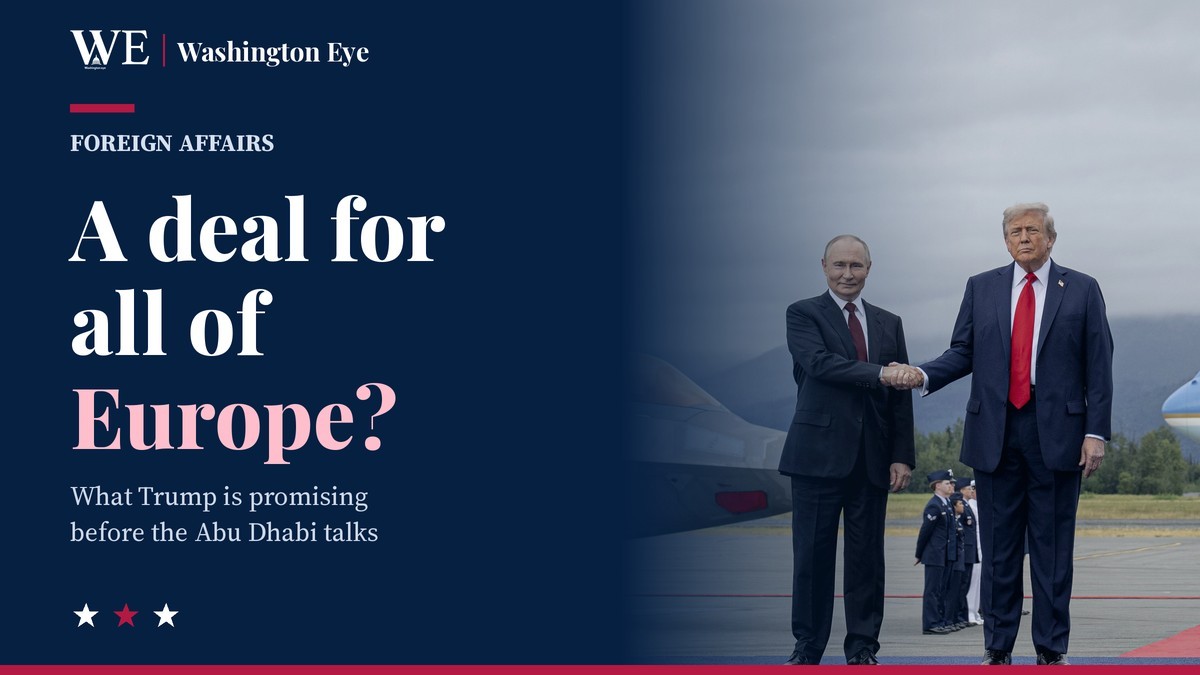
President Donald Trump has a habit of announcing agreements before anyone else can find them. On Thursday, 5 November, after a private Oval Office meeting with Kirill Dmitriev, the Kremlin envoy who runs Russia's sanctioned sovereign wealth fund, he told reporters that a settlement of the war in Ukraine was coming and that it would be larger than Ukraine itself. "It's going to involve more than Ukraine, and I could even say it might involve all of Europe," he said, adding that it would be "a big, beautiful agreement, and everyone's going to be thrilled." He declined to say what he and Dmitriev had discussed.
The remark lands at a delicate moment. On 10 and 11 November, American mediators led by special envoy Steve Witkoff and Jared Kushner are due to bring Ukrainian and Russian delegations together in Abu Dhabi for the first three-way talks since February, before the United States and Israel went to war with Iran. Russian President Vladimir Putin confirmed on Friday that his team, headed by presidential aide Vladimir Medinsky, would travel for two days of meetings. The question hanging over the Emirati capital is no longer only whether the guns in Ukraine can be silenced. It is whether Washington is now negotiating something much bigger, and with whom.
What has actually been put on paper is modest compared with the president's language. Within hours of Mr Trump's comments, Mr Kushner posted a statement on X describing the need for "a broader European security architecture" and listing five goals: permanent security consultations, reliable crisis communications, greater military transparency, reciprocal measures to reduce escalation risks, and an enduring framework for long-term European security and stability. According to RFE/RL's account of the statement, he also said every country would keep authority over its own security choices and alliances, that no state would hold a veto over another's, and that NATO would remain central to European collective defence.
Read on its own terms, that list resembles the confidence-building toolkit of the Cold War more than a new map of Europe. Rapporteur, a European news site, pointed out that it echoes elements of the 1975 Helsinki Final Act, which paired respect for borders with military transparency between East and West. Hotlines, notification of exercises and limits on deployments near frontiers are ordinary items of arms-control diplomacy, and some of them existed until Russia walked away from the agreements that contained them.
The trouble is the sequence and the company. The proposal was announced on the same day that Mr Trump met Mr Dmitriev alone, while the Ukrainian official who attended the same White House event, parliamentary faction leader David Arakhamia, was not invited into the Oval Office. The occasion itself was a celebration of a limited humanitarian ceasefire in the occupied town of Oleshky in the Kherson region, a six-day pause that the White House credits to First Lady Melania Trump. A small success on evacuation was, in effect, used as the backdrop for a much larger and much vaguer promise.
Europe's response was quick and unusually blunt. Kaja Kallas, the European Union's foreign policy chief, told reporters in Warsaw on Friday that "we already have a European security architecture in place" and that the real problem is that "Russia keeps breaking the treaties that underpin it." She added: "Putin does not have a veto over European security." Poland's foreign minister, Radoslaw Sikorski, went further, warning that an arrangement about Ukraine and Europe made "above our heads would not just be unwise. It is actually impossible." Ukraine's foreign minister, Andriy Sybiha, said the conversation should be about protecting Europe from Russia, not discussing spheres of influence with it.
Several European officials told CNN they did not know what the president was referring to. A NATO diplomat quoted by Politico Europe called the Kushner text "a bit obscure" and predicted that any talk with Moscow about a new architecture would be used by the Kremlin to legitimise its arguments. President Volodymyr Zelensky, who said he learned of the idea in a call with the American envoys, told CNN: "For me, it's not simple and it can be dangerous." His priority, he said, is to end the war first and settle guarantees second.
The European nervousness has a specific history. In December 2021, weeks before the full-scale invasion, Moscow sent Washington and NATO draft treaties demanding that the alliance roll back its forces from members that joined after 1997, which would cover Poland, the Baltic states and much of Central Europe. NATO rejected the demand on the principle that sovereign states choose their own alliances. When an American official now speaks of "reciprocal measures" and "military transparency" between Russia and Europe, governments on the eastern flank hear an echo of that ultimatum, even if the Kushner text explicitly rules out vetoes.
There is also a gap between Mr Trump's optimism and the positions the two warring sides still hold. As CNN and others have reported, Mr Putin continues to demand Russian control of the whole of the eastern Donbas region, limits on the size of Ukraine's armed forces and an end to Kyiv's ambition to join NATO. Ukraine regards those terms as proof that Moscow is not negotiating seriously. Meanwhile the fighting goes on. Earlier this week a Russian strike on a shelter where people had gathered for humanitarian aid killed at least 53 people, according to CNN, and Mr Zelensky said on Friday that Ukrainian intelligence expected new attacks on energy facilities and bridges across the Dnipro.
Kyiv's own preparation for Abu Dhabi has been practical rather than grand. Its delegation, led by Rustem Umerov, spent 4 and 5 November in Brussels with American, European Union, NATO, British, French and German officials, as well as the World Bank and private investors, working on reconstruction, the country's financing needs for 2027 and the shape of post-war security guarantees. Mr Zelensky said the aim was to have clear answers on paper about "what will be done, by whom, with what means, and when" if Russia attacks again. He has also pressed Washington for Patriot interceptors; the Kyiv Post reported that Ukraine had received only 24 from the United States over 90 days.
The administration's defenders make a reasonable case that a wider frame is not inherently a concession. Any durable ceasefire will require arrangements that Russia, Ukraine and their neighbours can all monitor, from deconfliction lines to rules on exercises near borders. A security guarantee for Ukraine that ignores what happens along NATO's eastern frontier may simply move the risk elsewhere. Mr Kushner has said the United States will consult European partners closely on the sidelines of the Abu Dhabi meeting through the so-called Shell Bay format, named after Mr Witkoff's Florida golf club, and will seek a broader multilateral format with Europe at the table if progress is made. On that reading, the president was describing a destination, not a deal already struck.
Critics see the same facts differently. They note that the White House has announced imminent breakthroughs before, that the envoy it chose to meet privately is a sanctioned Russian official, and that the language of "the security concerns of all sides" has long been the Kremlin's preferred way of describing its objections to NATO enlargement. CNN observed that the Kushner statement did not mention that it was Russia that invaded Ukraine. For allies who have spent nearly five years arguing that aggression must not be rewarded, a framework that treats Russian and European concerns as equivalent starts from the wrong premise.
There are also hard limits on what Mr Trump can deliver alone. As The Washington Post noted in its reporting on the Oval Office remarks, a unilateral pullback of American troops from Europe would face fierce opposition in Congress, including from many Republicans, and any plan built around joint economic projects with Russia would collide with European Union sanctions that Washington cannot lift. Those constraints tighten in January, when a Congress controlled by Democrats in both chambers takes office after this week's midterm elections. Members who already distrust the president's Russia policy will now chair the committees that oversee defence budgets and sanctions.
That domestic shift may matter as much as anything said in Abu Dhabi. A president weakened at the ballot box has two broad options in foreign policy: seek a quick, visible win that changes the subject, or move carefully because every concession will be examined by hostile committees. Mr Trump's language on Thursday suggested the first instinct. The structure his envoys described, with consultations, a multilateral format and explicit protections for sovereignty, leaves room for the second.
The test next week is therefore narrower than the rhetoric. The talks are being held at the level of negotiating teams, not leaders, and the Kyiv Independent reports that they will be technical negotiations that could prepare a later summit between Mr Zelensky, Mr Putin and Mr Trump. Observers will watch for three things. The first is whether Russia accepts any formula for post-war guarantees that involves Western forces or commitments in Ukraine. The second is whether the humanitarian track, including humanitarian exchanges and local ceasefires such as the one in Oleshky, can be widened. The third is whether European governments are given a defined role rather than a seat on the sidelines.
If those markers move, the president's "big, beautiful agreement" may yet acquire some content. If they do not, the episode will join a long list of announcements that ran ahead of the diplomacy behind them. Either way, the reaction from Brussels, Warsaw and Kyiv this week has made one point plain: whatever is agreed in Abu Dhabi, a settlement that reaches "all of Europe" cannot be signed without Europe.