
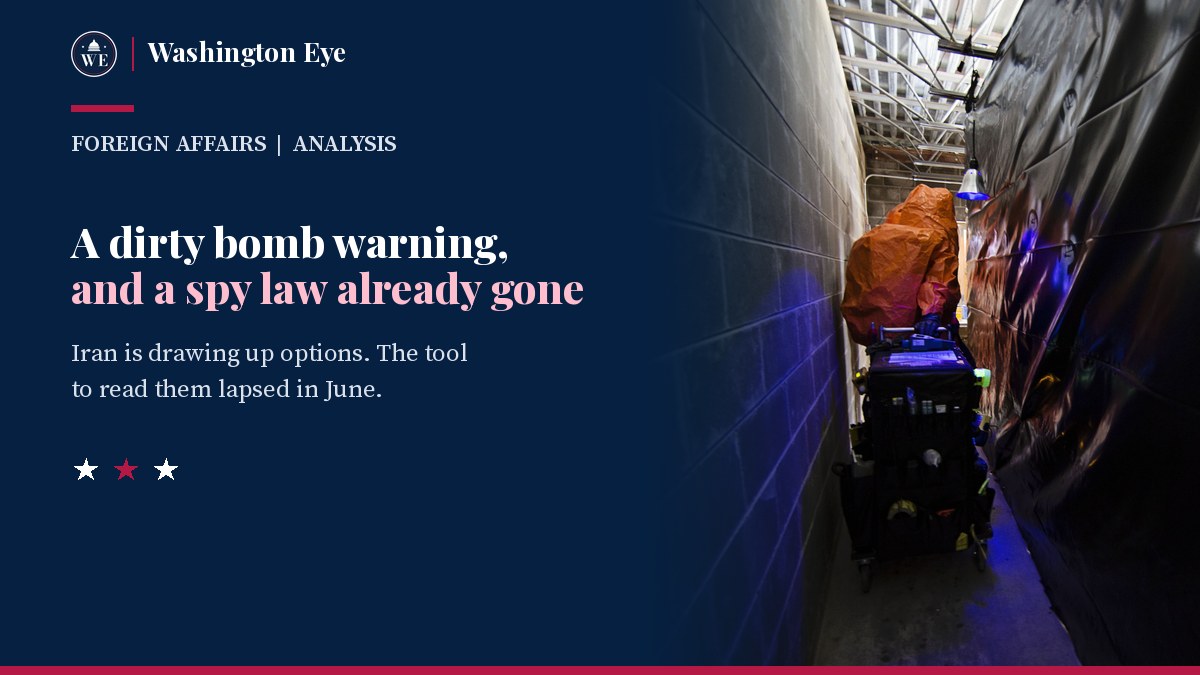
The warning reached Washington the way most frightening intelligence now does: through anonymous officials, a carefully worded White House statement and a president answering questions half a world away. According to seven US officials quoted in a report published late on Monday, new American intelligence indicates that Iran is developing plans to target senior Trump administration officials by detonating a so-called dirty bomb or a chemical weapon in the nation's capital.
Read quickly, that sounds like a city on the edge of an attack. Read carefully, it is something more complicated and, in some ways, more revealing. The same officials described the Iranian planning as an effort to give Tehran options, not as a sign that an attack is imminent. The White House says there is no credible threat to the homeland. And the most consequential detail in the story may not be about Iran at all, but about a surveillance law that Washington allowed to lapse five months ago.
What the intelligence says, and what it does not
Two of the sources told reporters that the plotting picked up by American agencies has been "very specific" and includes locations and targets. It has prompted what one called a flurry of contingency planning, including several meetings over the past week that another source described as "prudent." Officials still disagree on the central question: whether Iran can, or will, actually try to carry out such a plot.
"Whether they actually have the personnel in place to execute is a matter of debate," one of the sources said.
The administration's public line has been calmer than its private planning. White House spokesperson Lauren Bis said the United States is "monitoring any and all potential threats, but at this time there are no credible threats to the homeland." Homeland Security Secretary Markwayne Mullin, speaking in a television interview on Tuesday morning, called Iran's planning "aspirational" and said it did not amount to a new threat. "The homeland is secure, I can tell you that," he said, while adding that an attack would "cause an all-out war" with the United States.
President Trump, asked about the report in Manila during the first leg of his Asia tour, took a harder tone. "If there is, they will pay a price the likes of which no country has ever paid before," he said. "I hope it's not, but we take it very seriously, because they happen to be crazy." He then turned the moment into an argument for the war itself: "This is why they can't have a nuclear weapon, by the way, in case people had any questions."
Tehran denies the allegations. A spokesperson for Iran's mission to the United Nations said Iran "considers the use of chemical weapons under any circumstances to be wholly illegitimate" and rejected what it called "false and fabricated allegations," though the statement did not directly address the dirty bomb claim. Iran's foreign ministry spokesman, Esmaeil Baghaei, said those who started the war "are attempting to manufacture a veneer of legitimacy for further aggression and atrocities."
Capability did not change. Incentive did.
The most striking line in the reporting came from an official who argued that nothing about Iran's ability to mount this kind of attack is new. Dirty bombs, which wrap radioactive material around a conventional explosive, are not technically difficult to build. The hard part is getting the radioactive material. Officials quoted in the report said American intelligence has picked up Iranian chatter claiming that bomb-making materials have already been stashed inside the United States. They are divided on how credible that chatter is, but several believe such pre-positioning would be easy and may even be likely.
What has changed, in that official's words, is "the Iranian incentive." The war that President Trump launched in late February has been followed by months of American strikes and a naval blockade that senior administration officials describe as "devastating" Iran's economy. Diplomatic talks to end the blockade, reopen the Strait of Hormuz and halt the fighting have stalled. A regional source warned that the next several weeks will be critical for any agreement, and that hardliners or rogue elements in Tehran who have benefited from the war could try to play spoiler.
That framing matters. A regime that believes it is losing slowly has different calculations from one that believes it can wait out its enemy. One US official stressed that Iran understands the retaliation it would invite by using such a weapon, in the Middle East or in the United States. But the same official warned that if Iranian leaders come to see the survival of the regime as genuinely in question, they might decide the risk is worth taking.
It is also worth being precise about what a dirty bomb is. It is not a nuclear weapon. It does not produce a fission explosion, and experts say most casualties from such a device would come from the blast rather than the radiation. Its power lies in fear, disruption and contamination. "Any weapon like that is a weapon of terror, not a weapon of precision," one source said. "They can make people really sick and certain areas uninhabitable." In a city of close to 700,000 people that is also the seat of the federal government, even a small device could do outsized damage to daily life and to public confidence.
The fighting that frames the threat
The intelligence does not exist in a vacuum. On Tuesday, Iran's Revolutionary Guard launched drones at an American radar installation at Sheikh Isa Air Base in Bahrain, the third Iranian attempt against US military targets in the Gulf kingdom in a matter of days. US Central Command said the drones "were intercepted without any damage to US equipment or injury to American personnel." Hours later, an American fighter jet struck a Revolutionary Guard missile launch site on Iran's Qeshm Island in the Strait of Hormuz, in what a US military official called a strike "in self-defense."
The exchange broke a roughly two-month lull in direct fighting. It also came days after the Secret Service moved Treasury Secretary Scott Bessent into military housing because of threats from Iran, according to the same reporting. A separate stream of intelligence suggests Iran may consider chemical weapons against American troops stationed in the Middle East, and several officials said flatly that those troops lack adequate protective equipment or training for such an attack. A parallel effort is now under way to equip and train diplomatic and intelligence staff in the region.
Iranian plotting against American officials is not new. US authorities have tracked plans against current and former officials since the president's first term, including a murder-for-hire plot against Mr Trump in 2024. But most of that plotting focused on chances to strike officials travelling abroad. Planning that names targets inside Washington would mark a shift in ambition, even if not yet in capability.
The spy law nobody renewed
Here is the part of the story that should worry Congress most. One of the government's most effective tools for catching foreign terrorist plotting is a surveillance law that lets agencies collect foreigners' communications. That authority expired in June, during a standoff between the White House and Congress over the president's then acting director of national intelligence, Bill Pulte. Surveillance orders approved before June remain in force until March 2027. After that, unless lawmakers act, new collection of this kind stops.
Last week, Attorney General Todd Blanche, Director of National Intelligence Jay Clayton and CIA Director John Ratcliffe wrote to the Republican and Democratic leaders of both chambers urging reauthorization. Delay, they warned, would put "the lives of both Americans in the homeland and our troops stationed abroad at risk in the heightened threat environment briefed to the Gang of 8." The Gang of 8, the four congressional leaders plus the top members of the two intelligence committees, was briefed on Iran several days before that letter was sent. It is not clear whether that briefing covered the specific threat to Washington.
The lapse creates an uncomfortable picture. The administration is telling the public there is no credible threat while its three most senior security officials tell Congress the threat environment is heightened. Both can be true at once: a threat can be real in intention but not yet credible in execution. But the gap between those two messages is exactly where surveillance tools do their work, by telling officials whether "aspirational" planning is turning into something operational.
There were other signs of strain on Tuesday. Reports said the classified internal network used by the National Security Agency was down. An agency spokesperson attributed the outage to scheduled routine maintenance, and Mr Trump brushed it off in Manila: "It's fine." There is no public evidence linking the outage to Iran or to any attack. Still, it landed in a week when Washington could least afford questions about its intelligence plumbing.
What to watch
Three things will tell Americans how seriously to take this warning. The first is whether the administration's private contingency planning becomes visible, through security changes in the capital, public guidance or new protective details for officials. The second is Congress. The Senate is due to vote by Friday on a war powers resolution that would direct the president to end American involvement in the conflict, and lawmakers now face a sharper question about whether the surveillance authority they let lapse should be restored before the grandfathered orders run out.
The third is the negotiating table. Every official quoted in the reporting tied Iran's planning to pressure: the strikes, the blockade and the sense in Tehran that time may not be on its side. If talks revive, the incentive the officials worry about may fade. If they collapse, the same officials fear the war that began in the Gulf could find its way to the streets around the Capitol.
For now, the honest summary is this. American agencies believe Iran is drawing up options for an attack in Washington. They do not believe an attack is imminent. And the tool best suited to telling the difference is running on borrowed time.