
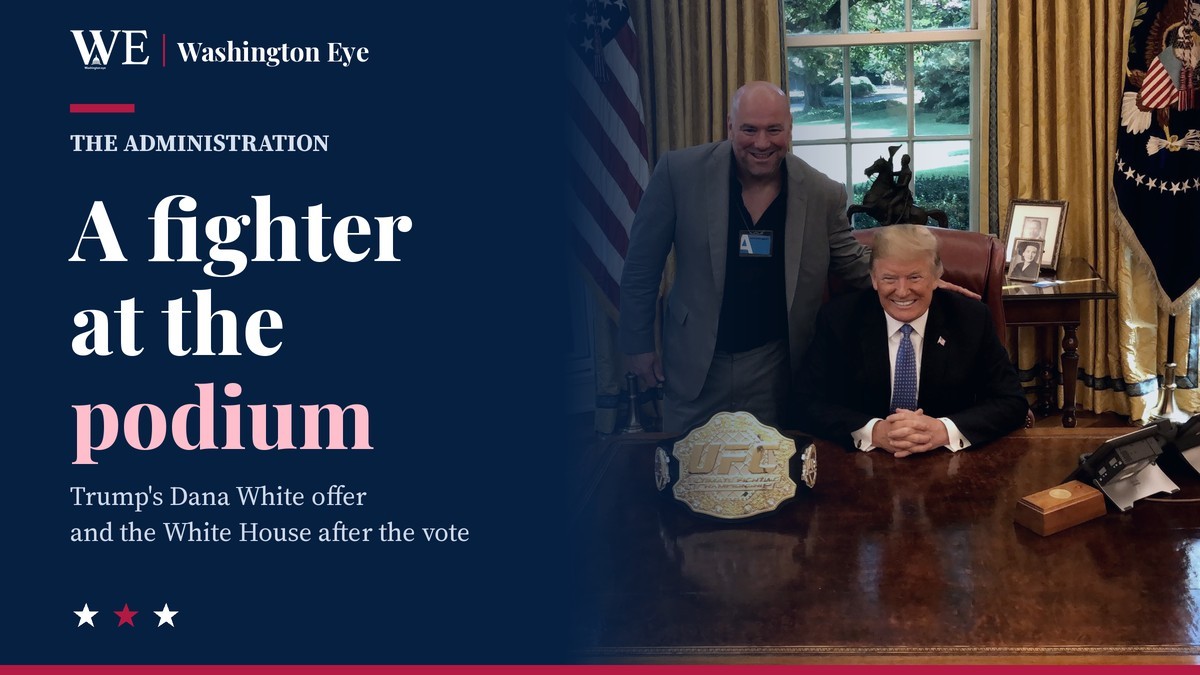
On Saturday, 7 November, four days after his party lost both chambers of Congress, President Donald Trump used his social media site to fill one of the most visible jobs in his government, or at least to say that he wanted to. "I am pleased to announce that the Great Dana White, a violent Fighter and Warrior, has been offered the job of Press Secretary of the United States," he wrote from his golf club in Florida. He added that White should bring along a team of mixed martial arts fighters as assistants, "even though some are not from our Country," and closed with a plea: "Dana, please take the job!"
White, the chief executive of the Ultimate Fighting Championship and a friend of the president for decades, was in London that evening for a boxing card promoted by his company. At the news conference afterwards he neither accepted nor refused. "I got a lot of jobs already," he said, laughing, before confirming that he was flying to Washington that night. "We have a meeting on Monday, so I'm sure we'll have more to talk about after that."
It is tempting to file the episode under presidential theatre and move on. A major cable news network reported, citing a source familiar with the matter, that White had already turned the job down, and one White House aide described the offer as a joke. Yet the message landed in the middle of a real staffing crisis, on the eve of a real reorganisation, and it tells us something about how this White House intends to talk to the country now that it faces a hostile Congress. The meeting on Monday is worth watching for that reason, whatever White decides.
Start with the vacancy. The White House has had no press secretary for more than three weeks. Karoline Leavitt, who held the job from the first day of the second term and became the youngest press secretary in American history, stepped down on 27 August to spend more time with her two young children. She has since joined a cable news network as a contributor and says she is advising the president on her replacement.
Her successor did not last. Katie Zacharia, a 41 year old conservative commentator who had worked as a senior communications adviser at the president's own media company, was announced on a Friday in October and gave her first and only briefing the following Tuesday, 13 October. It ran for roughly 14 minutes. Most of it was an opening statement listing the president's achievements, and she took questions from just three outlets, reportedly chosen in advance. She could not say whether the United States had stopped sharing intelligence with Ukraine. Within days it emerged that she had presented herself as a lawyer without having passed the bar exam.
By 16 October she was gone. The president said he had urged her to rethink. "I said to her honestly, 'If I were you, I'd reconsider,'" he told reporters. A senior official said she would move to another role, to be announced later. Trump then said he was in no hurry to name anyone else, and the podium stayed empty through the final weeks of a campaign in which he had complained publicly that his party was being hurt by bad public relations.
Leavitt has been unusually candid about what went wrong and what the president now wants. "The job obviously was not for her," she said of Zacharia in an interview with a cable news network's website in late October. Her description of the ideal candidate reads like a job specification: the president, she said, "knows he needs someone who is tough, who is smart, who understands his policies, who is loyal, and who can go out there and put up a fight."
Measured against that list, the Dana White idea is less random than it first appears. Tough, loyal and willing to fight are exactly the qualities Trump has praised in White for years. White called Trump a "fighter" during the 2016 campaign, introduced him at the 2024 Republican convention, and organised the UFC Freedom 250 card on the White House lawn on 14 June this year. He has also been widely credited with helping the 2024 campaign connect with male voters who rarely follow politics. What White is not, by any public evidence, is someone steeped in the details of tariff schedules, war powers or appropriations, the material a press secretary handles every day.
The wording of the offer is also revealing. The president framed the job as a defence force. "We need these people to defend us against the Lunatic Left," he wrote of the fighters he named: Islam Makhachev, Khabib Nurmagomedov, Justin Gaethje, Daniel Cormier, Amanda Nunes and Kayla Harrison. That is a striking way to describe a role that, in the traditional model, is about explaining policy to the public through the press. It suggests a White House that sees the next two years less as a period of governing through persuasion and more as a siege to be withstood.
That reading fits the other personnel news of the week. On Friday the president replaced his chief of staff, Susie Wiles, with Stephen Miller, the architect of his immigration agenda and among the most combative figures in his circle. Miller formally takes over on Monday, the same day White is due at the White House. We examined what the Miller appointment means for the West Wing in our earlier piece, "Miller at the Gate"; the relevant point here is that the communications operation he inherits has no chief spokesperson at the moment Democrats are preparing subpoenas. The president has also signalled that more changes are coming. "I'll be doing maybe a few changes," he told a television network on Friday.
Democrats will hold gavels in both chambers in January and have promised investigations of the administration. In that environment the press secretary is not just a spokesperson. The podium becomes the place where the White House answers, or refuses to answer, questions raised by committee hearings, document requests and testimony. A press secretary who cannot master detail, as Zacharia's single briefing showed, is a liability in that setting. A press secretary whose main asset is combativeness may be useful for rallying supporters but will struggle to rebut specific findings.
There is a reasonable counterargument. The briefing room has lost much of its central role. The president often takes reporters' questions himself and speaks directly to supporters on his own social media site. His communications director, Steven Cheung, remains in place, and he greeted the offer on a social media platform with "Hell yeah! Do it." The official White House rapid response account amplified the message too. In this view, the press secretary has become more of a performer than a policy explainer, and a celebrity promoter who has run a global sports business and fronted fight week news conferences, hostile questions included, for more than two decades is not an absurd fit.
History offers some support for an outsider, though less than the president's admirers might hope. Press secretaries have often come from outside party politics. Several were journalists, among them James Hagerty under Dwight Eisenhower and Jay Carney under Barack Obama, and Tony Snow joined George W. Bush's White House from a career as a conservative broadcaster. Ron Ziegler, Richard Nixon's press secretary, had worked in advertising and, famously, as a tour guide at Disneyland before reaching the podium at 29. What those figures shared was not political experience but a working familiarity with the news business, and in most cases a long apprenticeship in it. None arrived from professional sport.
The record on short and unconventional tenures is also instructive. Jerald terHorst resigned after about a month in 1974 in protest at Gerald Ford's pardon of Nixon. Anthony Scaramucci, a financier, lasted 11 days as communications director in 2017. Stephanie Grisham, the third press secretary of Trump's first term, never held a formal briefing at all. Zacharia's five days now set the low mark. Each of those cases shows that the job punishes people who arrive without either deep preparation or a clear mandate from the president about what the role is for.
White himself has reasons to hesitate. He runs a global sports business and has repeatedly said he has no interest in politics. Taking a federal job would likely mean giving up the business role, accepting ethics restrictions and facing reporters who would ask about everything from foreign policy to the fighters Trump named, two of whom were born in Russia. On Saturday he shared a photo of himself behind the briefing room lectern on a photo sharing app with the caption "On to the next chapter," which some read as a hint and others as a joke. The report that he had already declined, and the aide's description of the offer as a jest, point in the other direction.
The more likely outcome is that White says no, or says yes to something informal, such as an advisory or outreach role, and the search continues. The president has floated other unconventional names, including the rapper Nicki Minaj in a recent podcast interview, which suggests he enjoys the spectacle of the search itself. Each round of speculation keeps attention on the president's choice of messenger rather than on the midterm results or the investigations to come. That may be part of the point.
But the vacancy has costs. Without a press secretary, there is no single official whose words carry the White House's authority on routine questions, from troop deployments to economic data. Agencies and allies abroad read the briefing room for signals, and an empty podium leaves more room for confusion. For a White House about to face oversight from a Democratic Congress, the choice of who speaks for it will shape how every subpoena, hearing and leak is answered.
What to watch on Monday is therefore not only White's answer. It is whether Miller's first day as chief of staff brings a decision on how the White House communications operation will be organised, whether a conventional spokesperson is named alongside or instead of a celebrity, and whether the briefing room returns to regular use at all. The president's message described the job as a fight. The next few weeks will show whether the White House also wants someone who can explain.