
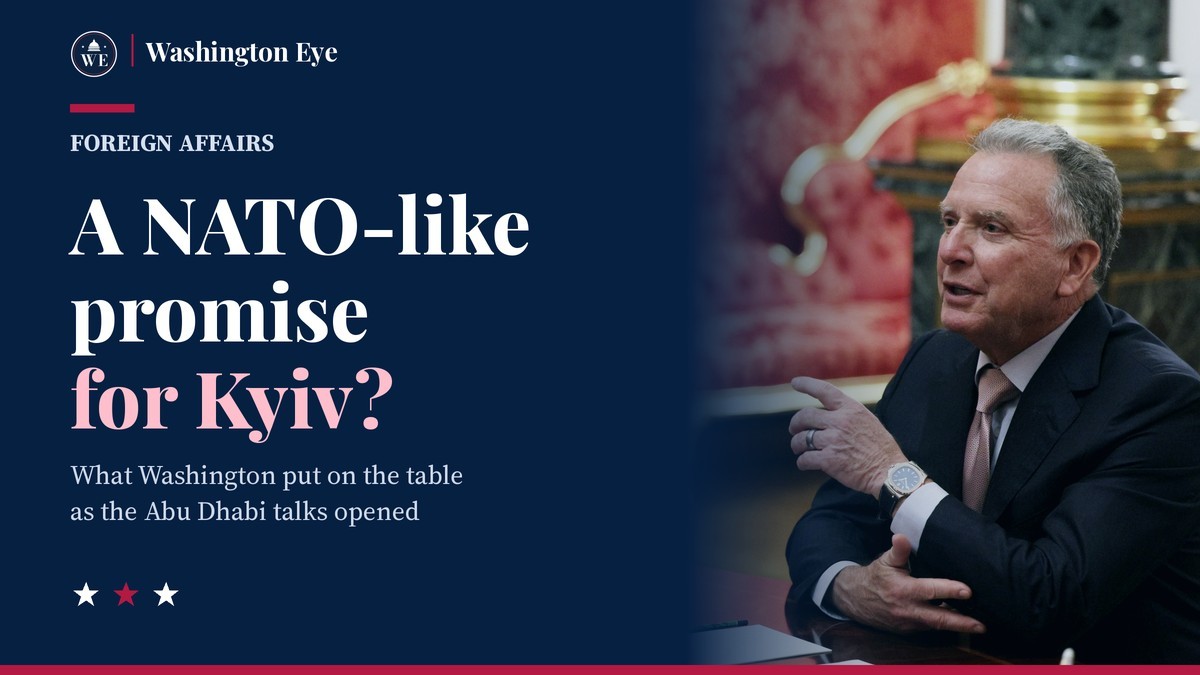
After nine months of silence, Russian and Ukrainian negotiators sat across a table again on Tuesday, this time in Abu Dhabi, with Jared Kushner and Steve Witkoff in the chair for Washington. The first day of the two day session ran for roughly four hours and ended without any announced result, which surprised nobody. What did emerge was a clearer picture of the American offer. Administration officials now say they have discussed with Moscow a security guarantee for Ukraine that would work much like NATO's mutual defence clause, alongside a revived channel between Russia and the alliance and possible relief from sanctions. That package carries both the best chance of a durable settlement so far and real risks for the allies who would have to live with it.
The talks are the first three way meeting since February, when a round in Geneva broke up without a breakthrough. Three earlier rounds this year produced none either. Since then the war has ground on toward its fifth winter, and Moscow has again been striking Ukraine's energy grid as temperatures fall. In Washington, the context has also changed. The session is the first major peace push since American and Israeli strikes on Iran, and it comes a week after midterm elections that handed both chambers of Congress to Democrats and left the president weaker at home than at any point in his second term.
## Who is in the room
The delegations are senior and familiar. Russia's team is led by Vladimir Medinsky, the presidential aide who has headed Moscow's side since the Istanbul talks of March 2022. With him are the deputy foreign ministers Sergei Ryabkov and Mikhail Galuzin, the military intelligence chief Igor Kostyukov and Yury Zhigarlovsky of the General Staff. Medinsky opened by saying his delegation “has become bigger and more professional” and that he hoped the meeting “will allow us to advance on the path towards peace in the interests of the people of Russia and the people of Ukraine.”
Ukraine sent Rustem Umerov, its chief negotiator and foreign intelligence chief, together with Kyrylo Budanov, President Volodymyr Zelenskyy's chief of staff, his deputy Serhii Kyslytsia, the parliamentary leader David Arakhamia and the deputy military intelligence chief Vadym Skibitsky. The American side included Gen. Alexus Grynkewich, the NATO commander, who pointed to “some great progress in the past in a military-to-military dialogue in a trilateral format.” The United Arab Emirates hosted the session, and its foreign minister, Sheikh Abdullah bin Zayed, appeared alongside the American envoys.
Before the Russians arrived, the Ukrainian team met the American envoys and representatives of Britain, France, Germany, Italy, NATO and the European Commission. That group issued a joint statement saying that “any future arrangements must respect sovereignty, territorial integrity, independent decision-making, and provide credible security guarantees for Ukraine.” The sequencing was deliberate. Europe wanted its red lines on the record before the trilateral session began.
## The bigger American offer
Kushner framed the talks in sweeping terms. The goal, he said in opening remarks, is to “create a new framework and a new understanding building upon the different institutions and understandings of the past.” He added: “We take what's worked, we try to identify what's failed, why we're in this position and hopefully create a new framework that leads us for decades, if not centuries, of peace.” He also said he believed there were “some good ideas how to bridge” the gap between the two sides.
On Monday, in a post on a social media platform, Kushner wrote that a “comprehensive and lasting settlement will also require direct engagement between Russia and our European partners on the broader security arrangements that affect them.” He described the framework he has in mind as one built on “stronger consultation, reliable crisis communications, greater military transparency, and reciprocal measures to reduce escalation risks, while fully respecting the sovereignty and independent decision-making of every nation.” According to reporting from Washington, the model is the NATO-Russia Council, the consultative body that was suspended after Russia's full scale invasion in 2022.
Administration officials have filled in a little more, speaking without their names attached. One said negotiators could revive that council and potentially lift sanctions on Russia to reach a deal. The same officials said they had discussed with Moscow security guarantees for Ukraine resembling NATO's Article 5, the alliance's mutual defence clause. “What they would be getting would be effectively very similar to Nato,” one official said, adding that “getting a US security guarantee is a really, really big deal.” Whether to offer it, the official said, would be up to President Trump and Zelenskyy.
Secretary of State Marco Rubio said on Monday that “there's been some advances made in what that architecture should look” like, while cautioning that the parties “obviously have to get past the conflict to get to that point.” The president has been more expansive. After meeting the Kremlin envoy Kirill Dmitriev last week, Trump spoke of “a big agreement” that is “going to involve more than Ukraine.” In a television interview broadcast on Sunday he predicted the war would end soon and that Ukraine would come out of it “a little bit different shape.”
## Why Europe is nervous
That last phrase is the core of the problem. Moscow's terms have not moved. President Vladimir Putin wants Ukraine to withdraw from the four regions Russia claimed to annex in September 2022 but has never fully captured, to abandon its bid to join NATO, to accept strict limits on its armed forces and to drop restrictions on the Russian language and on the Moscow affiliated Orthodox Church. He wants a comprehensive deal on those conditions and rejects a general ceasefire, arguing that a pause would only let Ukraine rest and rearm.
Kyiv's position is close to the mirror image. Zelenskyy, who was visiting Denmark on Tuesday, refuses to give up territory voluntarily, rejects any cap on his military and insists that a ceasefire must come first, with territorial questions settled only in a direct meeting between him and Putin. Last week he said that “issues concerning Europe's security must be discussed with the participation of European nations, all of which equally deserve guaranteed security.”
European officials fear that a broad conversation about the continent's security plays to a long standing Russian goal: a say over where NATO deploys forces in its own eastern members, the demand Moscow set out in draft treaties weeks before the 2022 invasion. Analysts quoted in American reporting described Tuesday's European security track as a risky nod to that ambition. Even a US official acknowledged that “there's a lot of baggage that people in Europe have about this idea,” while arguing that “we have to build something new that works today.”
Kaja Kallas, the European Union's foreign policy chief, repeated her scepticism on Monday, saying in an interview that Moscow had “just been pretending that they negotiate” and arguing that the problem is not missing institutions but Russia's failure to respect the agreements it has already signed. Italy's prime minister, Giorgia Meloni, complained last week about a “disorderly” tangle of meetings and phone calls that she said weakened Europe's ability to speak with one voice. A European security official from one of the countries at the talks said the US proposal was still unclear and that governments were bracing for serious concessions to Moscow.
## The case for the gamble
There is a serious argument on the administration's side, and it deserves a hearing. The architecture Kallas defends did not stop the war. Agreements on borders and sovereignty were signed and then broken, and Western sanctions, aid and diplomacy have not forced Moscow to accept anything close to Kyiv's terms in nearly five years. If the war is ultimately about Russia's view of its place in Europe, then a settlement that ignores that question may simply pause the fighting until the next crisis. Seen that way, bringing Europe and Russia into one conversation is not a gift to the Kremlin but an attempt to address the root cause.
A NATO-like American guarantee for Ukraine would also be a remarkable shift for an administration that has been openly sceptical of open ended commitments abroad. If it were real, written down and backed by Congress, it could give Kyiv more protection than years of uncertain promises about eventual NATO membership. Critics counter that Article 5 itself does not oblige allies to fight, that hybrid attacks and cyber operations blur the line for a military response, and that a guarantee from a president who has called for territorial concessions may not reassure the country making them.
## What to watch on day two
Ukrainian officials have set modest expectations. Arakhamia said he did not expect a breakthrough in the first round and was more hopeful about the second. “There has been a long pause in the negotiations,” he told a German broadcaster. “So, in terms of the domestic situation, simply resuming the talks is already an achievement.” Budanov said the focus would be humanitarian, including more prisoner of war exchanges, and Kyiv hopes to use the technical sessions to explore a maritime and energy ceasefire and lay the ground for a meeting between leaders.
Those small steps are the real test for Wednesday. A larger prisoner exchange or a pause in strikes on power stations before winter would show that the format can deliver something concrete. A grand statement about European security without them would suggest that the larger architecture is running ahead of the war it is meant to end.
There is also a question for Washington itself. Any lasting US security guarantee, any lifting of sanctions written into law and any new treaty structure would eventually run through a Congress that, from January, will be controlled by Democrats with large majorities. Many of them distrust the administration's approach to Moscow. A deal crafted by two envoys in Abu Dhabi will need more than the president's signature to survive. For now, the most that can be said is that the talking has resumed, the agenda has grown far beyond Ukraine's borders and the hardest choices have not yet been made.