
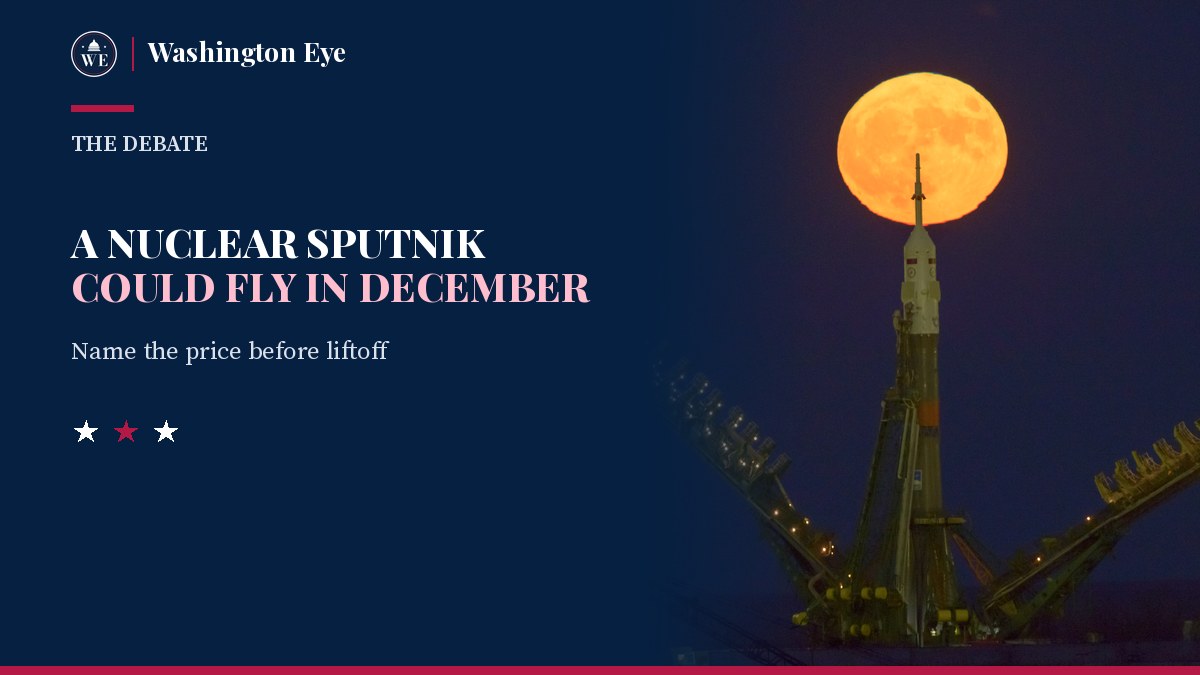
For two years the warnings came wrapped in caveats. In February 2024 the chairman of the House Intelligence Committee, Mike Turner, told colleagues about a serious national security threat, and the White House confirmed that Russia was working on an anti-satellite system built around a nuclear device, while stressing that it was not yet operational. On Monday the caveats got thinner. A joint investigation by two German public broadcasters and a Munich newspaper reported that Western intelligence services, including Germany's foreign intelligence agency and its armed forces, now believe Russia is preparing to put a nuclear-armed satellite into orbit this year.
According to that reporting, the satellite is called Sputnik-S. It was assembled years ago and has been stored in the greater Moscow area. Warnings shared among several NATO governments in early November said it could be launched within 60 days and would be ready for use soon after reaching orbit. Germany's military Space Command reportedly regards a launch in December as possible. Senior German officials, including Defence Minister Boris Pistorius, were briefed in recent weeks.
We think the West has spent long enough treating this as a hypothetical. Whether or not Sputnik-S flies next month, the time to tell Moscow what it would cost is now, before the rocket leaves the pad, not after.
What Moscow says, and what Washington already said
The Kremlin has waved the report away. "There are so many 'alleged' and 'possible' claims in it, attributed to who knows whom, that it's certainly hardly worth taking them seriously," said Dmitry Peskov, President Vladimir Putin's spokesman. The Russian embassy in Berlin called the story "unfounded allegations" and "part of a propaganda campaign", adding that Russia's space work serves "exclusively peaceful purposes".
Those denials would carry more weight if they did not sit alongside the American government's own published assessment. In October, a month before the German reporting, the Defense Intelligence Agency stated plainly: "Russia is developing a satellite designed to carry a nuclear weapon despite its obligation to comply with the 1967 Outer Space Treaty." It warned that such a weapon "could cause rapid and sudden loss or degradation of thousands of satellites" and that a detonation "would also leave lingering radiation belts, which could persist for years."
Nor did Russia help its case at the United Nations. In April 2024 the United States and Japan put a short draft resolution before the Security Council that did little more than reaffirm the existing ban on putting weapons of mass destruction in orbit. Thirteen members voted yes. China abstained. Russia, a party to the very treaty the text restated, vetoed it. A country with nothing in development rarely spends a veto protecting the option.
German Chancellor Friedrich Merz did not address the reported timing when he was asked on Monday, but his verdict was blunt. "The news that Russia is planning to arm space with nuclear weapons is not new, but that doesn't make it any less shocking," he said. "It shows the extent to which Russia is apparently prepared to escalate the situation." Standing beside him, NATO Secretary General Mark Rutte said the alliance would "defend every inch of NATO territory. And that includes making sure that we are safe when it comes to the space element."
Why one bomb in orbit is different
It is worth being precise about why this weapon matters, because it is not a weapon aimed at cities. When the Biden White House first confirmed the programme, its national security spokesman, John Kirby, said: "We're not talking about a weapon that can be used to attack human beings or cause physical destruction here on Earth." That is true as far as it goes. It is also why the threat has been easy to shrug off.
The history tells a less comfortable story. On 9 July 1962 the United States detonated a 1.4 megaton warhead about 250 miles above the Pacific in the test known as Starfish Prime. The electromagnetic pulse was far larger than scientists expected. Roughly 900 miles away in Hawaii, about 300 streetlights failed, burglar alarms went off and a telephone microwave link was damaged. Worse came later. The blast pumped energetic electrons into Earth's radiation belts, and in the months that followed six or more satellites failed, among them Telstar 1, the first commercial communications relay satellite, and Ariel 1, Britain's first satellite. In 1962 there were only about two dozen satellites in orbit or launched in the weeks after the test.
Today there are roughly 16,000 to 17,000 active satellites, by one current estimate, and most of them sit in low Earth orbit. General Stephen Whiting, the head of US Space Command, has said that a nuclear detonation there would probably knock out about a third of all satellites in low Earth orbit within the first hours to days, with the rest failing gradually over the following months. Those satellites carry navigation signals, banking timestamps, mobile networks, weather forecasting, missile warning and the targeting data modern militaries now depend on. Commercial broadband constellations, including the one Ukrainian troops have leaned on since 2022, fly in exactly the orbits at risk.
The weapon is indiscriminate. It would also blind Russian and Chinese spacecraft. That is precisely what makes it attractive to Moscow. The German investigation found that Western militaries are far more dependent on satellites than Russia's is. A Russia that has poured its money into the war in Ukraine rather than into a modern space fleet has the least to lose from a dark sky. Maj Gen Michael Traut, who commands Germany's Space Command, put the practical result simply: "We would have greater difficulty finding our targets."
Once such a satellite is in orbit, the options shrink. Intelligence assessments cited in the German reporting conclude there would be few effective countermeasures and that its use could probably not be prevented. A nuclear weapon parked in orbit can loiter for months or years, a standing threat that can be cashed in at the moment of Moscow's choosing. That is the whole case for acting before launch rather than after.
A fair objection
Not every expert is alarmed. Pavel Podvig, a researcher on Russian nuclear forces at a United Nations disarmament institute, told a German broadcaster that "the probability of such a step is extremely low" and that the information now available gives no reason to think a launch is actually planned. Leaks of intelligence can also be a form of signalling, and some analysts read Monday's disclosures as partly a message to the Kremlin that the West is watching.
We take that seriously. But the cost of being wrong runs only one way. If Mr Podvig is right and Sputnik-S stays in its hangar, a clear Western warning costs nothing. If he is wrong and the West has said nothing in advance, Moscow will have placed a weapon of mass destruction over every allied capital and dared the alliance to define its response under pressure. Deterrence works best when the price is announced before the act, not improvised after it.
What Washington should do now
First, say it out loud. The United States and its NATO allies should state jointly, and soon, that placing a nuclear weapon in orbit would be treated as a grave breach of the Outer Space Treaty and of the 1963 ban on nuclear tests in space, and as a direct threat to allied security, with consequences set out in advance. Ambiguity has its uses in nuclear strategy. This is not one of them. As of Monday night we could find no fresh public statement from the White House on the German report. That silence should end.
Second, put Beijing on the spot. China operates the second largest fleet of satellites in the world and would be the biggest loser after the United States from a nuclear blast in low orbit. Its leaders have said nothing publicly about Russia's programme, and its diplomats abstained rather than vote for a ban in 2024. Washington should make China choose, in public, between its friendship with Moscow and the safety of its own spacecraft.
Third, keep this off the bargaining table. With talks over Ukraine and a war with Iran crowding the agenda, there will be voices urging restraint so as not to complicate diplomacy. But a weapon of this kind is not a chip to be traded for a ceasefire line. Russia should gain nothing from threatening to break a treaty it has signed.
Fourth, build a sky that can take a punch. The United States has already moved in this direction. In September, Air Force Secretary Troy Meink acknowledged for the first time that Washington has deployed "on-orbit space control weapons" to defend its forces and systems. Large constellations of small satellites can absorb attacks that would cripple a handful of expensive ones. The same thinking needs to reach civilian life. Germany's interior ministry confirmed to the investigators that it has no concrete plan for a widespread satellite outage. Few allied governments could honestly claim much better. Backup timing and navigation, hardened ground systems and regular outage drills are cheap compared with the alternative.
The real test
Russia's behaviour in orbit has been growing bolder for years. It has tested a weapon that fires projectiles from one satellite at another, and in October one of its spacecraft drew very close to a Finnish commercial radar satellite that supplies imagery to Ukraine before backing away. A nuclear satellite would be a step beyond all of that, from harassment to holding the world's infrastructure hostage.
The Outer Space Treaty has kept nuclear weapons out of orbit for almost six decades because both superpowers decided the sky was too valuable to turn into a minefield. If Moscow is preparing to tear up that bargain, the free world should not wait to read about the launch. It should tell the Kremlin now, plainly and together, that the price will be high, and then make sure it is.