
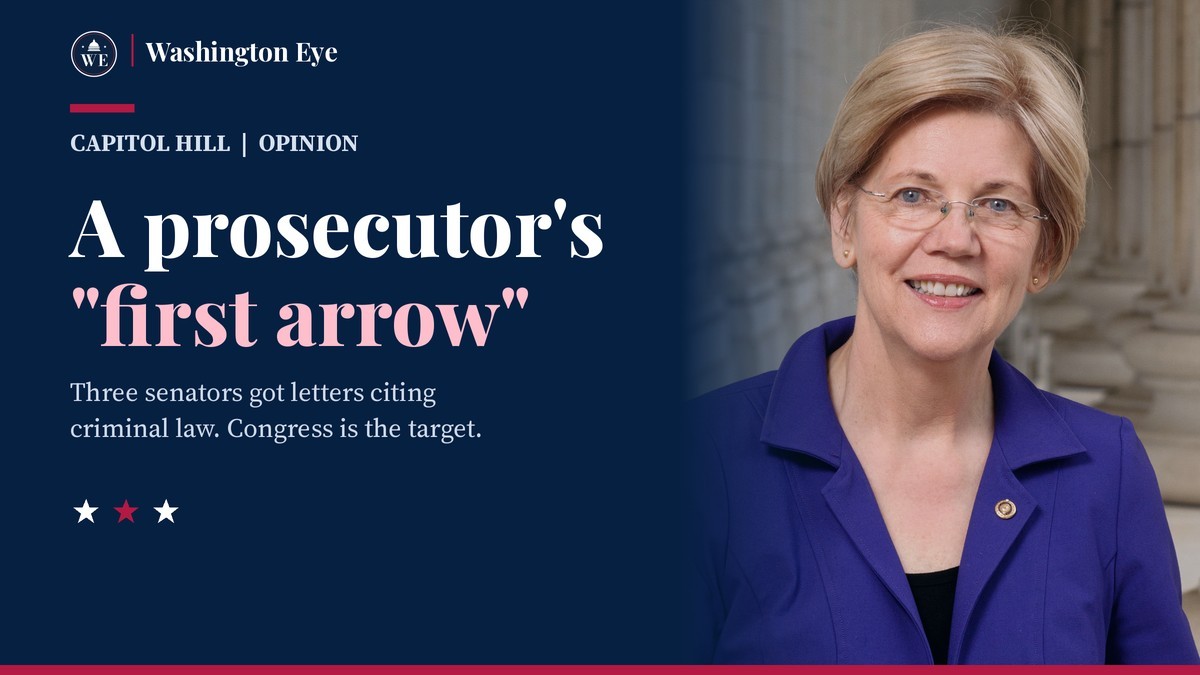
On Sunday, a federal prosecutor in Texas posted a letter to Senator Elizabeth Warren and added a caption that left little to the imagination. Warren, he wrote, was "on the warpath" and planned to use her committee gavel "like a tomahawk." He signed off the post with four words: "My first arrow shot." Later that day, President Donald Trump shared it with his own followers.
It would be easy to dismiss this as a crude joke about Warren's past claims of Native American ancestry dressed up as legal correspondence. That would be a mistake. The letter is the third of its kind in five days from the same office, each aimed at a Democratic senator who plans to investigate the administration next year. Together with a warning from the White House counsel a week ago, they amount to something new: an effort to treat congressional oversight as a possible crime before a single hearing has been held.
Democrats should refuse to be frightened by it. Republicans who believe in a strong Congress should say so out loud, because the precedent being set will not stay in one party's hands.
The author of the letters is Aaron Reitz, the US attorney for the Southern District of Texas. He was chosen for the post by the district's federal judges and sworn in on July 9, so he has never faced a Senate confirmation vote. Before that he was chief of staff to Senator Ted Cruz and a senior aide to Texas Attorney General Ken Paxton.
His first letter went to Senator Richard Blumenthal of Connecticut on Wednesday, November 11. It pointed to Blumenthal's October letters asking donors to the new White House ballroom what they had given and why, and accused him of an "intent to deprive citizens of their core constitutional rights." Reitz cited two federal criminal statutes, 18 U.S.C. 241 and 242, ordered Blumenthal to preserve records held by his staff, consultants and campaign personnel, warned of "significant legal consequences," and set a deadline of November 18. The next day he sent a similar letter to Senator Elissa Slotkin of Michigan over her promise to "go hard on accountability," telling her that her oversight plans "seem to have no legitimate legislative purpose and may therefore be unlawful." Her office said the letter appeared online before she received it.
Then came Warren. Reitz cited a television interview on November 8 in which she said that companies making "profits by cheating American families" should "get ready for some investigations, serious ones." Asked whom she had in mind, she answered: "Anyone who has been cheating." He also cited a November 11 letter that Warren, Blumenthal and Representative Robert Garcia of California sent to Meredith O'Rourke, a leading Trump fundraiser. Reitz called it a demand for "sweeping information" about private citizens. He gave Warren until 6 p.m. Eastern time on November 23 to confirm that she has preserved her records.
Look at what the O'Rourke letter actually says, because it is the heart of the matter. The lawmakers write that she has reportedly coordinated more than $800 million in contributions to projects the president favours, including the ballroom and his presidential library. They list companies that gave and then received something from the government. A bank and a carmaker each donated $1 million to the 2025 inaugural fund, after which the consumer finance regulator dropped a lawsuit against one and ended a consent order against the other. A defence contractor gave more than $10 million to the president's projects and was later awarded a missile contract worth up to $35 billion. A consumer watchdog group found that 14 corporate donors to the ballroom had won more than $50 billion in new or expanded federal contracts. The letter asks questions, requests answers by November 25 and says plainly that the lawmakers are weighing whether federal ethics and bribery laws are strong enough.
That is not a witch hunt. It is a textbook description of legislative oversight: gather facts about how money moves around the presidency, then decide whether the law needs changing. The Supreme Court described exactly this power in Trump v. Mazars in 2020, when it said a congressional inquiry must be "related to, and in furtherance of, a legitimate task of the Congress." Writing ethics law is about as legitimate a task as Congress has.
The statutes Reitz invokes make the overreach plain. Section 241 punishes two or more people who conspire to "injure, oppress, threaten, or intimidate" someone in the exercise of their constitutional rights. Section 242 punishes officials who willfully strip someone of those rights under color of law. They are the laws used against officials who abuse citizens. Jenny Carroll, a criminal law professor at Texas A&M University, called their use here "a total misapplication of that law," noting that they "were really designed to protect citizens" from abusive state actors. Tim Stretton, who directs congressional oversight work at a nonpartisan government watchdog group, was blunter: "These letters are meritless."
There is also the Constitution itself. Article I says that for "any Speech or Debate in either House," members of Congress "shall not be questioned in any other Place." Stretton argues the letters fly in the face of that clause, and it is hard to see how they do not. A prosecutor demanding that senators preserve evidence of their own inquiries, under threat of criminal statutes, is about as direct a form of questioning as one can imagine.
The administration's defenders have a real argument, and it deserves a fair hearing. The same Mazars decision says Congress may not use subpoenas for "law enforcement," a job that belongs to the executive branch and the courts, and that people who receive subpoenas keep their constitutional rights. Trent McCotter, the acting deputy attorney general, put the case this way: "The First Amendment expressly prohibits Congress from infringing the speech and association rights of Americans." White House communications director Steven Cheung accused Warren of seeking to "weaponize" her position against people "simply close to President Trump." Donating to a ballroom is not a crime, and private citizens may support a president without being hauled before a committee for sport.
All of that is true, and none of it justifies these letters. The remedy for an abusive subpoena already exists: the recipient goes to court, as Trump himself did in the Mazars case, and a judge decides. No subpoena has been issued to anyone. Democrats do not yet control a single committee. What Reitz is policing is not conduct but intent, inferred from interviews, press releases and a letter full of questions. The executive branch is not the referee of whether Congress may ask questions about the executive branch.
Nor are the letters isolated. On November 9, White House counsel Will Scharf told Garcia, the likely next chair of the House Oversight Committee, that some investigations "may cross the line into blatant criminality." Shortly after the midterms, the president publicly urged Attorney General Todd Blanche to investigate Democrats over their promised oversight and named Slotkin. Last year, prosecutors sought charges against Slotkin and five other Democratic lawmakers over a video telling service members they could refuse illegal orders; a grand jury declined to indict. And on Sunday, Stephen Miller, one of the president's most senior aides, reposted the Warren letter with a caption that consisted only of the two statute numbers.
Blanche himself has wavered. In a television interview he said "there could be" a crime if Democratic rhetoric turned threatening. A few days later, in Missouri, he said: "Congress has oversight authority. It always has, it always will." If that second statement is the department's real view, the attorney general should say so to the US attorney who keeps posting letters suggesting otherwise.
The most persuasive voice on this may be a Republican. Representative James Comer of Kentucky, who as Oversight chairman ran a wide-ranging investigation of former President Joe Biden and his family, said last week that there will always be "a strong desire for the Oversight Committee to be a check and balance on the executive branch, regardless of the political scenario." Imagine the Biden Justice Department answering that inquiry with letters citing civil rights crimes. Republicans would have called it an attack on Congress, and they would have been right.
So what should Democrats do? First, refuse to blink. Blumenthal's answer is a good model. He called the "implied threat of an investigation" baseless, said he "will not be intimidated," and asked Reitz to preserve his own communications with the White House and senior Justice Department officials about the decision to send the letter. Warren should answer in the same spirit, and every Democratic senator should say publicly that a threat against one committee chair is a threat against all of them.
Second, be disciplined, because discipline is the best defence. The legal question in any future fight will be legislative purpose. Democrats should tie every request to a bill or a gap in the law: ethics rules for presidential fundraising, disclosure for donations to projects linked to the White House, limits on contractors who give to them. They should put those reasons in writing at the start. The outgoing Republican Representative Thomas Massie, no friend of the president, offered fair advice last week: "I hope they have real hearings about real things, not another Russia-gate." Fewer, better hearings with clear findings would prove the point.
Third, drop the swagger. Garcia's advice to Trump officials to "lawyer up" and Warren's warnings to executives may have thrilled supporters, but they also handed Reitz the quotes he now uses as evidence of bad intent. Voters elected a Democratic Congress to find facts, not scalps. The best answer to a prosecutor who talks about arrows is a committee that talks about documents, dates and dollars.
The deeper stakes reach beyond this president or this Congress. If a single US attorney can open a paper trail against senators for announcing what they plan to investigate, every future administration will have a template for frightening its overseers. Today the target is a Democrat asking who paid for a ballroom. Tomorrow it could be a Republican chair questioning a Democratic White House.
Warren has until November 23 to reply. Blumenthal's deadline falls on Wednesday. The right reply is the same in both cases: the records will be kept, the questions will be asked, and the Constitution, not a prosecutor in Texas, will decide where the line falls.