
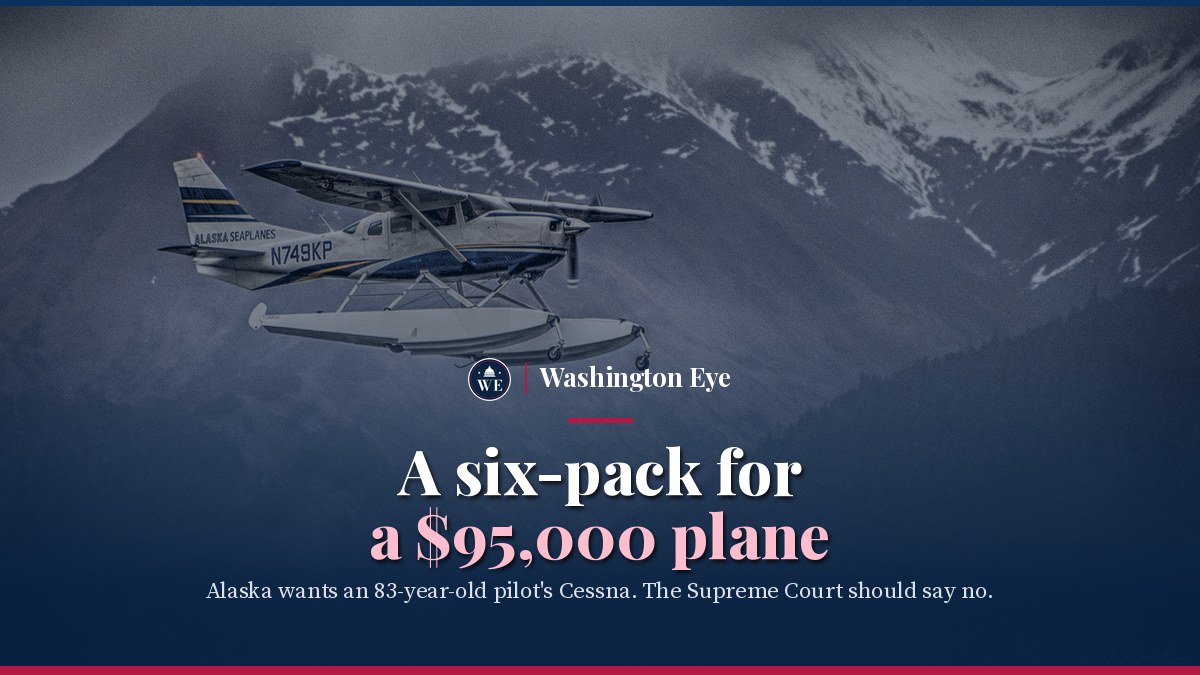
On the morning of April 3, 2012, Ken Jouppi was loading a 1969 Cessna 206 at a Fairbanks airstrip for a charter to Beaver, a village on the Yukon River about 14 miles below the Arctic Circle. He had been flying the Alaskan bush since the 1970s, running a one-man air taxi called AirKen that carried tourists, locals, groceries and fuel to places no road reaches. Before he could take off, state troopers holding a search warrant searched the plane and found 72 cans of beer among a passenger's groceries.
Beaver is a dry village. It is one of 71 Alaskan communities that use a state law to ban the importation of alcohol, according to the state's Alcoholic Beverage Control Board. The beer belonged to a repeat customer flying in to spend her birthday with her husband, who was then the village postmaster. Mr Jouppi said he did not know it was there. Troopers said at least one six-pack of Budweiser sat visibly in a grocery bag. A jury convicted him of a misdemeanor, knowingly transporting alcohol into a dry community, and the judge gave him the minimum the law allowed: three days in jail and a $1,500 fine. His company was fined another $1,500. He was 70, with a clean record.
That should have been the end of it. It was not. Alaska law makes forfeiture of an aircraft used to import alcohol into a dry village mandatory, even for a first offence, and the state has spent the fourteen years since trying to take the plane, which the trial court valued at $95,000. Mr Jouppi is now 83. On Tuesday, December 1, at ten in the morning in Washington, his case, Jouppi v. Alaska, will be argued before the Supreme Court of the United States.
We think the justices should rule for the pilot, and we think conservatives in particular should want them to. This is not a case about whether dry villages may stay dry, or whether bootlegging into the bush is a real harm. It is. It is a case about whether the Constitution's ban on excessive fines means anything once a legislature has decided that a crime is serious in general.
A very old rule
The Eighth Amendment says that "excessive bail shall not be required, nor excessive fines imposed, nor cruel and unusual punishments inflicted." The middle clause is the forgotten one, but it is the oldest. Magna Carta in 1215 promised that a free man "shall not be amerced for a small fault, but according to the measure thereof." The English Bill of Rights of 1689 banned excessive fines after the Stuart kings used ruinous penalties against their critics. The founders carried that promise into the Bill of Rights because they understood something that remains true: most punishments cost the state money, but fines and forfeitures earn it money. That is a standing temptation to punish too much.
The modern Supreme Court has only rarely tested the clause. In United States v. Bajakajian in 1998, Justice Clarence Thomas wrote for a five to four majority that "a punitive forfeiture violates the Excessive Fines Clause if it is grossly disproportional to the gravity of a defendant's offense." In Timbs v. Indiana in 2019, a unanimous court held that the clause binds the states too. Tyson Timbs had pleaded guilty to selling $400 worth of heroin; the state tried to keep his $42,000 Land Rover, even though the maximum fine he faced was $10,000. Indiana's courts eventually ordered the vehicle returned.
Alaska does not dispute that taking Mr Jouppi's plane is a fine for constitutional purposes. The only question is whether it is excessive, and that turns on a deceptively technical point: when a court weighs "the gravity of the offense", does it look at what this defendant actually did, or at the harm the crime causes across the whole state?
Gravity at thirty thousand feet
The case's own history shows why the answer matters. The trial judge held a hearing, looked at Mr Jouppi's conduct and ruled the forfeiture unconstitutional. Even assuming he knew about all of the beer, the court found, the amount sat at the low end of the misdemeanor range and was plausibly for personal or family use; it was "easy to imagine much more egregious" violations. The state court of appeals agreed that the focus should be on his specific culpability and sent the case back for more fact finding. Then the Alaska Supreme Court reversed and upheld the forfeiture as a matter of law.
It did so by weighing the offence in the abstract. "It is clear to us that the legislature determined that the harm from even a six-pack of beer knowingly imported into a dry village is severe enough to warrant forfeiture of an aircraft," the court wrote. The quantity, in other words, did not matter. Neither did the passenger's ownership of the beer, nor the pilot's record, nor the fact that the plane was his livelihood.
His lawyers at the Institute for Justice, the public interest firm that also won the Timbs case, put the problem bluntly in their brief. "Under the standard below, the gravity of the offense is the same whether you're dealing kilos of cocaine or giving your spouse an Ambien," they wrote. "Or, in Alaska, whether your offense involves sixty pallets of whisky or a six-pack of Budweiser." They note that the plane is worth more than nine times the maximum fine he could have been ordered to pay. The federal appeals court whose territory includes Alaska, the Ninth Circuit, takes the opposite view from the Alaska Supreme Court: judges must "review the specific actions of the violator rather than by taking an abstract view of the violation." That split between a state's highest court and the federal circuit covering the same state is exactly the kind of conflict the justices exist to resolve.
The abstract test proves too much. Measured against the statewide toll of alcohol abuse, from crime and addiction to fetal alcohol syndrome and death, almost no penalty for almost any alcohol offence could ever be excessive. A clause that can never be violated is not a protection. It is a decoration.
The administration picked the wrong side
Here is the part that should trouble readers on the right. The Trump administration has joined the case on Alaska's side, and the court has allowed the Solicitor General to share the state's argument time. The Justice Department argues that the United States has a long history of authorising the forfeiture of vehicles used in crimes, and that forfeitures required by statute differ from monetary fines, where judges enjoy wide discretion.
We understand the institutional reflex. Federal prosecutors defend large fines and forfeitures every day, and a more demanding test would make their work harder. But an administration that campaigns against an overbearing federal bureaucracy, and a movement that has spent years warning about government weaponised against ordinary citizens, should be uncomfortable defending the proposition that a legislature can declare any offence grave enough to justify taking a man's means of earning a living, no questions asked. The historical argument cuts the other way too. The tradition the founders inherited was one of measuring the penalty against the fault. Mandatory forfeiture, by design, refuses to measure at all.
Look at who is standing with the pilot. More than two dozen organisations and individuals filed friend of the court briefs in the case, and those backing Mr Jouppi include the Cato Institute, the Pacific Legal Foundation, the National Taxpayers Union Foundation, the U.S. Chamber of Commerce and Oklahoma's Republican governor, Kevin Stitt, alongside criminal defence lawyers, a reform minded prosecutors' group, the National Air Transportation Association, legal historians and Tyson Timbs himself. When free market think tanks, the business lobby and reform minded prosecutors land on the same side of a constitutional question, the government should at least ask itself why.
The strongest case for Alaska
Fairness requires stating Alaska's best argument, and it is a serious one. "The Alaska legislature made a reasonable judgment to mandate forfeiture to stop the scourge of alcohol-induced injuries and crimes in Alaska's most isolated villages," the state told the court. "Jouppi fell within the class of defendants principally targeted by the law." In villages where an air taxi is often the only way in, pilots are the natural choke point. Bajakajian itself said that judgments about appropriate punishment "belong in the first instance to the legislature."
There is also a factual wrinkle that the pilot's admirers tend to skip. A commentary published this week by two defence lawyers, one a former federal prosecutor, noted that Mr Jouppi was not stopped by chance: he was under surveillance for allegedly moving alcohol to dry villages on numerous occasions, and the plane carried 72 cans, not six. Those allegations were never tested for this purpose, because the criminal trial only needed to show he knowingly carried some beer.
But that wrinkle is an argument for our side, not against it. If Mr Jouppi was a serial bootlegger, a court applying an individualised test could say so, find the facts and uphold the forfeiture on the strength of them. The trial judge looked and concluded otherwise. What the Alaska Supreme Court did instead was declare that none of it mattered, that a pilot who knew of one six-pack deserved the same penalty as a smuggling ring. A proportionality test that ignores the defendant's actual conduct is not deference to the legislature. It is abdication by the courts.
Why it reaches beyond the bush
Few readers will ever fly a floatplane into a dry village. Many more own a car, a truck, a boat or a business that some statute somewhere makes subject to forfeiture. Forfeiture has grown sharply in recent decades under laws that let agencies keep the proceeds when seized property is sold. The Excessive Fines Clause is often the only meaningful check, and it usually cannot be raised until the government has already won, which is why so few such cases ever reach the top court. If the justices accept Alaska's abstract test, legislatures will have a simple formula for escaping the clause altogether: declare the problem grave, make the forfeiture mandatory, and let the value of the property fall where it may.
A ruling for Mr Jouppi would not empty the forfeiture laws. It would require judges to do what the trial court did years ago: look at the person in front of them, weigh what he actually did, and ask whether the punishment bears some real relationship to it. That is not judicial activism. It is the oldest rule in the Anglo-American law of punishment, and conservatives who claim to read the Constitution as written should insist on it.
A decision is expected by early summer. Until then Mr Jouppi, at 83, waits to learn whether a six-pack in someone else's grocery bag can cost him his plane. The court should tell Alaska, and the Justice Department, that it cannot.