
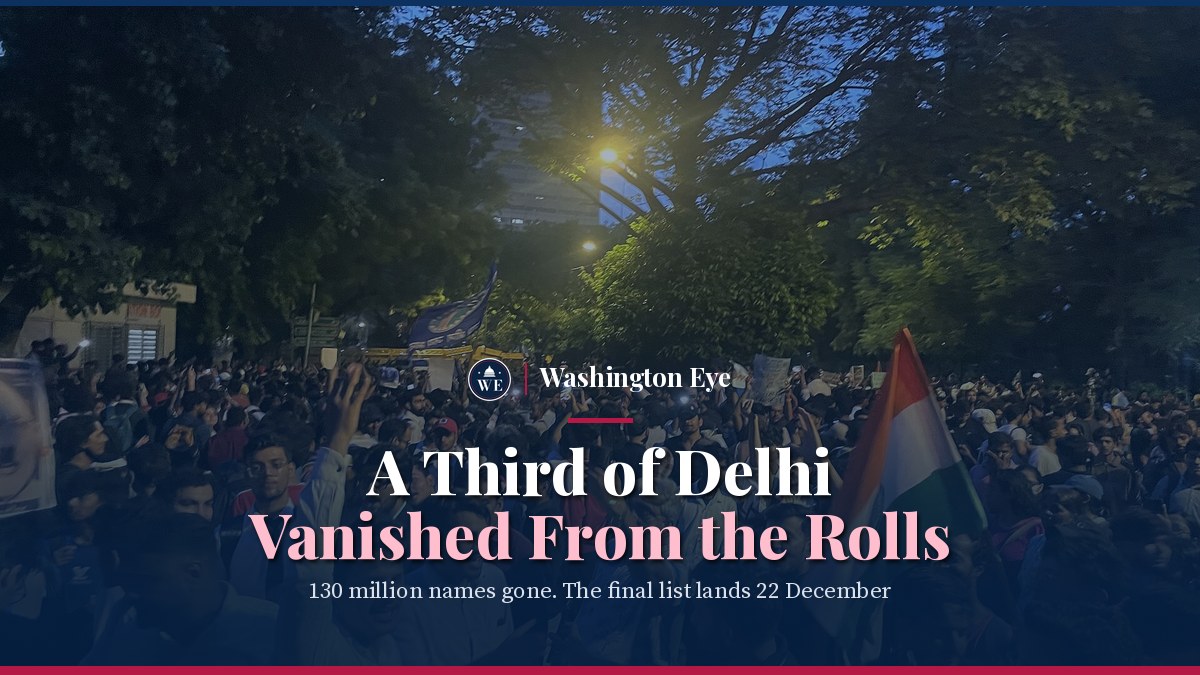
On Wednesday a deadline passed in India that most of the world did not notice. It was the last day for citizens to file objections and corrections to the largest clean up of voter rolls ever attempted in a democracy. More than 130 million names have been struck off during a nationwide recheck of India's nearly one billion registered voters. In Delhi alone, 4.76 million people, close to a third of the capital's electorate, have been removed. The final rolls are due on 22 December.
Behind those figures sits a fight that has filled the streets of Delhi, Mumbai and Kochi since October, put a youth movement named after cockroaches at the centre of Indian politics and drawn in an American technology giant. Here is what is happening, who is arguing what, and what to watch over the next four weeks.
What exactly is the Election Commission doing?
The commission, which runs every national and state election in India, ordered in June 2025 that every voter on the rolls be rechecked. The exercise is officially called a Special Intensive Revision. Its stated aim is to clear the lists of the dead, of duplicate entries, of people who have moved and of what the June 2025 order called "foreign illegal immigrants." It has been rolled out in phases across states and union territories. In Kerala, for example, around 900,000 names were removed when the state's final roll was published in February, leaving more than 26.9 million voters.
Figures drawn from Election Commission data show that of the roughly 130 million deletions nationwide, about 63 million involved people recorded as having relocated and about 30 million involved people who could not be traced. The commission has denied favouring any party.
Why are so many people angry?
Critics argue that the recheck shifts the burden of proof onto ordinary voters, and that the people least likely to hold the right documents, the poor, women, migrants and minorities, are the ones most likely to be dropped. Human Rights Watch has reported that the purge has fallen disproportionately on women, the poor and Muslims. In one area of West Bengal where Muslims are about nine per cent of the population, the group found that more than 92 per cent of those deleted were Muslim. Opposition leaders call the exercise a back door version of the National Register of Citizens, a citizenship list that the governing Bharatiya Janata Party promised in 2019 to extend across the country.
The government's side is just as firm. The party of Prime Minister Narendra Modi strongly backs the recheck, saying it is needed to remove undocumented migrants from neighbouring Bangladesh who have slipped onto the rolls. Home Minister Amit Shah has defended it as a way to "detect, delete, deport" what he calls infiltrators. The party accuses its opponents of trying to undermine Indian democracy by questioning a legitimate electoral process.
Why is the election chief himself the target?
Chief Election Commissioner Gyanesh Kumar both referees India's elections and runs the recheck. He was chosen in February 2025 under a 2023 law that gave the prime minister more say over appointments, and the decision was announced late at night over the written dissent of opposition leader Rahul Gandhi.
The anger turned personal in late September, when a national daily reported that Mr Kumar's two fellow commissioners, Sukhbir Singh Sandhu and Vivek Joshi, had raised objections on record at least 14 times in 10 months to recheck decisions and orders that they said were issued in the commission's name without their knowledge. The commission responded that all of its decisions on the recheck were unanimous and that differing views in internal deliberations are normal. The Congress party demanded Mr Kumar's removal on 23 September, and a public interest petition in the Supreme Court is seeking action against him and an inquiry into the deletions.
Who are the cockroaches?
The Cockroach Janta Party is not, despite its name, a registered party. It began in May as a social media account created by Abhijeet Dipke, a 30 year old from Maharashtra who was studying in Boston, after the Chief Justice of India compared some young people to cockroaches. The account reportedly drew about 20 million followers within a day. With two friends, Ashutosh Ranka and Saurav Das, Mr Dipke turned it into a street movement that protested against a leaked national medical entrance exam in the summer, a campaign that ended with the resignation of the education minister in July.
In late September the group gave Mr Kumar 48 hours to resign, and when he did not, it took to the streets on 2 October, the birthday of Mahatma Gandhi. Its demands go further than one resignation: an end to the recheck, restoration of the January 2025 voter rolls and repeal of the 2023 appointments law.
The state's answer has been tough. On 10 October police detained more than 2,000 people in Delhi, including opposition figures and journalists, and around 600 in Mumbai, while mobile internet was cut in the centre of the capital. A well known online commentator, Dhruv Rathee, was taken from his family's home near Delhi that morning and held for most of a day before being released without charge. He later said in a video that he had been "kidnapped, not detained." Police said the detention was preventive because the protest had no permission. Two days later Jantar Mantar, Delhi's traditional protest square a short walk from Parliament, was removed from the list of places where demonstrations are allowed.
The movement has kept its protests nonviolent and has spread them. In early November it marched in Kochi in Kerala. On 14 November it named coordinators across ten zones, including Uttar Pradesh, which holds state elections next year, and it says its membership has passed 1.5 million, a figure a senior member admitted still needs to be verified. Mr Ranka insists the aim is pressure, not a new party. "We are very effective as an independent pressure group and we are going to continue with that," he said in recent days. The wider opposition alliance, known as INDIA, has also brought tens of thousands onto the streets to demand Mr Kumar's resignation.
Where does an American tech company come in?
Since last Friday the youth wing of the Congress party has been protesting at the offices of Meta, the American owner of several of the world's biggest social media apps, in Hyderabad, Mumbai and Gurugram, clashing with police near some of them. It wants accounts that were taken down on government orders restored and an explanation of how the company's algorithms restrict political posts. Posters in several cities have shown chief executive Mark Zuckerberg in the uniform of the Rashtriya Swayamsevak Sangh, the Hindu nationalist organisation that is the ideological parent of the governing party.
Meta's top executives in India met Congress leaders on Tuesday to try to calm things down, according to people familiar with the talks. The company says it moderates content in line with Indian law and is neutral between parties. Its own disclosures show the scale of the pressure: it restricted more than 5.4 million posts or accounts under local law in the first half of 2026, up from about 70,000 in the whole of 2025, a jump it attributes to amended rules requiring faster and more proactive takedowns.
Why should anyone outside India care?
India is the world's most populous democracy and one of Washington's most important partners in Asia. How it manages its voter lists will shape the legitimacy of state elections in 2027 and the general election due by 2029. When a United Nations body urged the authorities to respect the right to peaceful assembly after the October crackdown, India's foreign ministry called the statement "selective" and "an unwarranted interference" in its internal affairs. That reaction is a reminder that outside pressure is likely to harden positions in New Delhi rather than soften them.
There is also a commercial thread that runs straight to the United States. American platforms are now caught between a government demanding more takedowns and an opposition accusing them of bias. How Meta handles that squeeze in its biggest market by users will be watched by every technology company operating in large democracies with assertive governments.
What to watch next
First, the numbers. Once the objection window has closed, the key question is how many of the deleted names are restored before the final rolls appear on 22 December. If millions remain missing, expect the opposition to argue that eligible citizens have been disenfranchised, and expect the government to say the rolls are finally clean.
Second, the courts. The petition before the Supreme Court over Mr Kumar and the deletions could become the most important venue for the dispute, and any order on the scale or method of the recheck would carry national weight.
Third, the street. The Cockroach movement has promised what its legal head called "maximum pressure" through both dates. Whether the authorities answer with dialogue or another round of detentions will say a great deal about where India's democracy is heading.
And finally, the platforms. If Meta concedes anything to the opposition, the government may push back. If it concedes nothing, the protests outside its offices may grow. Either way, a fight that began over voter lists in Delhi has already reached the boardrooms of Silicon Valley.