
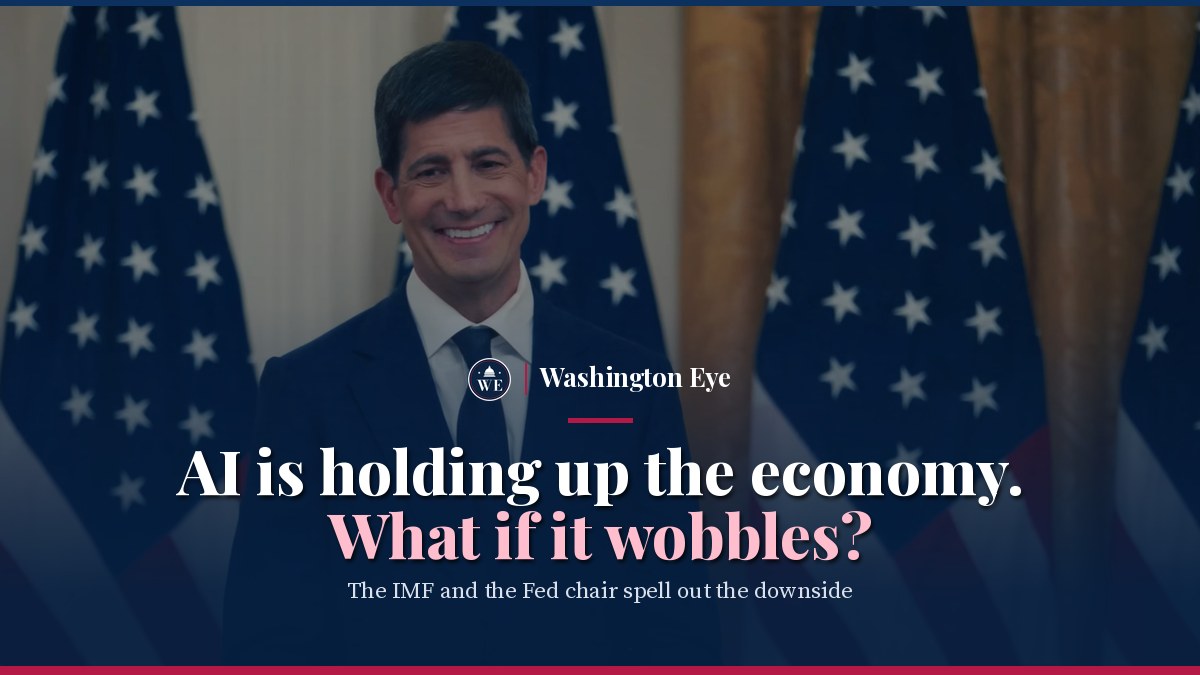
The head of the International Monetary Fund reached for a vivid image on Monday. "We have a world economy that is standing on one leg on the AI leg," Kristalina Georgieva said in an interview on the sidelines of a Southeast Asian summit in the Philippines. "If this leg wobbles, that can lead to financial stability troubles."
Later the same day, the chairman of the Federal Reserve made a similar point in more careful language. Opening a conference on productivity and jobs in San Francisco, Kevin Warsh set out three ways artificial intelligence could reshape the American economy over the next several years. In one, the gains are widely shared. In another, growth rises but jobs are lost. In the third, he said, the technology "could disappoint."
Markets were already nervous. US stocks fell hard on Monday, with the S&P 500 down about 2 percent and the Nasdaq Composite down about 2.5 percent in afternoon trading, as chipmakers and other companies tied to AI led the decline. Nvidia, the chipmaker at the center of the boom, fell about 4 percent after dropping 13 percent the week before.
Taken together, the day offered the clearest picture yet of a question that now hangs over the whole economy: what happens if the biggest investment wave in a generation pays off later, or less, than investors expect? Here is what is known, and what is not.
The claim that AI is holding things up is not just a figure of speech. In October the IMF raised its forecast for global growth this year to 3.1 percent, as major economies leaned on AI investment to offset much of the drag from the energy crunch caused by the war with Iran. One independent research firm has estimated that as much as 80 percent of the recent growth in global exports came from AI-related goods.
The spending is enormous. In its April financial stability report, the IMF said the giant cloud companies known as hyperscalers were expected to account for about 70 percent of a projected $3.4 trillion in AI-related capital spending through 2029. Rising share prices have added a second channel, which economists call the wealth effect: households that feel richer tend to spend more. Athanasios Vamvakidis, a deputy director at the Fund, said at the launch of its October report that a correction would therefore reach well beyond technology companies. Lower share prices could cut household wealth, companies could scale back investment, and tighter financial conditions could spread into other markets.
Georgieva's sharpest warning on Monday was about a pattern that has become common across the industry. In what is known as circular financing, money invested in an AI company ends up flowing back to the investor through purchase orders. A chipmaker might take a stake in a cloud provider, for example, which then uses the money to buy that chipmaker's processors.
The IMF now estimates that such arrangements have grown to a little over $1 trillion, about two thirds of it funded by debt. "It's not a huge size, but it is a rapid increase," Georgieva said. In its October report, the Fund reviewed 14 publicly disclosed deals since 2023. Together they involved roughly $300 billion in equity investment and about $650 billion in debt, linked to about $1.4 trillion in promises to buy computing services or chips in the future.
Those future promises are what make the deals different, according to Jason Wu, an assistant director in the IMF's monetary and capital markets department. If AI revenue falls short, equity stakes could lose value at the same moment that borrowers struggle to repay their debts and the promised purchases fail to arrive. One weak project could pull on several others.
No company sits closer to the middle of this web than Nvidia. Beyond selling the processors that train and run AI models, it has become a financier for its own customers. Its recent quarterly filings showed $36 billion in off-balance-sheet backstops for smaller cloud providers, a guarantee of up to $105 billion for chips, land and power at a proposed OpenAI data center in Ohio, and more than $500 billion in off-balance-sheet commitments over the coming years.
In most of these deals Nvidia pays nothing unless a partner defaults. That is precisely the scenario investors now worry about. The company has lost more than $1 trillion in market value over the past month, and its shares are more than 30 percent below their October record after the departure last week of its co-founder and chief executive, Jensen Huang, following reports about his personal conduct. An analyst at the Swiss bank UBS estimated in a recent note that a pullback in Nvidia's financing could easily drain $50 billion or more out of the system, at a time when higher interest rates have already made corporate borrowing more expensive.
This week brings two big tests. Nvidia reports quarterly results after the market closes on Tuesday, with analysts expecting revenue of about $109.5 billion. Anthropic, one of the leading AI developers, is expected to price its stock market debut late on Wednesday, with trading set to start on Thursday at a value that could exceed $1 trillion.
The strain is not only coming from inside the technology sector. Borrowing costs are rising. Consumer prices rose 0.4 percent in October, and producer prices were 6.5 percent higher than a year earlier, the fastest annual increase in almost four years. Futures markets now put the chance of a quarter point Fed rate increase in December at about 92 percent. The 10-year Treasury yield, which guides rates on mortgages and many business loans, ended Friday at 5.15 percent after the worst week for Treasuries since April 2025, before easing slightly on Monday.
Higher rates matter for an industry that increasingly runs on borrowed money. The IMF found that hyperscalers now account for roughly 10 percent of global investment grade bond issuance, up from less than 1 percent in 2024, which puts them in direct competition with governments and other companies for investors' cash. Smaller players pay far more. Last month, bonds issued by CoreWeave, one of the largest of the newer cloud providers, maturing in 2031 and 2032 were yielding more than 15 percent.
Warsh stressed that his staff's projections were "illustrative scenarios, not forecasts." In the best case, AI lifts productivity and the gains are "shared broadly across labor and the owners of capital," growth stays above its long-run average and the country remains close to full employment. In the second, growth still rises, but "widespread automation, combined with labor market frictions, could push the jobless rate above levels consistent with full employment."
The third case is the one markets heard. "After significant capital investment and stock market gains, expected returns could turn down and equity valuations could fall, leading to an economic slowdown and a more notable rise in unemployment," Warsh said. The economy would recover in time, he added, "but without the productivity gains."
Warsh is no skeptic of the technology itself. He described the present as possibly "the most transformational period in my adult lifetime" and asked: "Can you be a superpower without super intelligence?" But he said the central bank's role is "neither advocacy nor opposition." Its job, he said, is to prepare for whatever comes, and he offered a line that applies to everyone watching this market: "We can't know the future and ought not to pretend otherwise."
The IMF has tried to put numbers on the downside. In a scenario in its October World Economic Outlook, expected productivity gains fail to appear, technology investment retreats, and US share prices fall 20 percent in 2026 while equities elsewhere drop 15 percent. In that case US investment falls by around 5 percent, and global output ends up about 1.1 percent below the Fund's baseline by 2028. Asia, home to much of the world's chip supply chain, would take a heavy hit.
The Fund also stress tested the world's banks against a mix of an AI disappointment, bond market turmoil and an energy shock. Banks as a whole held up, but those holding 22 percent of global banking assets fell into its weak capital category, up from 18 percent in the previous year's exercise.
None of this is a prediction, and there are good reasons for calm. Georgieva described the recent market swings as "orderly" and unlikely to spiral into something that could undermine the world economy. The IMF has also pointed out that today's technology leaders, unlike many dot-com companies of the late 1990s, earn strong profits that have repeatedly beaten forecasts. Third quarter earnings for S&P 500 companies are expected to be about 31 percent higher than a year earlier. The worry is not that the companies are empty. It is that expectations may have run ahead of what the technology has yet proved it can deliver. "We tend to rush ahead," Georgieva said, which is why "some corrections" become necessary.
For most Americans, the argument can feel remote. It reaches them in three ways. The first is savings: a 20 percent fall in US share prices, as in the IMF's scenario, would hit anyone with a retirement account invested in stocks. The second is work: two of the three outcomes Warsh described involve higher unemployment, one through automation and one through a bust. The third is the cost of borrowing, which already reflects stubborn inflation and a central bank leaning toward higher rates.
By the end of this week, investors will have Nvidia's numbers, the minutes of the Fed's October meeting and the first day of trading in Anthropic's shares. None of that will settle whether the AI leg is strong enough to carry the world economy. It will show whether the people who built the boom still believe it can. "We have to be watchful," Georgieva said.