
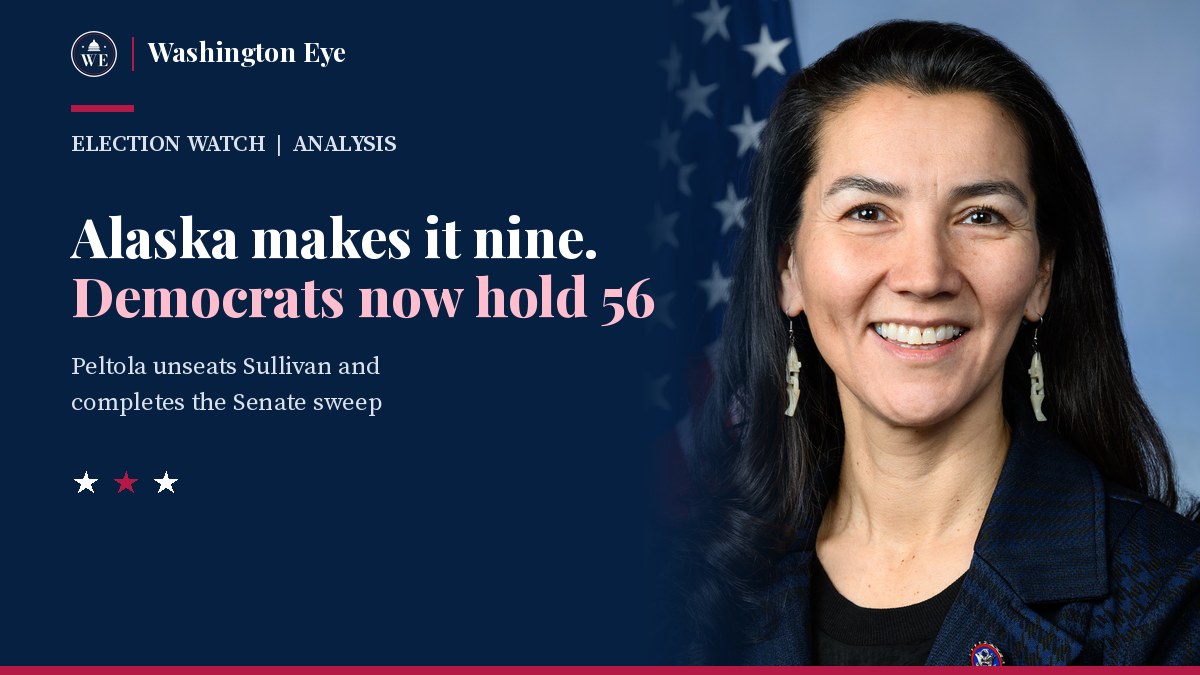
The last uncalled Senate race of the 2026 midterms is over, and it ended the way the rest of the map did. Democrat Mary Peltola has defeated Republican Senator Dan Sullivan in Alaska, a wire service projected at 10:19 p.m. Eastern time on Tuesday, early Wednesday in the Gulf. Her win gives Democrats 56 seats in the Senate that convenes in January, against 44 for Republicans, the largest majority either party has held in 16 years.
It also completes a sweep. Democrats flipped nine Republican seats this year: Iowa, Kansas, Maine, North Carolina, Ohio, South Carolina, Texas, Mississippi and now Alaska. All but one of those states, Maine, voted for President Donald Trump in 2024. Alaska backed him by about 13 points. Two weeks later its voters sent a Democrat to the Senate for the first time since Mark Begich won in 2008.
The result is still unofficial. Published tallies put Ms. Peltola at about 50.1 percent of first-choice votes, with Mr. Sullivan near 46 percent and the remainder split between a second Republican, Gerald Heikes, and a second candidate named Dan Sullivan. Alaska's Division of Elections is aiming to certify on November 25, and the senator's campaign has said it will not concede before then. "Alaskans deserve a complete and accurate count, and we will let that process run its course until every legal vote is counted and certified," his spokesman, Nate Adams, said on Monday, adding that the campaign would not comment on "outside projections" in the meantime.
Why the call came now
For most of the past two weeks the question in Alaska was not who was ahead but whether the leader would clear half the vote. Alaska uses a top four primary and a ranked choice general election. If no candidate wins a majority of first choices, the last-place finisher is eliminated and those ballots move to their voters' next choice, round by round, until someone passes 50 percent. A tabulation of that kind had been scheduled for this week.
Ms. Peltola hovered just below the line for days. As of Tuesday afternoon, Eastern time, her share stood at 49.98 percent, with absentee ballots postmarked by Election Day still allowed to arrive. Her campaign had already declared there was "no mathematical path" for Mr. Sullivan. The final batches pushed her over 50 percent of first choices, which means no ranked choice rounds are needed at all.
That detail matters more than it sounds, because it quietly settles the most bitter fight of the campaign.
The other Dan Sullivan
Alaska's ballot carried two men with the same name: the incumbent, listed as Dan S. Sullivan, and Dan J. Sullivan, a retired teacher and political newcomer. Republicans suspected the second Sullivan had been recruited by Democrats to confuse voters and siphon support from the senator. State and federal prosecutors were investigating his candidacy by July. In October the Justice Department filed a lawsuit aimed at blocking Alaska from certifying the result if the Republican lost, a move Mr. Trump told reporters he had ordered.
Days later, a major American newspaper reported that Ms. Peltola's campaign had been involved in recruiting the second Sullivan. She has denied any involvement, and he has said running was his own decision. Mr. Trump called for her to be prosecuted, the Justice Department said it would redouble its inquiry, and Governor Mike Dunleavy, a Republican, ordered a state investigation of her campaign. On the weekend before Election Day, a federal judge dismissed the administration's attempt to have ballots cast for Dan J. Sullivan set aside.
Those investigations have not been closed, and nothing in the result answers the question of who recruited whom. But the arithmetic has removed the practical stakes. The spoiler theory only mattered if the race went to ranked choice rounds, where the second Sullivan's voters would have been redistributed and any confusion between the two names could have tipped the outcome. Because Ms. Peltola won an outright majority on the first count, those ballots never come into play. As things stand, any challenge to the result would have to argue about first-choice votes for Ms. Peltola herself.
How a red state got here
Ms. Peltola, 53, is not a newcomer to statewide wins. She took Alaska's single House seat in a 2022 special election, the first Alaska Native elected to Congress, won a full term that November, and lost the seat in 2024. Alaska has not voted for a Democratic presidential candidate since 1964. Its other Senate seat has been held by a member of the Murkowski family since 1981.
Her campaign borrowed the national Democratic playbook and fitted it to Alaska. She tied Mr. Sullivan, 61, to Mr. Trump, and hammered him on inflation, fuel costs and the war with Iran. "Dan's part of a rigged system where politicians get wealthy and you get hurt," she said in one advertisement. "They make cash while our diesel prices go up, our healthcare prices keep rising, and we have fewer fish in our rivers." She also outraised him heavily, about $37 million to $14 million through mid-October.
Mr. Sullivan's answer was that his challenger had little to show for her time in Washington. If she made an advertisement listing her accomplishments, he said, "that would be the shortest ad in American history." None of her bills became law during her House term. Mr. Trump flew to Alaska in mid-October to campaign for the senator. It was not enough. Though Mr. Trump carried Alaska three times by double digits, he never won 55 percent there, which left a Democrat with a real ceiling to aim at in a bad year for Republicans.
This was a bad year for Republicans in Alaska well beyond the Senate. The state will also swear in its first Democratic governor since 2002, Jonathan Kreiss-Tomkins, on December 7.
What 56 seats actually buys
Democrats already knew they would control the Senate in January. The open question was the size of the majority, and the difference between 55 and 56 is not cosmetic.
Start with nominations. Cabinet secretaries, judges and most senior officials need only a simple majority. With a Republican vice president able to break 50 to 50 ties, Democrats need 51 votes to defeat a nominee or pass their own measures on a party line vote. At 56 seats, a Democratic leader can lose five members and still win. Republicans, needing six Democratic defections to prevail, will find it harder to peel off a handful of moderates from red states. That changes the confirmation math for every Trump nominee in the last two years of his term, and the current lame duck Senate has already shown how fragile that math is: on Tuesday the White House withdrew its pick to lead the Food and Drug Administration after Republican senators signaled she lacked the votes.
Then there is the filibuster. Most legislation still needs 60 votes to advance, and 56 is four short. That leaves Democrats needing a few Republican votes for anything substantial, but it also lowers the price. "The numbers do matter: 55, 56," a Democratic strategist told a Capitol Hill newspaper before the call, arguing that the size of the majority shows how much strength the party will have to constrain Mr. Trump. Expect the 56th seat to be cited in every argument over whether to change the filibuster rules, from both sides.
Finally, there is 2028. Ms. Peltola joins a group of Democrats newly elected to six-year terms from states usually counted as Republican, including Annie Andrews in South Carolina, James Talarico in Texas, Josh Turek in Iowa, Adam Hamilton in Kansas and Scott Colom in Mississippi. Each of those seats is now a Democratic incumbency Republicans must win back. A party trying to recover the chamber from 44 seats needs a net gain of seven for an outright majority, and it now has to do so while defending its own ground.
What to watch next
Three things will shape the next few weeks. First, whether Mr. Sullivan concedes when the count is certified on November 25, or whether his campaign or the administration seeks to contest it. The Justice Department's October lawsuit and the state inquiry into Ms. Peltola's campaign remain the obvious vehicles, although a first-round majority leaves either with little room to change the outcome.
Second, how Mr. Trump responds. He personally campaigned in Alaska, said he ordered the federal lawsuit and called for Ms. Peltola's prosecution. A president who has questioned other results this month now faces a final Senate loss in a state he won comfortably.
Third, how Senate Democrats use a majority this large. A 56-seat caucus that stretches from Vermont to Mississippi to Alaska will not vote as a bloc on everything. Its red-state members won by running on cost of living, not on national party priorities, and they will face voters who backed Mr. Trump two years ago. The size of the majority gives Democratic leaders room to lose votes. It also means they will have to.
For now, the map is complete. Nine seats changed hands, all in the same direction, and the last one fell in a state where Republicans have dominated for decades. When the new Senate meets in January, Alaska will be represented by a Murkowski and a Peltola, and the chamber will be run by the largest majority Washington has seen since 2009.