
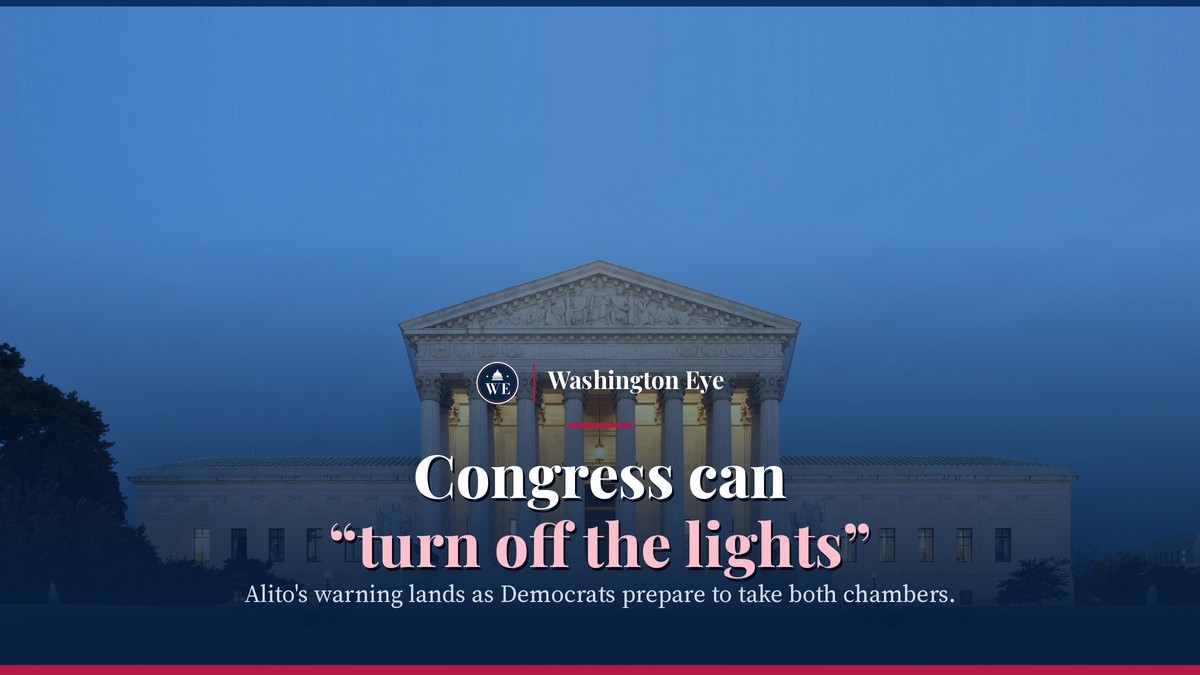
Justice Samuel Alito did not mention the midterm elections when he stood up at the Federalist Society's Antonin Scalia Memorial Dinner in Washington on Thursday night. He did not have to. The room of more than 1,000 conservative lawyers knew that, a week earlier, Democrats had flipped at least 40 House seats and at least seven Senate seats, and that come January they will control both chambers of Congress for the first time since early 2023. So when Alito described what a hostile Congress could do to the nation's highest court, everyone heard a warning about the months ahead.
"Congress can turn off the lights at the Supreme Court and stop everything from happening if they want to defund their activities," he said. "And there are many, many, many other things that they can do, or at least try to do. So, it is important to preserve the independence of the judiciary. If that is eliminated, then the Constitution as adopted in 1789 will no longer be the same."
Critics will call that alarmist, and they will point out that Alito chose a partisan setting to say it. Both points deserve an answer. But on the substance, the justice is right, and the new Democratic majority should take his warning seriously rather than treat it as a dare.
Start with the constitutional design, because it explains why the judiciary is exposed. Article III gives federal judges their offices "during good Behaviour" and promises that their compensation "shall not be diminished during their Continuance in Office." That protects a justice's paycheck. It protects nothing else. The clerks, the police officers, the library, the computer systems, the case management staff and the building's daily operations all depend on appropriations that Congress writes every year and can decline to write.
Alito put it in his own vivid terms. The judiciary, he said, is the least powerful branch and is "vulnerable" to both Congress and the executive. Comparing the three branches to weapons, he offered a hand grenade, a 500-pound bomb and a nuclear weapon. "The hand grenade is the least dangerous," he said. "But that is not to say that it is not dangerous." The point cuts both ways, and he meant it to. Courts can do damage. But the branch with the smallest arsenal is also the easiest to disarm.
The money involved is strikingly small, which is part of what makes it such a tempting lever. When Justices Elena Kagan and Amy Coney Barrett appeared before a House appropriations subcommittee in July, the first time the court had testified to that panel since 2019, Kagan told lawmakers that the Supreme Court's budget represents just 2 percent of the judicial branch's total funding, which in turn is about one tenth of one percent of the federal budget. The court asked for an additional $14 million for the coming fiscal year, a 7 percent increase.
Nearly all of the recent growth, Kagan said, has gone to security. Over the past five fiscal years the court's funding needs have risen by an average of 15 percent a year, driven by larger protective details, the shift of residential security from the Marshals Service to the Supreme Court Police, new physical security systems and cybersecurity. When threats rose after the leak of the draft opinion in the abortion case, the court expanded its residential protection. Barrett told the same subcommittee about a swatting attempt at her home and about being issued a bulletproof vest when threats against her were especially intense. "I didn't expect that performing this service was going to put me in the position of explaining to my children what a bulletproof vest was and why I had to wear one," she said.
That is the budget Alito says Congress could squeeze. It is not a theoretical concern. On March 31, 2023, fifteen Senate Democrats, among them Sheldon Whitehouse of Rhode Island, wrote to appropriators asking that $10 million of the court's funding for the following fiscal year be withheld until the justices adopted a public, enforceable code of ethics. The court did adopt a code of conduct that November. Its critics, who have a fair point, say it still lacks a real enforcement mechanism. But the episode established a precedent that should worry anyone who wants the court to rule without looking over its shoulder: the purse had already been floated as a tool to change the court's behaviour.
Now consider the incentives facing the incoming majority. Democrats have a long list of court proposals. Several House bills would set 18-year terms for the justices with regular appointments. One bill introduced this year by Representative Al Green of Texas would expand the court from nine seats to 13. Whitehouse and Representative Hank Johnson of Georgia have pushed legislation requiring a binding ethics code and new gift and income disclosure rules. Representatives Jamie Raskin and Alexandria Ocasio-Cortez have proposed barring judges and justices from accepting gifts worth more than $50.
Every one of those ideas runs into the same wall: President Donald Trump, who would have to sign them. Some legal scholars also argue that term limits would require a constitutional amendment. With the ordinary road to reform blocked until at least 2029, the appropriations process becomes the one place where a frustrated majority can apply pressure without new statutes. Must-pass spending bills are where riders live. That is exactly why Alito's warning is timely rather than paranoid.
There is a conservative case here that should appeal well beyond conservatives. The independence of the courts is not a gift to whichever side currently holds a majority on the bench. It is a structural guarantee that protects whoever happens to be losing. Democrats spent much of the past decade insisting, correctly, that judges must be free from intimidation by an angry executive. The same principle applies when the pressure comes from Capitol Hill. A court that must calculate whether a ruling will cost it security officers or staff is a court that has been bent, whether or not anyone ever actually cuts the money.
History offers a guide. The size of the court has changed six times, but it has held at nine since 1869. When the House impeached Justice Samuel Chase in 1804, the Senate acquitted him, and that verdict has long been read as a warning against removing judges for their politics. Americans have repeatedly decided that the way to change the court is through appointments, confirmations and, when necessary, constitutional amendments, not through slow strangulation of its operations.
None of this places Alito above criticism, and his remarks invite some. His swipe at lower-court judges will strike many readers as ill-timed. He said they have issued "unjustified" orders blocking presidential policies in recent years. "They are dedicated and they are skillful, but they're not perfect and they make mistakes," he said. "And in some instances, I think they have gone far astray in abuse of their powers." A justice defending judicial independence in one breath and scolding fellow judges in the next can sound as though he cares about independence mainly when it runs in one direction. And choosing a Federalist Society dinner, the gathering place of the movement that helped build the current majority, as the venue for a warning to Congress hands opponents an easy line of attack.
Yet the substance of the lower-court complaint has some support in the court's own recent work. This week the justices granted the administration's request to resume border wall construction in the Big Bend region of Texas in an apparent 8 to 1 vote, with only Justice Ketanji Brown Jackson indicating that she would have denied it. When a lower-court order is set aside by a margin that includes most of the court's liberal wing, the argument that some judges have reached too far is not simply partisan grievance.
The more serious question is what Democrats will actually do. Alito, who is 76, has said he has no plans to retire and intends to serve through at least the current term, which ends in late June or early July. Justice Clarence Thomas is 78. With a Democratic Senate arriving in January, any future vacancy would leave Trump needing Democratic votes to fill it, and Republicans are under pressure to confirm as many lower-court nominees as they can first. As of November 8 the federal judiciary had 28 vacancies and 16 nominees awaiting action. That scramble will make the incoming majority angrier, not calmer, and anger is when budget leverage starts to look attractive.
Democrats can prove Alito wrong, and they should want to. The simplest step would be a public commitment from the new leaders of the appropriations committees that the court's operating and security budgets will be set on their merits, and never used as a bargaining chip over ethics, rulings or retirements. They can pursue an ethics code, term limits or anything else on their list through ordinary legislation and make their case to voters and to the president. They can hold hearings, demand disclosures and debate the court's emergency orders in the open. What they should not do is threaten the lights.
Republicans have obligations too. If they want Democrats to respect the court's funding, they should stop treating every complaint about judicial ethics as an attack on the institution. The court's 2023 code was a start, not a finish, and conservatives who care about public trust in the bench should be the first to say so.
Alito chose his words and his audience in a way that will make his warning easy to dismiss. That would be a mistake. The Founders gave judges protected salaries and life tenure precisely because they knew the courts would one day face a Congress that disliked their decisions. That day is about seven weeks away. How the new majority handles the court's budget will say more about its respect for the Constitution than anything it says about the justices.