
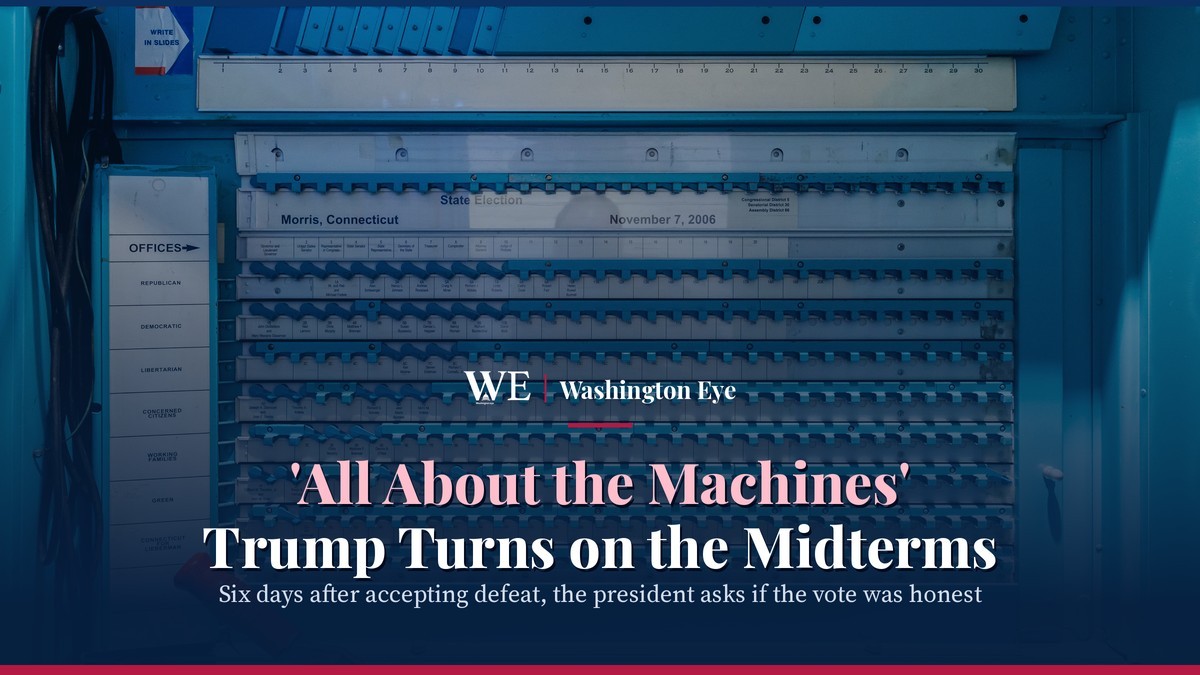
For six days after Republicans lost both chambers of Congress, President Donald Trump did something his critics had not expected. He congratulated the winners, blamed his own side's messaging and conceded that parts of his agenda had cost his party votes. On Monday morning he changed course. "Does anybody really believe that this 'Election' was honest," he wrote on his social media platform. "How could the Polls be so wrong??? Some early voting 'dumps' were so large that it was impossible to win, no matter how many people went to vote. It's all about the machines, which are far more important than the voter!"
The post offered no evidence of a specific error, a specific county or a specific machine. It did not ask any court or election office to do anything. But it was the most direct challenge to the midterm results the president has made so far, and it lands at a delicate moment. Two Senate races are still being counted, 19 House contests remain uncalled, recounts are possible in Florida and North Carolina, and the Justice Department is preparing for two years of combat with a Democratic Congress. The question is no longer whether Mr Trump accepts the overall verdict of last Tuesday. It is what his doubts will mean for the races that are still open and for the rules of the next election.
Start with how far he has moved. On election night, as the scale of the Democratic sweep became clear, the president told a major American newspaper that he was "absolutely willing" to accept the results. "We'll, you know, look forward to working with them," he said of the Democrats. "We'll probably work something out." In a call to a cable news channel the same night he was gracious. "Congratulations to the Democrats, they did a good job," he said. "They've been looking for this one for 11 years, and they finally got it." The next day he said he would "get along probably with the Democrats unless they want to be destructive."
He also offered explanations that had nothing to do with fraud. He said he would have "won easily" if he had been on the ballot. He faulted weak Republican candidates. In a television interview taped on Friday and broadcast on Sunday, he acknowledged "bad messaging" on the economy and said his immigration crackdown had at times been too tough. On the war with Iran, which began in February and has pushed up energy prices, he was candid. "People agree with what I'm doing on Iran but they really probably weren't willing to do the short term consequences of paying more for gasoline," he said. "I understand that." Vice President JD Vance has also pointed to the war as a reason for the defeat.
There were signs over the weekend that this tone might not last. The president shared several posts questioning the results, including one that argued Democratic gains across many states followed a suspiciously similar pattern and called for "answers at the ballot level." And before the vote he had set a condition. Asked at Joint Base Andrews on 27 October whether he would accept the results whatever happened, he replied: "I will, if they're honest elections."
Monday's post rests on two claims, and both can be tested against what is publicly known. The first is about the polls. Mr Trump asks how they could have been so wrong. They were wrong, but not in the way the post implies. A nonpartisan research organisation found that polling averages understated the Democratic margin by at least two points in 23 of the 27 Senate and governor's races for which it had data, with an average miss of roughly four points and some of the biggest gaps in Georgia and Texas. Pennsylvania was a partial exception: Governor Josh Shapiro won by about 22 points, a few points less than surveys had suggested. Pollsters underestimating a wave is a familiar problem in American elections. It is evidence that voters moved further than expected, not evidence that votes were changed.
The second claim is about early votes and machines. In many states, early and mail ballots are processed before Election Day and reported first, often in large batches soon after polls close. When one party dominates early voting, those first releases can look decisive, and in a landslide they often are. That is how the count works in normal years, and it is why the same pattern has been called a "dump" by losing campaigns of both parties in the past. Machines are a longer running grievance. After his 2020 defeat, the president and his allies blamed a voting equipment company for his loss. A cable news network later agreed to pay $787 million to settle a defamation lawsuit the company brought over false claims aired about it. On Election Day in 2022 he warned that "they are trying to steal the election with bad Machines and DELAY." In August 2025 he wrote that "elections can never be honest with mail-in ballots/voting" and promised to lead a movement against both mail voting and machines.
Election officials tell a less dramatic story about 2026. Top state and local administrators have reported a mostly smooth process. Extreme weather forced some polling places to close, and a handful of administrative or technical problems slowed counting in a few jurisdictions, but no state has reported anything that would change the outcome of a race. Officials and election lawyers had spent months preparing for exactly this kind of challenge from the White House or from election sceptics, which partly explains why the response on Monday was so muted.
The administration's own record also matters. Before the vote, the Justice Department filed lawsuits challenging how votes would be counted and certified in states including California and Alaska, and pressed California to set aside ballots from about 20,000 voters whose citizenship it had questioned. Judges ruled against the department in nearly all of those cases. That history cuts two ways. Critics see it as proof that the government was looking for grounds to contest a defeat. Supporters argue that it shows the administration raised its concerns through the courts, in advance, rather than after the fact.
Where could the post have practical effect? The obvious places are the races still open. In Alaska, former Representative Mary Peltola, a Democrat, leads Senator Dan Sullivan by 637 votes. Absentee and contested ballots must be counted by 18 November, with a target date for certification a week later, and if no candidate clears 50 percent the race moves to a ranked choice tabulation that could take weeks. In Mississippi, Democrat Scott Colom leads Senator Cindy Hyde-Smith by 2,574 votes. Counties have until Friday to certify, 75 of the state's 82 counties have done so unofficially, and just under 2,900 ballots are outstanding. Neither race decides control of the Senate, which Democrats have already won with at least 54 seats. But a president questioning the integrity of machines and early ballots could encourage challenges in close contests, put pressure on local certification boards and invite lawsuits over the ballots that remain.
There is a policy dimension too. The House Freedom Caucus has sent Republican leaders a list of demands for the lame-duck session that includes legislation requiring voter identification in federal elections. With Republicans still in charge until January, conservatives may try to use the president's doubts to press for that measure before the new majorities arrive. Democrats, who will control the committees from January, are likely to answer with oversight of the Justice Department's pre-election lawsuits. Attorney General Todd Blanche said on Monday that the department would not "stop working with Congress" under the incoming majority, but the president has also asked the department to investigate Democratic lawmakers, which guarantees friction.
The constitutional limits have not changed. Elections in the United States are run by the states, and Congress can set some federal rules. The president has no formal role in counting votes. When Mr Trump argued last year that states were "merely an 'agent' for the Federal Government in counting and tabulating the votes," even some of his allies demurred. "So elections are run by the states," Representative Harriet Hageman of Wyoming, a firm supporter, told constituents at the time. "So I don't know that President Trump is going to succeed at that." Ohio's Republican secretary of state, Frank LaRose, has defended voting machines as faster and more accurate than hand-counted paper ballots.
Republicans now face a familiar choice. Many senators already blame the president for the scale of their losses and are openly debating whether to delay their own leadership elections. Embracing a fraud narrative would give them a convenient explanation that does not require changing course on the war, prices or immigration. Rejecting it risks a public argument with a president who still commands the party's voters. Some prominent conservatives have chosen ridicule over rigour. "It's been 4 days and no protests, riots and vandalism," a former White House press secretary wrote on Saturday, needling Democrats. A political reporter replied with a reference to the Capitol riot of 6 January 2021: "Traditionally, that happens in early January. Not November."
For Democrats, the risk is overreaction. The post changes no results, and their majorities are large enough that no plausible challenge would reverse them. Treating every presidential complaint as a constitutional crisis could make it harder to argue, in the oversight fights ahead, that the stakes are real when they are. The stronger response, many election lawyers argue, is the boring one: finish the count, certify on schedule and publish the audits.
Several things are worth watching. Whether the White House or the Republican National Committee files or backs any challenge in Alaska, Mississippi or the uncalled House seats. Whether state officials in those places, Republicans among them, publicly vouch for their machines and their counts. Whether Republican leaders in Congress repeat the president's claims or quietly distance themselves from them. And whether the president follows his post with an executive action on voting equipment or mail ballots ahead of 2028, the step he promised last year and has not yet taken.
For now, the result of the midterm elections stands, and the president himself spent most of last week explaining why his party lost. Monday's post did not erase those explanations. It added a second story alongside them, one that asks voters to doubt the count rather than the choices that led to it. Which of those stories Republicans decide to tell will shape not only the next two months of counting but the next two years of governing.