
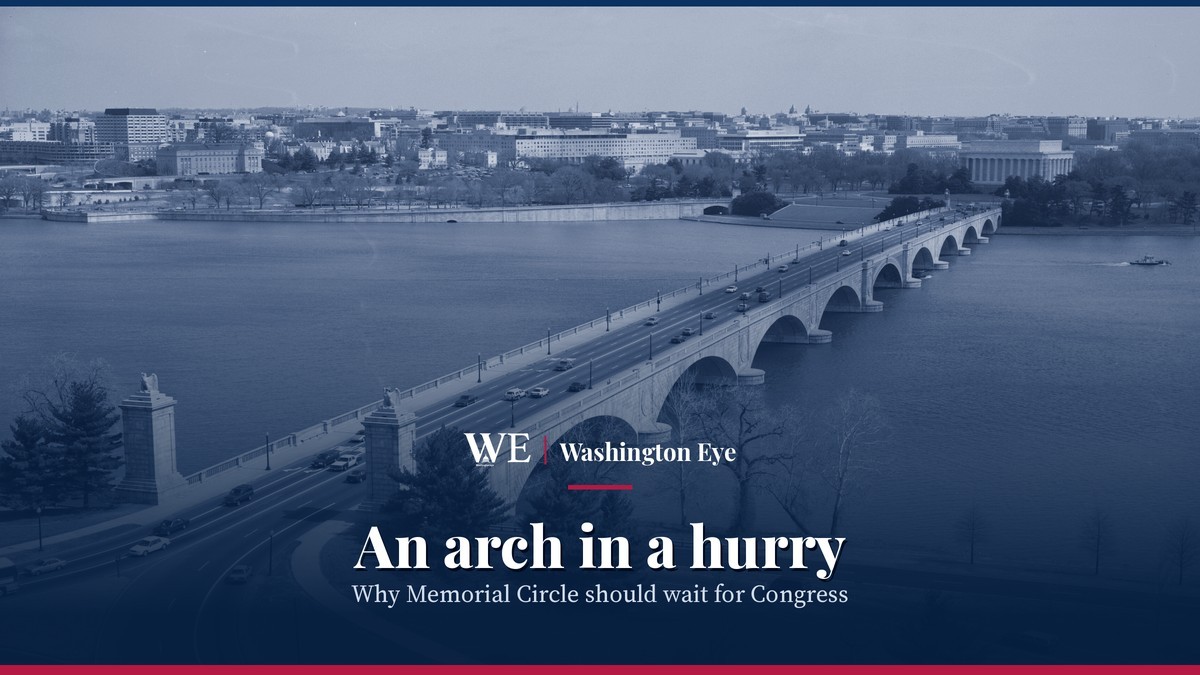
Perspective: This is an opinion piece. It argues from a progressive, rule-of-law point of view and is not straight news reporting. The facts it relies on are sourced below, and the strongest arguments for the arch are set out in the article.
Late on Thursday, a few hours after a federal planning commission approved President Donald Trump's 250-foot triumphal arch, US District Judge Tanya S. Chutkan stopped construction. The BBC reported that her order imposes a 14-day pause before any work can begin at Memorial Circle, the traffic circle on Columbia Island at the Virginia end of Arlington Memorial Bridge. According to the Washington Post's public summary of the ruling, she sided with military veterans and local officials who had asked her to halt the project while their lawsuits continue.
The order is short and temporary. It does not decide whether the arch is lawful. What it does is give the country time to think about a permanent monument, and the administration has tried hard to avoid exactly that.
According to the Associated Press account carried by PBS, the administration said it could begin construction within a day of the commission's vote. Before Thursday's hearing began, Justice Department lawyers told the court that a contractor had already carried out site-preparation work on 31 October. Judge Chutkan said that work appeared to have no authorization from the National Park Service. Earlier in the week, she had ordered the government to tell her within an hour of any decision by the planning commission, the Park Service or the Interior Department. At one hearing she asked what the hurry was, apart from the President's "desire to bedazzle the city." An administration lawyer, Robert Stander, answered that the arch was "absolutely a high-priority project."
The planning commission's own record shows how quickly the design advanced. Its executive director's report for the 5 November meeting says the Commission of Fine Arts approved the concept on 16 April 2026 and the final design on 21 May. The planning commission commented on the concept on 4 June, approved the preliminary plans on 9 July, and was asked to give final approval this week. The BBC reported that the final vote was 8-4 after nearly nine hours of public comment. AP noted that the commission's chairman, Mark Paoletta, is a Trump appointee who is also general counsel of the White House budget office, and that two other commissioners are White House aides.
A monument meant to stand for centuries went from concept to final federal approval in less than seven months. Its main federal reviewers were people who report to the President who wants it built. Arguing that this process deserves more scrutiny is not partisan obstruction. It is a basic check on a government building something permanent.
The administration's legal case depends on one old act of Congress. In its findings, the planning commission agreed that in 1925 Congress authorized a plan by the Arlington Memorial Bridge Commission that included elements above the limits of the 1910 Height of Buildings Act, and gave that commission discretion to revise the design, a discretion now held by the Interior Department. From this the commission concluded that Congress had "implicitly waived" the height limit and that the arch does not need to comply with it. Paoletta told the hearing it was a "national disgrace" that no memorial arch had been built at the site that the 1925 law designated.
That argument cannot simply be dismissed. Congress did plan grand features around the bridge, and designs going back to the McMillan Commission in 1902 identified the area as a site for monumental features. If that history did not exist, the administration would have no legal case at all.
Still, an implied waiver from a century ago is a weak basis for this particular structure. According to the staff report, the design is a 166-foot arch topped by three gilded figures, reaching 250 feet in total. AP described a 106-page plan that includes an observation deck, offices, a staff lounge, elevators and a fire command center. The BBC reported that the administration says the arch would also store military equipment and could be used to deploy snipers and drones. It is hard to believe that the Congress of 1925 had anything like this in mind. The plaintiffs' central claim, as described by AP and the Washington Post, is simple: a project this new and this large needs approval from the current Congress. A court should test that claim before the ground is broken. Once a monument is built, it is very difficult to take down.
The site is not empty space. The planning commission's own staff report says Memorial Bridge and Memorial Circle were "designed to create a physical and symbolic connection between the North and South." It also notes that they were listed on the National Register of Historic Places in 1980, and that the sight line along Memorial Avenue contributes to the historic district of Arlington National Cemetery. The view from the Lincoln Memorial to the cemetery was designed to express national reconciliation after the Civil War.
The veterans who came to the hearing understood this. John Pomeroy, an Air Force veteran of the Vietnam era whose parents are buried at Arlington, told the BBC the arch "would lessen the solemn nature of a visit to the cemetery." Representative Jared Huffman of California, expected to chair the House Natural Resources Committee next year, told the commission the structure would be "a tribute to Donald Trump," built in a style associated with "emperors or kings who built grand arches as tributes to themselves."
The other side deserves a fair hearing, and its best arguments are serious.
First, the purpose. The planning commission formally supported the project as a celebration of America's 250th anniversary. Paoletta argued that "it's important to our national identity to display who we are through grand monuments," and supporters at the hearing, including Republican lawmakers and a veteran, said the arch would honor those who served. Great capitals do build monuments, and Washington has added ambitious ones before.
Second, the process. The project passed through two federal review bodies, each of which held hearings, requested changes and received revised plans. The staff report shows that the applicant reduced the number of traffic-signal poles from 32 to 17 at the commission's request and submitted new traffic studies. Supporters can fairly say this was more than a rubber stamp.
Third, the risk of endless litigation. If any opponent can stop any public project by filing suit, nothing ambitious will ever be built. Supporters of the arch will argue that the courts are being used to win by delay what opponents could not win at the commission.
These arguments deserve answers, and they have them. Celebrating the 250th anniversary does not require an arch built this year. The country could mark it with a structure that has the clear support of the people's representatives. Review by bodies chaired by the President's own staff is a weaker check than review by an independent Congress. And the 14-day pause is not endless litigation. It is a short delay so a judge can consider whether an irreversible project is lawful.
The election makes the timing more important. On Tuesday, voters gave Democrats control of both the House and the Senate from January. The AP story carried by PBS noted that Trump's projects around Washington "could soon face intense scrutiny" from the new majority. Read generously, the administration's rush is a sincere wish to finish a project for the anniversary year. Read less generously, it is an attempt to create a permanent fact before the newly elected Congress can weigh in. Either way, the right course is the same.
Representative democracy has a reasonable answer to a dispute like this. If Congress in 1925 authorized a monument at Memorial Circle, the Congress of 2027 can confirm that this monument is the one the country wants. If the administration is confident in its design, it should ask for that vote. If the votes are not there, that tells the country what it needs to know.
Judge Chutkan has not decided that question, and an opinion page should not claim she has. Her order only makes sure the question can still be asked before construction begins. For a 250-foot structure at the entrance to the nation's military cemetery, two weeks is a small delay.