
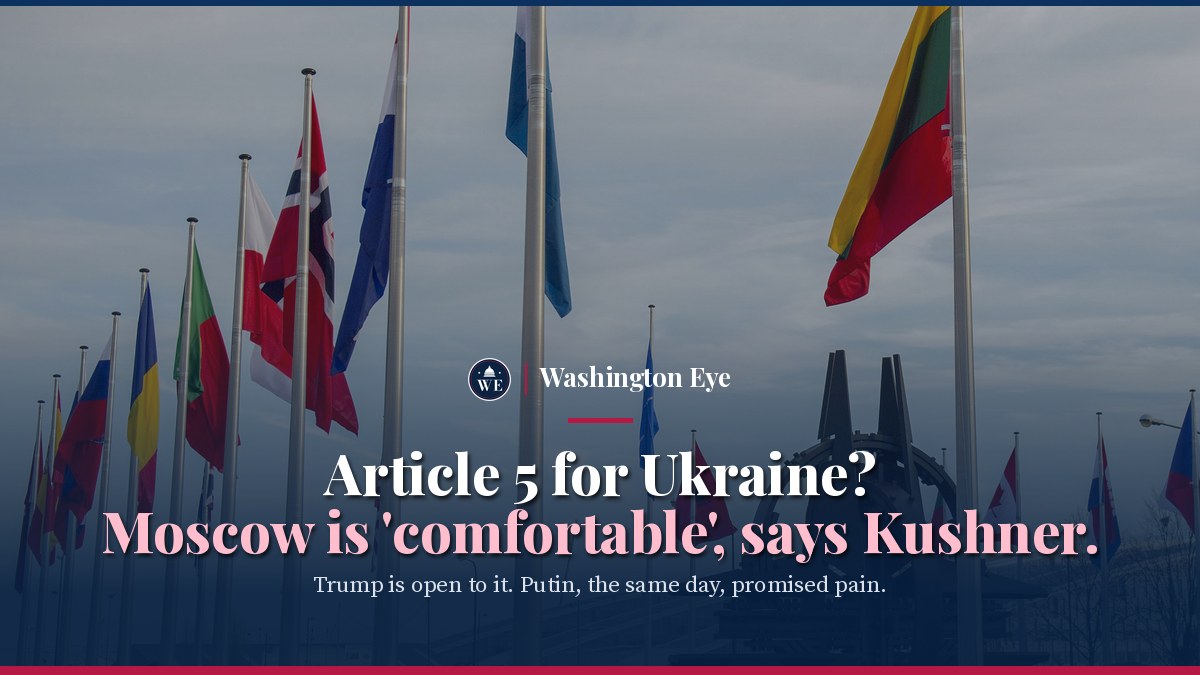
For nearly five years, the single hardest question in any plan to end the war in Ukraine has been the one Kyiv asks first: what stops Russia from coming back? On Thursday evening in Berlin, President Donald Trump's envoy Jared Kushner offered an answer that would have sounded unthinkable a year ago. Russia, he told reporters, has become "comfortable" with the idea that any security guarantee for Ukraine would be modelled on Article 5, the mutual defence promise at the heart of the North Atlantic Treaty.
"I think we've gotten the Russians comfortable with that concept where any security guarantee for Ukraine would be based on Article 5," Mr Kushner said after a summit of Ukraine's allies at the German Chancellery. He added a careful qualifier about the United States' own role: "From America's perspective, giving an Article 5-like security guarantee is a really, really big deal. And I think that that's something that President Trump is open to, but obviously it has to be in America's interest to do that."
The remark landed at the end of one of the strangest diplomatic days of the war. In the morning, Mr Trump sat at a round table in Shenzhen with Xi Jinping and Vladimir Putin. By the afternoon, he was on the phone from Air Force One questioning Europe's plans to keep funding Kyiv. And within hours of Mr Kushner's upbeat assessment, Mr Putin had already promised a response "far more painful" than Ukraine's strikes on the bridge to Crimea and said Moscow would not negotiate a partial ceasefire after them. The question is which of those signals tells Americans more about where this war is heading.
What Kushner actually said
The precise wording matters, because it is easy to overread. Mr Kushner did not say Russia had signed anything, and he did not say Moscow had accepted NATO membership for Ukraine, which the Kremlin has rejected for decades. He described a concept: a guarantee for Ukraine that borrows the logic of Article 5 without necessarily placing Ukraine inside the alliance. He also acknowledged the doubts at home in Russia, saying "there's a lot of skepticism and disbelief on that concept in Russia," and argued that this was exactly why talks between Europe and Russia needed to restart.
Article 5 itself is short. It says an armed attack against one member "shall be considered an attack against them all," and commits each ally to take "such action as it deems necessary, including the use of armed force." That final phrase has always given each government room to decide how to respond. A guarantee "based on" Article 5 could therefore range from a binding promise of American and European military help to something much looser. Mr Kushner gave no details on which version Washington has in mind, and Moscow has not publicly confirmed his account. One live blog covering the press conference added a pointed aside after reporting his claim: it was not sure the Russians would say the same.
He did sketch the outlines of a broader package. According to reports from the press conference, he said the talks had made "a lot of progress" on a postwar prosperity plan, on security guarantees and on an exchange of prisoners of war, and that NATO would be "a central pillar" of postwar security proposals. He said the American envoys would next meet national security advisers to work on detail. "For us, success in an outcome would be to have a sovereign, secure, prosperous and free Ukraine at the end of the war," he said.
The phone call from Air Force One
If Mr Kushner's message was hopeful, the one his boss delivered earlier in the day was more combative. Mr Trump dialled into the Berlin meeting on Mr Kushner's phone while flying home from China, according to several European officials briefed on the discussion who spoke anonymously to describe a private meeting. Accounts of the call differ in tone. Two participants described it to a British newspaper as a "tirade" against plans by the European Union and other backers to help cover Ukraine's estimated 70 billion euro financing gap for 2027. A third said Mr Trump had simply stressed how much money every country could save if the war ended.
All the accounts agree on two points. Mr Trump spoke very positively about the prospects for a negotiated settlement, and he told the leaders he believed Mr Putin wanted peace. One official said the president lamented the number of people dying and the money being "wasted" on the war. The White House had not publicly commented on the call when the meeting ended.
Those two messages are not necessarily in conflict. An American president who wants a deal can push allies to stop spending and, at the same time, dangle a strong guarantee to persuade Kyiv to accept painful terms. But they do point in different directions for Europe. The coalition's joint statement promised extra air defences for Ukraine before winter and called on Russia to accept an energy ceasefire for the duration of the cold months as a first step towards ending hostilities.
Europe's answer: no Yalta
The European leaders in Berlin went out of their way to signal that they will not be bystanders. German Chancellor Friedrich Merz, the host, gave each guest a piece of the Berlin Wall and invoked the 1945 conference at which the wartime powers divided the continent. "A 'Yalta-style' format will not bring about peace," he said, in an unmistakable reference to Thursday's three-way summit in Shenzhen. "Negotiations can only succeed if Ukraine and Europe are part of the process together."
British Prime Minister Andy Burnham said Europe had "a clear and consistent and united negotiating position" and that "it's not for the aggressor in this conflict to set out wide ranging and unrealistic security demands." He also offered rare optimism, saying he saw "alignment" across Europe for the first time in his premiership and "some grounds for optimism that there can now be progress," before adding that one man could determine that more than anyone else: Mr Putin. French President Emmanuel Macron went further than most, saying that in the face of Russia's maximalist demands it was "the right point in time" to discuss Ukraine's NATO membership, and that Russia had not submitted "concrete and tangible proposals for peace."
Ukrainian President Volodymyr Zelensky, standing beside them, was the most sceptical voice in the room. Mr Putin, he said, "has always said no." He confirmed that Russian drone attacks on Kyiv had damaged the Austrian and Dutch embassies, pressed for more air defence and said the next round of talks should include European leaders. Polish Prime Minister Donald Tusk, speaking on his way home, said Mr Trump's remarks sounded "quite optimistic" but warned: "I don't think it's likely that Russia will sit down at the negotiating table in any serious way before the winter is over."
Putin's version of the same day
Mr Putin's own press conference in Shenzhen, held before the Berlin briefings, offered a very different picture of Russian flexibility. Ukrainian drones and missiles have struck the Crimean Bridge three times this week, collapsing part of its central road section on Tuesday and hitting it again in the early hours of Thursday, hours before the Shenzhen summit. Mr Putin insisted the bridge was a purely civilian structure, a claim Kyiv rejects, and said he had been considering a limited ceasefire on maritime and energy targets until the strikes. "After the strikes on the Crimean Bridge, we will not negotiate," he said, according to the Kremlin's transcript. "We will respond to these attacks. Our response will be far more painful than Kyiv's attack on the bridge."
He also repeated that pressure on Russia over territory was pointless, and said Moscow had invited European representatives to Moscow through diplomatic channels to "determine their positions" before deciding in what format talks with Ukraine would continue. He said the Americans had been "insistently" asking Russia to let Europe take part. Earlier this week, a senior Kremlin aide said a "great deal" of work would be needed before the negotiating format could be widened.
Set side by side, the two accounts suggest Moscow is willing to talk about the shape of a future settlement while giving nothing on the ground today. Accepting the idea of an Article 5-style guarantee in principle costs Russia little if the territorial lines, the size of Ukraine's army and the role of foreign troops remain open. Those are the questions on which every previous round has stalled.
Why Washington's promise is the real story
For American readers, the most consequential sentence on Thursday may have been the one about the United States rather than Russia. Mr Kushner said an Article 5-like commitment is "a really, really big deal" for America and that Mr Trump is "open to" it, provided it serves American interests and forms part of a broader package. That is a notable shift for a president who has spent years questioning the value of the alliance's existing commitments and who has ruled out NATO membership for Ukraine.
It also follows a week of unusual signals from the same envoys. Mr Zelensky said earlier this month that the American side had asked whether Ukraine would withdraw from the part of the Donbas region it still controls in exchange for NATO membership. Taken together, the pattern points to an American team testing how much protection it can offer Kyiv in return for concessions on land, while Mr Trump publicly presses Europe to spend less.
A guarantee of that kind would raise hard questions in Washington. A treaty-level commitment would need the Senate's consent, and lawmakers in both parties have long argued over whether American troops should ever be pledged to defend Ukraine. A looser political promise would be easier to give but easier for Moscow to doubt, which is the problem Ukraine already lived through after the 1994 Budapest Memorandum, when it gave up the nuclear weapons on its soil in exchange for security assurances that did not stop Russia's later invasions.
What to watch next
Three things will show whether Thursday was a turning point or a mood. The first is Moscow's own description of Mr Kushner's claim; a Kremlin denial or silence will say a lot. The second is whether European officials actually travel to Moscow at Mr Putin's invitation, and on what terms, given Mr Burnham's insistence that a European security dialogue can only follow a peace deal between Russia and Ukraine. The third is the scale of Russia's promised retaliation for the bridge strikes, which could quickly overshadow any talk of guarantees.
Mr Trump is due to hold a press conference at the White House on Friday after his return from China, according to reports from the summit. He will be asked whether he really believes Mr Putin wants peace, and whether he is prepared to put America's word behind Ukraine's security in a way no president has before. On Thursday, his envoy said he is open to it. Mr Putin, on the same day, promised pain.