
Here is the most revealing fact about America's chip policy toward China, and it has nothing to do with spies or affairs. After a year of lobbying, a presidential reversal and a relaxed licensing regime, Beijing still has not approved large-scale imports of the advanced Nvidia H200 processors that Washington agreed to let it buy. Hundreds of thousands of the chips were still waiting to ship as of early this month, according to reporting on the company's dealings.
That should settle an argument conservatives have been having with themselves since the president cleared the H200 for export last December. Sellers said China would stay hooked on American technology; skeptics said you do not sell the key industrial input of the century to the rival you are racing. Beijing has now answered the question for us. It treats access to American chips as a bargaining chip of its own, to be accepted or refused on its schedule, while it pours money into building its own.
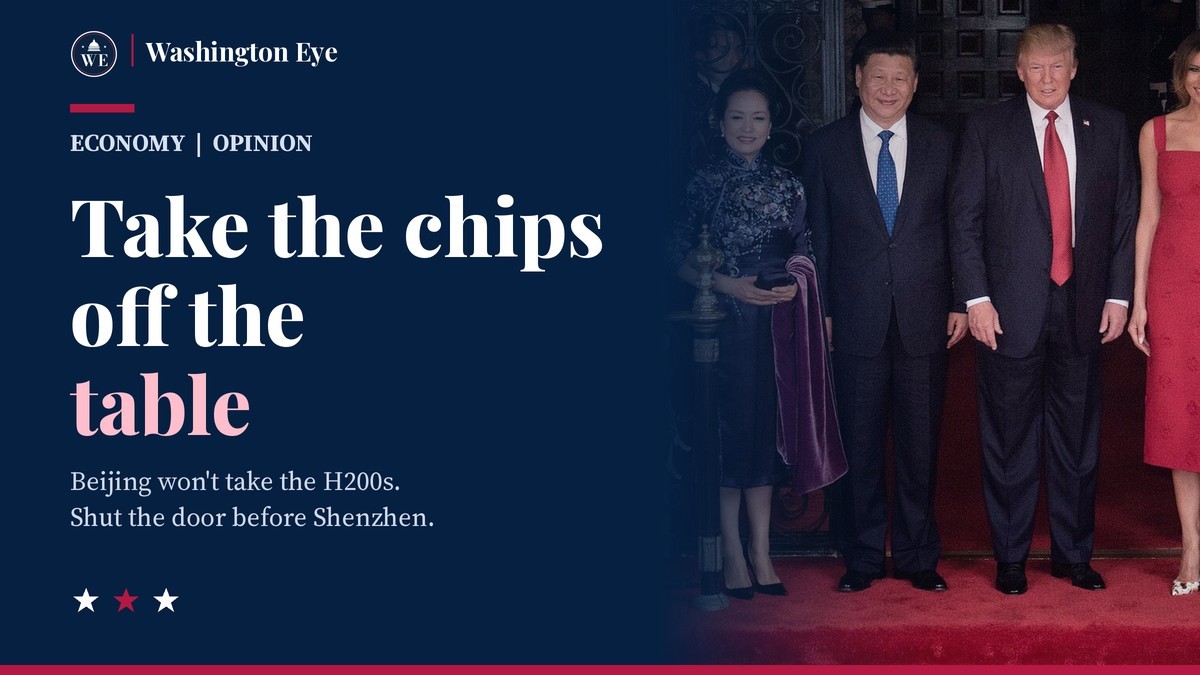
With President Trump due to sit down with Xi Jinping in Shenzhen next week, on the sidelines of the Asia-Pacific Economic Cooperation summit on 18 and 19 November, Republicans have a narrow window to fix this. They should write the chip red line into law before the president gets on the plane, and they should do it in the annual defense bill while they still control both chambers.
Treasury Secretary Scott Bessent laid out the administration's framing on Tuesday night in New York, at a gala marking 60 years of a leading US-China relations group. He said he wanted to "build a constructive relationship on the basis of balance and reciprocity." He announced that the Shenzhen meeting, the third between the two leaders this year, would launch a new bilateral dialogue on what the administration calls superintelligence, including exchanging practices for testing advanced models before release and "keeping human judgment firmly in command of this technology."
Then came the line conservatives should hold him to. "We should harbor no illusions about the differences between the United States and China," Bessent said. "Our interests will not always coincide." He described the goal on trade as "de-risk, not to decouple." Those are the right words. The problem is that chip policy over the past year has not matched them.
Consider the record. In December 2025, days after another meeting with Nvidia chief executive Jensen Huang, the president announced that he would allow H200 sales to approved Chinese customers, and the Commerce Department formally relaxed its licensing rules the following month. Nvidia has committed at least $26 million to projects the president favours, including $25 million toward the new White House ballroom and $1 million to his 2025 inaugural fund, and it spent a record $2.15 million on federal lobbying in the third quarter of this year. The company says its gifts were independent of its business interests. But no conservative who spent the last decade warning about corporate capture of Washington should be comfortable with that sequence.
Now add the scandal. Huang admitted last weekend to an affair with Alice Huang, an executive at the Singapore cloud company Megaspeed whom American officials have concluded was working for Chinese intelligence, according to a major American newspaper. The two are not related. Nvidia's board has opened an independent investigation and says it has no reason to believe national security or company secrets were compromised. Beijing calls the spying allegations a smear. The same newspaper has reported that a Commerce Department probe of Megaspeed was transferred to the Justice Department in August 2025 after outreach from Nvidia's general counsel. The department says it enforces "strictly by the book."
None of that proves wrongdoing by Huang, and the investigations should run their course. But conservatives do not need a verdict on one man's private life to see the policy failure. The question is not whether Jensen Huang is loyal. The question is why American export policy toward our principal rival should rise and fall with the access, charm and donations of a single company's chief executive.
The president's own reaction has not helped. "I really believe him," he said on Monday after speaking to Huang, calling him "a very honorable guy." Asked whether he would raise the affair with Xi in Shenzhen, he said, "I don't think so." Asked earlier whether he would still bring Huang on the Asia trip, he said, "I'd certainly take him." A major American newspaper has reported that the president was briefed on the intelligence concerns long before they became public and that a classified memo on the matter circulated among senior officials this spring. The president has suggested he only learned of the allegations recently.
Here is where Republicans in Congress come in, and where the right should stop waiting for the White House. Senator Jim Banks of Indiana introduced the AI OVERWATCH Act in April with original cosponsors including Tom Cotton of Arkansas and Pete Ricketts of Nebraska, alongside Democrats Elizabeth Warren, Jeanne Shaheen and Catherine Cortez Masto. The House version comes from Rep. Brian Mast of Florida, the Foreign Affairs Committee chairman. Across both chambers the bill has 56 cosponsors. It would require licences for exporting advanced AI chips to China and other countries of concern, end the use of general licences for them, give Congress advance notice of sales and demand certification that the buyer will not feed China's military, intelligence or surveillance apparatus. Banks has said it was included in the Senate's version of the fiscal 2027 defense authorization bill.
On Monday Banks and Warren issued a joint statement. "It is time for Congress to take decisive action to pass key bills like the AI Overwatch Act in the NDAA that will cut off the various pathways through which China accesses advanced chips," they said, adding that Nvidia had "reportedly received approvals to export hundreds of thousands of advanced AI chips to China, including to companies tied to China's military." House Republicans have moved too. Chairmen John Moolenaar of the China select committee, Mast and Rick Crawford of the Intelligence Committee asked Huang to brief them behind closed doors on 18 November, the same day the Shenzhen talks open, and gave him until today to accept or offer another date. "It is vital that Congress determines the extent to which U.S. national security has been placed at risk," they wrote.
Some on the right will object that this is a gift to Elizabeth Warren and an attack on the president's negotiating hand. It is neither. Banks's own office describes the bill as codifying the president's restrictions on the most advanced chips. A statutory floor does not weaken a negotiator. It strengthens him. Every serious bargainer knows the value of being able to say that the other side's demand is not his to give. If Xi asks for looser chip rules in Shenzhen, the best answer an American president can offer is that Congress has already taken that card off the table. Ronald Reagan understood that firmness at home bought leverage abroad.
The political calendar makes the argument for acting now even stronger. Republicans lost control of Congress last week. In January, Democrats will hold the gavels, and Warren is expected to chair the Senate Banking Committee, which oversees export controls. If Republicans leave this to the next Congress, chip security becomes a Democratic investigation into a Republican president's donors. If they pass it in the lame-duck defense bill, it becomes a Republican achievement on national security, signed by a Republican president. That is not a hard choice. Kyle Chan of the Brookings Institution said the president is "no longer this seemingly invincible political brand." Republicans should use that freedom for something that matters.
The serious counterargument is about retaliation, and it deserves an honest answer. China dominates the processing of rare earths, and its pause on new export controls on those minerals is the most valuable thing it has offered in this truce. Ilaria Mazzocco of the Center for Strategic and International Studies has noted that this leverage could limit Washington's room to tighten chip rules. Emily Benson of Minerva Technology Futures warned that legislation Beijing sees as aimed at China "would almost certainly invite swift retaliatory action by Beijing to destabilize US supply chains." The truce, now extended to 10 January 2027, is worth something to farmers.
But look at what the truce has actually delivered. Under the new Board of Trade, each side has listed roughly $30 billion of what both call non-sensitive goods for reciprocal tariff cuts. America would cut duties on small appliances, toys, holiday decorations and children's car seats. China would cut duties on many American farm goods, seafood, logs, cosmetics and medical devices. Whole soybeans, the crop that matters most to the Farm Belt in this trade, were left out, and China's extra 10 percent tariff on them stays. Beijing has promised to buy at least 25 million metric tons of American soybeans a year through 2028 and at least $17 billion of other farm goods a year, but an agricultural trader told a Hong Kong newspaper this month that the $17 billion commitment remains largely unfulfilled, and China's commerce ministry now says more buying depends on tariff cuts being implemented first.
Rare earths are a real vulnerability, and the honest response is to fix it, not to pay for it in semiconductors. That means faster permitting for domestic mines and processing, stockpiles, and partnerships with allies, all things conservatives have championed. A country that trades away its decisive technological edge to buy time on minerals will find, when the time runs out, that it has neither.
Chris McGuire, a senior fellow at the Council on Foreign Relations who has worked on these controls, put the frustration plainly in a post online on Monday. It was "utterly baffling," he wrote, that officials had not taken "even the most basic actions to protect the country, such as cutting off a company that is literally run by Chinese spies from buying AI chips." Ali Wyne of the International Crisis Group offered the realist's caution: "Congress can only do so much to force his hand." Both are right, which is why Republicans should act while the hand is still theirs to shape.
The president can still have his summit. He can pursue the superintelligence dialogue, the incident hotline and the tariff lists, and he can try to end the trade war on terms that help farmers. Conservatives should wish him well in Shenzhen. But he should walk into that room with the chip question already answered at home, by a Republican Congress, in a defense bill he would be hard pressed to veto.
Beijing has told us, by refusing the H200s it was allowed to buy, that it does not see American chips as a favour to be repaid. It sees them as leverage. The right response from a party that calls itself America First is simple: take them off the table, and keep them there.