
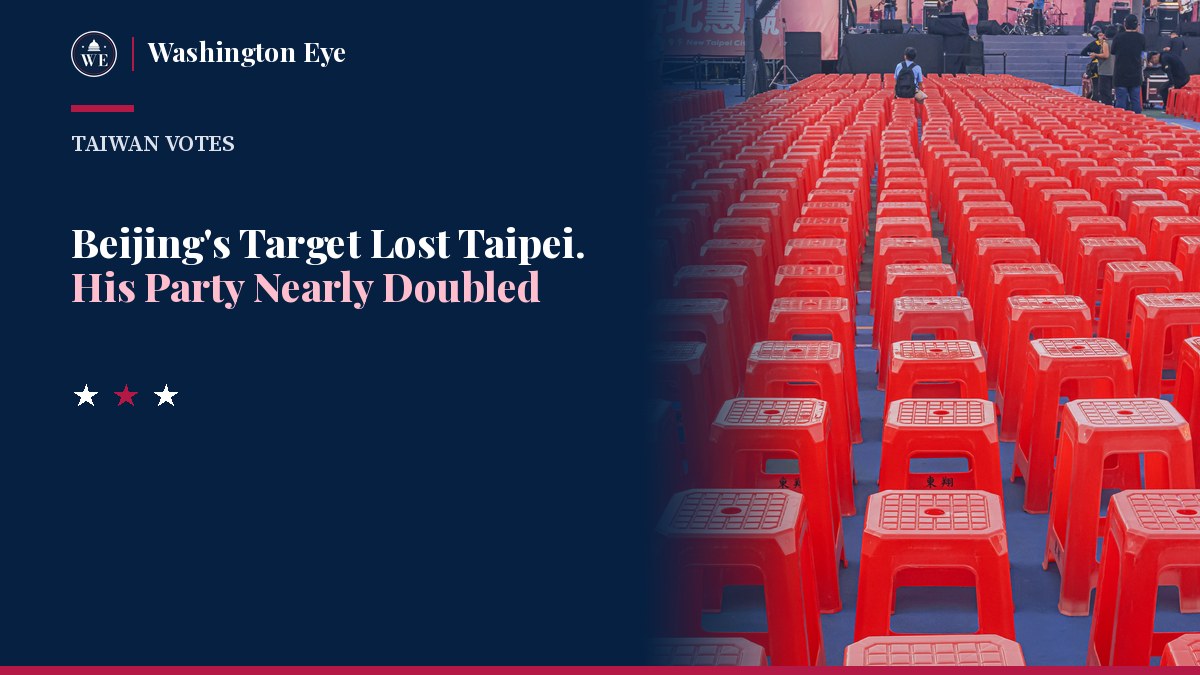
Puma Shen did not wait for the official count. Less than four hours after Taiwan's polls closed on Saturday, the opposition's most famous target in Beijing walked onto a stage in Taipei in front of thousands of supporters and said it plainly: "The result is already out. I lost."
On the face of it, that was the night's headline. Shen, a criminologist turned lawmaker whom China has branded a "separatist" and barred from entering the mainland, had spent six months turning an underdog bid for the capital into the most watched race on the island. He came up well short. With almost every ballot counted, Taipei Mayor Chiang Wan-an of the Kuomintang, the party that favours closer ties with Beijing, had about 53.7 per cent of the vote to Shen's 45.7 per cent.
But step back from the capital and the map tells a different story. Going into Saturday, President Lai Ching-te's Democratic Progressive Party held just five of Taiwan's 22 cities and counties. By late Saturday night it had declared victory in nine. The Kuomintang, which swept 14 races four years ago, had claimed ten, with two contests still too close to call. Beijing's least favourite candidate lost, and his party still nearly doubled its local footprint.
<h2>Where the map moved</h2>
The biggest prize to change hands was Taichung, Taiwan's second most populous city and a Kuomintang fortress for the past eight years. The Democratic Progressive Party's Ho Hsin-chun beat Kuomintang lawmaker Johnny Chiang by roughly 50.7 per cent to 48.4 per cent, a margin of about 35,000 votes out of more than 1.5 million cast. Four years ago the Kuomintang won the city by more than 20 points.
The governing party also flipped Changhua County after eight years of opposition control, took back Yilan County and Chiayi City, and won Hsinchu County for the first time since 1997, a result that breaks one of the opposition's oldest strongholds in the island's technology belt. In the south, its heartland held firm. Chen Ting-fei won Tainan with about 52.5 per cent and will become the city's first female mayor, while Lai Jui-lung kept Kaohsiung with about 52.9 per cent.
The Kuomintang's consolation was the north. Beyond Taipei, it held Taoyuan, where Mayor Chang San-cheng won about 55.7 per cent, and New Taipei, the most populous city on the island, where Lee Shu-chuan edged the governing party's Su Chiao-hui by roughly 51.2 per cent to 48.3 per cent before she conceded. It also kept Keelung, Miaoli, Nantou, Taitung, Kinmen and Lienchiang, and won back Penghu County from the governing party. Hsinchu City stayed with its incumbent, Kao Hung-an, who ran as an independent. Hualien and Yunlin were within the 0.3 per cent margin that allows a recount, and in Hualien an independent candidate said he would ask for one.
Of the six big special municipalities, the split is now three each, after four to two in the Kuomintang's favour in 2022. All of these figures are candidates' declarations and the electoral commission's running count; results become official only when the commission confirms them.
<h2>Why the capital went the other way</h2>
Polls in the final weeks had shown Shen closing the gap and in some surveys edging ahead. Preliminary turnout in Taipei reached 68.85 per cent, above the 67.7 per cent recorded in the 2022 mayoral race. The extra voters did not break his way.
Albert Tzeng, a former Kuomintang adviser, said Shen had run "a very innovative campaign" built on social media and street energy, but that Chiang held the city's "more senior, conservative population." Those voters, he argued, were undercounted in polls because of their "reluctance to express their political preferences." His most pointed observation was about what drove them out. "The strongest force that mobilised them is not the campaign of the KMT," he said, "but the reaction to the aggressive presence of Shen's supporters."
Chiang, 47, was gracious and brief. "I thank the great citizens of Taipei for using their sacred ballots to affirm the administration's performance over the past four years," he told supporters. He now leaves the night as one of the most talked about names in his party for the 2028 presidential race, even though the Kuomintang's wider result makes that conversation harder.
Shen, 44, may also have won something by losing. He entered the race with low name recognition and no campaign experience, and finished with a national following. Before polling, he had said that whoever won, the Taipei race would be a victory for democracy in the face of pressure from China.
<h2>The shadow over the ballot</h2>
That pressure was not abstract. Taiwan's defence ministry said on Saturday morning that it had detected 33 Chinese military aircraft and eight warships around the island in the previous 24 hours. On the eve of the vote, Chinese state media ran a fresh series of attacks on Shen. Taiwan's government had warned for weeks that Beijing was using "cognitive warfare" and "transnational repression" to tilt the elections, and officials pointed to thousands of suspected disinformation incidents, including AI generated videos aimed at politicians Beijing dislikes.
China rejects those claims. A spokesperson for its Taiwan Affairs Office, Zhu Fenglian, has said the allegations were designed to "stir up anti-China sentiment to win votes."
Read one way, Beijing got the result it wanted in the one race it campaigned against most loudly. Read another, the party it attacks hardest gained ground almost everywhere else. Both readings are true, which is why the night is unlikely to settle much about cross-strait politics on its own. Local races in Taiwan turn on transport, childcare, housing and urban renewal, and the candidates spent weeks posing for selfies in night markets and waving from the backs of pick-up trucks, not debating sovereignty.
<h2>A verdict on nuclear power</h2>
The vote that may matter most beyond the island was not a race at all. Alongside the local elections, Taiwan held a national referendum on whether the government should use nuclear power to boost the economy and abolish its "nuclear-free homeland" policy. By 9 p.m. local time the electoral commission's count showed more than 7.1 million yes votes against about 4.4 million no votes, comfortably clearing the threshold of roughly five million, a quarter of all eligible voters, that a referendum needs to pass.
It was the island's fourth national referendum on nuclear power since 2018, and it comes 18 months after Taiwan shut down its last reactor in May 2025. For an economy that powers a large share of the world's most advanced chips, and that imports most of its energy by sea through waters China could one day try to blockade, the result reopens a debate the governing party had considered closed. The referendum's outcome becomes official only when the commission announces it.
<h2>What it means for 2028</h2>
For the Kuomintang chair, Cheng Li-wun, this was the first test at the polls since she took over the party in October 2025, and it is a mixed one at best. Cheng, whose openly friendly stance toward Beijing has unsettled parts of her own party and who met Chinese leader Xi Jinping in Beijing in April, campaigned hard in Yilan, Hsinchu County and Changhua. All three fell to the governing party. Before the vote, the political scientist Kharis Templeman sketched a scenario in which the governing party picked up Yilan, Changhua and Chiayi City and won New Taipei, which he said "would be quite bad for Cheng." Three of those four happened.
The Kuomintang will now begin arguing over its 2028 ticket. The names in play include the outgoing Taichung mayor Lu Shiow-yen, whose city has just fallen to the other side, legislative speaker Han Kuo-yu, Chiang himself and possibly Cheng. Pressure on the chair to step aside is likely to grow.
For Lai, the night is the mirror image of 2022. After heavy losses that year, his predecessor Tsai Ing-wen resigned as party chair, saying, "I must shoulder all the responsibility." Lai faces no such reckoning. He has spent much of his term fighting an opposition-controlled legislature over budgets and policy, and his allies suffered a bruising defeat last year when a mass campaign to recall opposition lawmakers failed. Saturday's result gives him something he has lacked since then: evidence that his party can still win outside its southern base.
Analysts caution against reading too much into it. Taiwanese local elections have a long record of pointing the wrong way. The Kuomintang crushed the governing party in 2018 and again in 2022, and lost the presidency both times that followed. The point of these results is less a forecast than a correction: neither the story of Kuomintang dominance at the local level nor the story of a Shen wave was the whole truth.
<h2>Why Washington should care</h2>
For the United States, Taiwan's voters delivered a message that should be reassuring and unsettling at once. Reassuring, because a democracy under constant military and information pressure from its largest neighbour turned out in high numbers, rejected neither of its main parties, conceded gracefully within hours and moved on. Unsettling, because the referendum shows Taiwanese voters are increasingly focused on energy security, and the rise of a Beijing-friendly opposition chair means American policymakers can no longer assume the island's next government will look like the current one.
Washington tends to view Taiwan through one lens: how ready it is to resist pressure from China. Taiwan's voters, on Saturday, looked through several at once. They kept the capital in friendly hands with Beijing, handed the president's party its best local result in years, and voted to bring back the power source the government had just abandoned. Anyone hoping for a simple verdict will be disappointed. Anyone looking for a working democracy will not.