
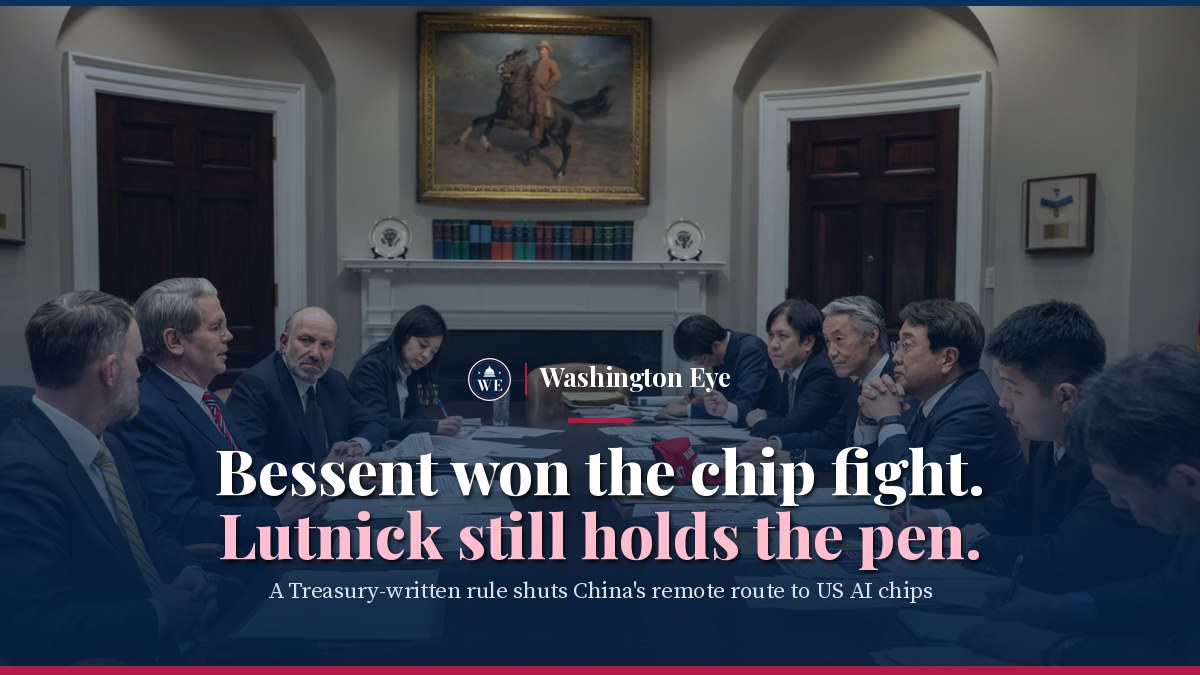
For a week, the fight inside the Trump administration over American AI chips and China played out in television interviews and anonymous briefings. On Monday it became a federal regulation. The Commerce Department's Bureau of Industry and Security released an interim final rule to stop Chinese companies from renting the computing power they are not allowed to buy, and the bureau's own announcement said the rule was "written by and at the direction of the Department of Treasury and the National Security Council."
That sentence is unusual. Export controls on chips are Commerce's job, and agencies rarely advertise that another department drafted their rules. It is the clearest sign yet that Treasury Secretary Scott Bessent, who has spent days publicly questioning how Commerce handled the Nvidia scandal, has won the policy argument. Whether he has won the larger fight is a different question, because the man he has been fighting, Commerce Secretary Howard Lutnick, still controls how the new rule is enforced, and President Donald Trump made clear on Monday that he is in no hurry to pick a side.
The problem the rule targets is simple to describe. Since 2022 Washington has tried to keep the most advanced American AI chips out of China by restricting where they can be shipped. But a chip does not need to be in China to be useful to a Chinese company. A data center in Southeast Asia can buy the chips legally, rack them, and sell access over the internet to whoever pays. Until now, selling remote access to AI servers to customers in China was legal. The rule's preamble describes that gap as a way for "existing restrictions on access to sensitive American technology" to be "circumvented through remote computing arrangements involving data centers in third countries."
The rule closes it in three main ways. First, it creates a new licence requirement for any data center, anywhere in the world, that supplies a large volume of computing power to companies headquartered in China, Macau or the other countries on a US list of arms-embargoed destinations. The threshold is technical, 12 million units of what the rule calls "aggregate TPP", a measure of chip performance, counted at one site or across linked data centers. Data centers already providing that kind of service must obtain a licence within 90 days of the rule taking effect "or face future export restrictions," the text says. Operators, chip exporters and foreign foundries must also do "robust due diligence" on who really owns their customers, and licence holders face monthly reporting.
Second, the rule adds a country licence requirement for advanced chips going to five places where Washington sees "an unacceptable risk of diversion": Indonesia, Malaysia, Singapore, Thailand and Brazil. Buyers headquartered in the United States are exempt if the exporter meets new reporting requirements. Third, it scraps the worldwide licence requirement created by the Biden administration's January 2025 AI diffusion framework, replacing it with what the rule calls "more focused and effective" destination and end-use controls.
There is one notable carve-out. The licence requirement does not apply to computing power used "exclusively" for commercial recommender systems, the algorithms that online retailers and social media companies use to decide what users see. The rule says those functions "do not pose the same national security threat" as training advanced AI models. The rule is effective when it is published in the Federal Register, with a 60-day window for public comment afterward. In a sign of how far the administration's language has shifted, the text also replaces "artificial intelligence" with "super intelligence" throughout, citing a presidential executive order.
The five countries were not picked at random. The scandal that forced Jensen Huang out as Nvidia's chief executive last week centres on Megaspeed, a Singapore-based cloud and data center company that became one of Nvidia's biggest customers and that US authorities have investigated on suspicion of moving restricted chips into China. Mr. Huang admitted an affair with Alice Huang, a former Megaspeed executive whom US officials suspect of working for Chinese intelligence. The two are not related.
US investigators have alleged that Alice Huang used industry contacts and a series of shell companies to gain access to 240,000 chips banned for export to China, according to a report by a US television network. China has denied that she was a spy. Megaspeed has denied that any smuggling took place and has launched its own internal review. Congress is still trying to get answers from Nvidia; a spokesperson for House Foreign Affairs Committee Chair Brian Mast said "negotiations are still going" over Mr. Huang testifying before three House committees.
Read against that background, the rule is a direct answer to the Megaspeed business model. A Singapore data center serving Chinese clients would now need a licence to receive the chips in the first place, and another to keep selling large amounts of computing power to Chinese-owned customers.
The fingerprints on the rule matter because of what Mr. Bessent has been saying for days. Last Friday he told a television interviewer that Treasury, the State Department, the Pentagon and the Office of the US Trade Representative all "were in favor of putting Megaspeed on the entity list for months," adding, "My deputy has been pushing this for months." Asked why it had not happened, he said: "Commerce has the pen, and you will have to ask them about their internal processes."
He has also tried to move attention away from the personal side of the scandal and toward the companies involved. "The real story here should be: Did Nvidia know their client, and was there a robust effort at Nvidia to make sure that there was no leakage and that they were selling to what were obviously pass-through shell companies?" he said in another television appearance. "I think it's important that anyone at the company there be held accountable for that."
Three people familiar with the matter told a Washington political news site that Mr. Bessent pushed the rule through over Commerce objections. Commerce's own credit line for the rule supports that account. A Commerce spokesperson, for their part, told a major American newspaper that Mr. Bessent has never confronted Mr. Lutnick over his handling of Megaspeed.
Megaspeed, notably, is still not on the Entity List, the Commerce blacklist Mr. Bessent wanted it added to. The new rule tightens the system around companies like it without naming it.
If Mr. Bessent expected the president to seal his victory, he did not get it. Speaking to reporters on Monday morning as he left the White House for a trip to Asia, hours after his own White House had directed the crackdown, Mr. Trump sounded more like a referee than a commander.
"If you did do something, you could have a blow-up with China," he said. "We're having a very good relationship with China right now, and I understand both sides of it. And I'll make a decision, but I understand very well both sides." He said Mr. Lutnick had been right to delay blacklisting Megaspeed for that reason, said he had no plans to replace him, and called his commerce secretary's performance "a very good job." A White House official said Mr. Lutnick would travel with the president on the Asia trip.
Mr. Trump went further on the scandal itself. He said he did not believe his relationship with Jensen Huang had put national security at risk, and he questioned the spying allegation. "Nobody's proven that she's a spy," he said. "She may not be a spy." On Mr. Huang's future, he said "I think he learned a big lesson" and added, "I would certainly not mind seeing that" when asked about a return to Nvidia. An online petition calling for Mr. Huang's reinstatement has gathered more than 177,000 signatures.
The result is a strange split screen. The administration has formally accepted the hawkish diagnosis that Chinese firms were exploiting a loophole through overseas data centers. The president, on his way to meet Chinese leader Xi Jinping, is publicly sceptical of the central allegation behind it and keeps the official who resisted the crackdown in charge of running it.
That is where Mr. Bessent's victory may prove thinner than it looks. A rule is only as strong as the agency that enforces it. Licences under the new framework will be reviewed case by case by Commerce. Decisions about which countries are "tolerating evasion", which companies get their status downgraded and which firms land on the Entity List all sit with Commerce. Treasury can draft a regulation; it cannot run the licensing desk. As a major American newspaper noted in its own reporting, enforcement "would be up to the Commerce Department."
Supporters of the rule argue that the text itself does a lot of the work. Because data center operators must now prove who ultimately owns their customers, the burden shifts onto companies, and the 90-day deadline forces existing arrangements into the open. Sceptics point to the same week's events: the agency that would judge those licence applications spent months declining to blacklist the company at the centre of the scandal, according to the Treasury secretary himself.
The timing could hardly be more sensitive. Mr. Trump is heading to an Association of Southeast Asian Nations summit in Manila and then to Shenzhen for a meeting with Mr. Xi and Russian President Vladimir Putin, with nuclear arms, Ukraine, Iran and trade on the table. A senior administration official, speaking anonymously, said Mr. Trump did not expect countermeasures from China.
Chinese commentators were less relaxed. Hong Yuan, a researcher at the Chinese Academy of Social Sciences, told a Chinese state newspaper that Washington had handed down "a political conviction, substituting suspicion for proof." Chinese analysts quoted in state and Hong Kong media argued that the rule could push Chinese firms faster toward home-grown chips, and that American companies "stand to lose" customers and influence for years.
Three things will show who really won this week. The first is whether Commerce adds Megaspeed or similar firms to the Entity List now that the rule is out; Mr. Trump's comments suggest that is not imminent. The second is how many licence applications Commerce receives from data centers in the five named countries within the 90-day window, and how quickly it rules on them. The third is whether China raises the rule in Shenzhen, and whether Mr. Trump, who said he will "make a decision", treats it as a bargaining chip.
For now, Washington has a tougher chip policy written by one department, enforced by another, and endorsed by a president who says he understands both of them. That may hold together while the cameras are on. The test comes when the first licence request from a Singapore data center lands on Mr. Lutnick's desk.