
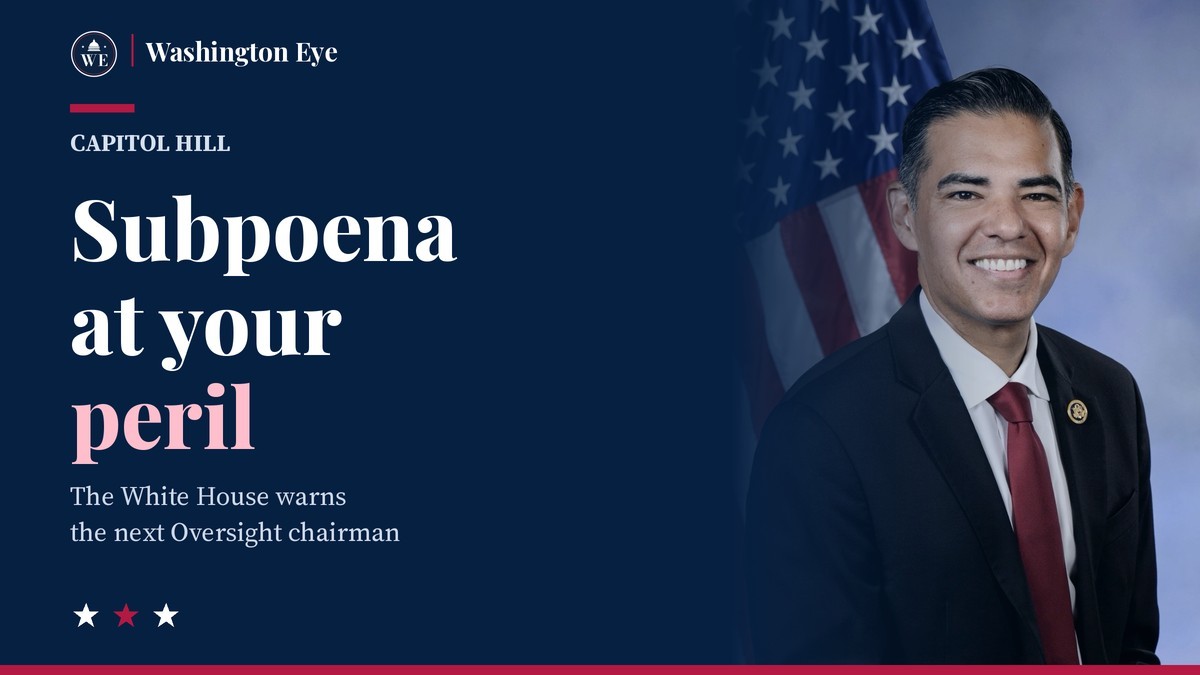
Congress has not yet changed hands, and the subpoenas have not yet been written. But the White House has already told the man most likely to sign them that he may be committing a crime. In a letter dated Monday, White House counsel Will Scharf warned Representative Robert Garcia of California, the senior Democrat on the House Oversight Committee and its probable chairman from January, that some of the investigations his party is planning "may cross the line into blatant criminality."
It is one of the most aggressive opening moves any administration has made against an incoming congressional majority. Presidents of both parties have resisted oversight, slow walked document requests and fought subpoenas in court. What is unusual here is the suggestion, put in writing by the president's chief lawyer, that the act of investigating could itself be a matter for criminal inquiry.
The key passage is short. "Threats to executive branch officials designed to deter them from public service, or process designed merely to abuse or instill fear in the recipient may cross the line into blatant criminality," Scharf wrote. "And issuing unlawful subpoenas with the intention of depriving citizens of their constitutional rights and privileges may warrant further investigation."
Around that warning the letter builds a familiar argument. Congress, Scharf writes, may only investigate in support of a legitimate legislative purpose, not as a tool of what he calls "criminal persecution." He argues that Democrats' public statements show their probes are designed "to harass and aggrandize rather than to advance any legitimate legislative end." And he closes the door on compromise in tone if not in law: "The administration will not be extorted and will not be cowed."
Much of the letter is aimed at Garcia's own words. After the November 3 midterms gave Democrats control of both chambers, he posted a two-word message to administration officials: "Lawyer up." He repeated the theme in a short video, saying Americans were "tired of the unprecedented level of corruption coming out of this White House." Scharf quotes Garcia's remarks on a podcast and a social media image he shared, writing: "Bizarrely, you have chalked your motives up to nothing more than 'gay' 'pettiness' rather than any legislative purpose and compared yourself to a demonic clown."
The letter did not come out of nowhere. On Saturday, President Donald Trump called Democrats' threats to investigate his administration "illegal" in a social media post and said he was "ordering the Department of Justice to look into this criminal act, immediately!" The next day, in a television interview, Attorney General Todd Blanche declined to rule out investigating Democratic lawmakers. Asked whether their conduct amounted to a crime, he answered: "It depends on what's said." He added that he "would be very worried" if he sat on the committee, while saying the department would continue to respond to Congress through the normal channels of letters and subpoenas.
What Scharf's letter adds is formality. A post from the president can be dismissed as rhetoric, and an attorney general's answer in an interview can be walked back. A signed letter from the White House counsel to a named member of Congress is a statement of position. It tells Garcia, and every Democrat who expects to chair a committee next year, how the administration intends to treat their requests.
Garcia's answer was immediate. "It appears Donald Trump has something to hide," he said in a statement. "Let's be clear: Congress' authority comes from Article I of the Constitution, not from the permission of the White House. Congress has wide latitude to conduct investigations and oversight, an authority inherent in the power to legislate." He had already said after the attorney general's interview: "They can come after us however they want. We're not going to be intimidated."
On the law, Garcia stands on firm ground, though not unlimited ground. The Supreme Court held in McGrain v. Daugherty in 1927 that the power to investigate, and to compel testimony, is an essential part of the power to legislate. Congress cannot make good laws, the justices reasoned, without information, and it cannot always rely on people to volunteer it. That principle has survived every test since.
The limits are real too, and Scharf leans on them. In Watkins v. United States in 1957, the court said there is no congressional power "to expose for the sake of exposure," and that investigations must be related to a valid legislative task. In Trump v. Mazars in 2020, a case about subpoenas for Trump's personal financial records from his first term, the court set out a stricter test when Congress seeks a sitting president's own papers, asking whether the information is really needed, whether the request is no broader than necessary and whether the stated purpose is backed by evidence. Those cases give an administration grounds to resist particular subpoenas in court. None of them suggests that issuing a subpoena is a crime.
There is a further barrier. The Constitution's Speech or Debate Clause says members of Congress "shall not be questioned in any other Place" for their legislative work. The Supreme Court has read that protection broadly. In Eastland v. United States Servicemen's Fund in 1975, it held that a Senate subcommittee's issuance of a subpoena was a legislative act shielded by the clause. A prosecution built on a lawmaker's decision to issue a subpoena would run straight into that precedent.
The quoted passages of the letter do not cite a specific criminal statute. The phrase about "depriving citizens of their constitutional rights" echoes the language of federal civil rights law, which makes it a crime to deprive a person of constitutional rights under colour of law. Applying such a provision to a committee chairman's subpoena would be novel, and many legal scholars would say impossible under the Speech or Debate Clause. Scharf's wording is careful: conduct "may" cross the line and "may" warrant investigation. It is a warning, not a charge.
The administration's defenders see the letter differently. In their view it is a response to Democrats who have spoken openly about jail and prosecution, not about legislation, and who have suggested that officials, donors and people considering government jobs should fear what comes next. Blanche has argued that criticism of the administration is protected speech but that some language aimed at its supporters goes beyond legitimate scrutiny. Supporters also note that Republicans endured years of Democratic investigations in Trump's first term, and that the White House is entitled to set out, early and in writing, the constitutional limits it intends to enforce.
There is also a recent record that gives the warning weight beyond its words. The administration has already pursued criminal cases against several Democratic members of Congress. Grand juries declined to indict six lawmakers who appeared in a video urging service members to refuse illegal orders, but other cases remain open. Democrats who read the Scharf letter will not treat it as an abstract statement of constitutional theory.
Democratic leaders have tried to keep their message steady. Hakeem Jeffries, who is expected to become Speaker when the new Congress meets, has said lawmakers should "follow the facts, apply the law, be guided by the Constitution at all times." He has paired talk of accountability with legislative priorities such as reversing cuts to Medicaid and food assistance and extending Affordable Care Act tax credits. That pairing matters, because it is exactly the legislative purpose that the courts look for when a subpoena is challenged.
Garcia, for his part, has begun to name targets. He has pointed to Elon Musk's role in cutting the federal workforce and to immigration decisions associated with Stephen Miller, now the White House chief of staff. Both lines of inquiry touch areas where Congress writes and funds the law, which strengthens the case for a legislative purpose. Other proposed investigations, particularly any that reach the president's family, would face a harder test under the Mazars standard.
Three things are worth watching as January approaches. The first is whether the Justice Department actually opens an inquiry in response to the president's Saturday demand. As of Sunday it remained unclear whether any investigation had begun. The second is how Democrats draft their first requests. Committees that tie each demand to a specific bill or spending decision will be far better placed in court than those that rely on broad claims of corruption. The third is whether Republicans in Congress, now heading into the minority under a leadership built around fighting oversight, defend the principle of congressional investigation they relied on when they held the gavel.
For now the letter has done what it was designed to do: frame the next two years before they begin. The White House has signalled that it will not simply refuse documents and litigate. It will question the legitimacy, and possibly the legality, of the investigators themselves. Democrats have signalled that they will not be deterred. Between those positions sits a century of case law that has, so far, favoured a Congress that investigates with a clear purpose. Whether that body of law is tested in a courtroom or only in the court of public opinion may be the defining oversight question of 2027.