
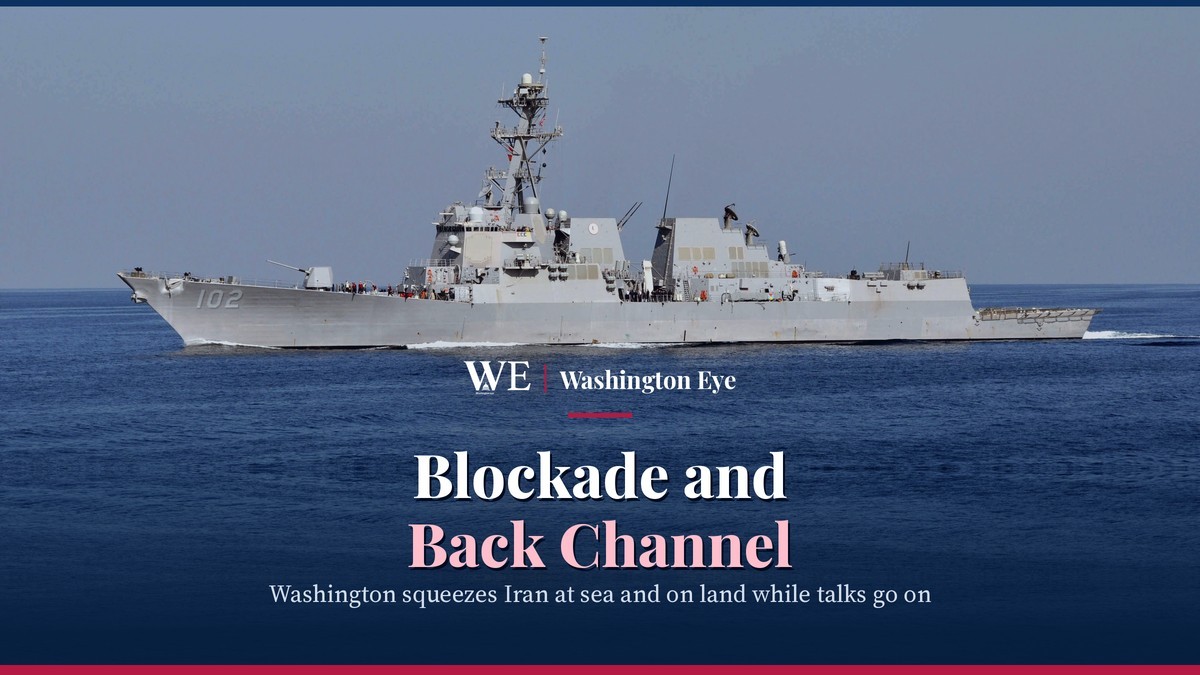
On Saturday, 7 November, a United States military aircraft fired precision munitions into the stern of a cargo ship in the Gulf of Oman. The vessel, the St. Kitts and Nevis flagged bulk carrier M/V Huda, had called at an Iranian port and was trying to leave regional waters. According to US Central Command, its civilian crew ignored repeated warnings and tried to break the American naval blockade of Iran several times before the strike. The crew, the command said, had first been told to abandon the parts of the ship that were about to be hit.
On the same day, the same command announced a new unit, Task Force Iron Gate, to choke off Iran's land borders and its routes across the Caspian Sea. And in the background, through Qatari and Pakistani intermediaries, the vice president of the United States has spent roughly two weeks trying to revive a ceasefire and restart nuclear talks with Tehran.
Put those three facts side by side and the shape of American Iran policy five days after the midterm elections becomes clearer. Washington is tightening the physical squeeze on Iran at sea and on land while keeping a diplomatic channel open at the highest level. The question is whether those two tracks reinforce each other or quietly work against each other, and how long either can last now that the president's party has lost both chambers of Congress.
The Huda is not a large ship. Trade press descriptions put it at just under 25,000 deadweight tonnes, 159 metres long, built in 1999 and under Turkish management. One maritime publication noted that the vessel did not appear to be under sanctions. The British military's maritime trade reporting centre placed the ship about 18 nautical miles east of Khor Fakkan, on the coast of the United Arab Emirates, and said the status of the crew was unknown. Central Command did not say how badly the ship was damaged.
What makes the strike notable is less its size than its timing. It was the first ship the United States reported disabling since 10 October, when another bulk carrier, the Ocean Molica, was struck in the same waters after it too left an Iranian port. In the weeks between, the blockade continued, but mostly without force. Central Command says that since it resumed the blockade in mid July, 147 commercial vessels have complied with orders and turned back, and five that refused have been disabled. Before that phase, American forces destroyed ten tankers that US officials linked to Iran's oil trade.
The command's own statement was blunt. "CENTCOM continues to strictly enforce America's naval blockade against Iran," it said, advising all mariners near Iranian waters to heed blockade warnings from US forces. The message was aimed as much at shipowners and insurers as at Tehran. A blockade only works if the people who run merchant fleets believe the penalty for testing it is real. A single strike after a month of quiet is a reminder that the rules have not changed because the political weather in Washington has.
The sea around Iran has not been calm. The maritime trade reporting centre recorded six confirmed attacks in the region in the first days of November and five more in the last days of October, while Iran has issued near daily claims of ships hitting mines in the Strait of Hormuz. By the centre's count, 133 vessels have been damaged in the region so far this year, with 82 people injured or killed. Iran, for its part, has demanded that the blockade be lifted as a condition for reopening the strait.
The second announcement on Saturday may matter more over time. Admiral Brad Cooper, the head of Central Command, directed the creation of Task Force Iron Gate, a staff of about 20 civilian and military personnel based in Tampa, Florida. Its job, in the command's words, is to coordinate with other agencies to stop "the movement of advanced weapons systems, dual-use technologies, sanctioned materials, and illegal revenue streams across Iran's land borders and the Caspian Sea."
"The establishment of Task Force Iron Gate reinforces the success of our ironclad blockade against Iran at sea," Cooper said. "Strengthening CENTCOM's collaboration with U.S. interagency partners will further constrain Iran's ability to finance terrorism, rebuild weapons factories, and replenish their military." The command says the naval blockade has already kept more than $25 billion worth of Iranian crude off world markets in recent months.
The logic is straightforward. If the sea lanes are closed, cargo moves by other routes. A recent investigation by a major wire service reported that Iran built a network of military agencies that imported at least $2 billion in hardware, explosives and heavy trucks since January 2025, by ship across the Caspian from Russia, by road from Central Asia and by cargo plane from China. A US military official, speaking anonymously, said the new task force would work with the Treasury, State and Justice Departments and the intelligence community. Regional reporting noted that a command graphic highlighted Iran's borders with Turkey, Afghanistan, Turkmenistan and Pakistan.
Twenty people in Florida will not seal a land border that runs for thousands of kilometres. The task force is a coordinating cell, not a fleet. Its tools will be sanctions designations, intelligence sharing, pressure on transit countries and, possibly, prosecutions. That makes it slower and less visible than a strike on a ship's stern, but potentially more durable, because much of that machinery can keep running regardless of what happens in Congress.
The third track is the quietest. According to a US news site's reporting, citing two sources, Vice President JD Vance has spent the past two weeks personally involved in indirect talks with Iran aimed at a new ceasefire and a return to nuclear negotiations. He has reportedly spoken almost daily with Qatar's prime minister, Sheikh Mohammed bin Abdulrahman Al Thani, and with Pakistan's army chief, Field Marshal Asim Munir. White House envoy Steve Witkoff and Jared Kushner are also said to be involved. About two weeks ago, the reporting says, Vance sent a letter to Mohsen Rezaei, secretary of Iran's Supreme National Security Council, proposing a return to direct negotiations. A working level technical meeting has been discussed but has not yet happened.
Vance's role is not new. He was described as the most sceptical voice in the president's inner circle before the war began at the end of February. He led the American team at an April summit in Islamabad, was involved in the memorandum of understanding reached in June, and led a round of direct talks in Switzerland that ended with an Iranian commitment to invite UN inspectors to its nuclear sites. That framework collapsed after Iran's Revolutionary Guard resumed attacks on shipping. After Tuesday's election, Vance said the war was the main reason voters had repudiated Republicans.
President Trump has, for now, given diplomacy room. "We're talking to them," he told reporters on Friday. He spoke the same morning with the Emir of Qatar, Sheikh Tamim bin Hamad Al Thani, whose office stressed the need to "continue dialogue and pursuing diplomatic means" and to ensure "freedom of maritime navigation and the security of energy supplies." Qatar's prime minister said on Friday evening that the American intention to find a diplomatic solution "is still there" and that a deal remains possible, though he described progress as slow.
Tehran's public tone is harder. On Saturday, Rezaei used a social media platform to mock Washington's leadership after the midterms. "You lost the war and the election," he wrote, before warning: "Start a war, and you'll face a devastating response." His post claimed, without evidence, that senior US officials were on their way out. It was, in part, an attempt to read the election as American weakness. That reading may prove to be a miscalculation, because the blockade and the new task force show that the coercive machinery is still running.
There is also a reminder that the shooting has not fully stopped. On Friday, American forces struck an anti-aircraft missile launcher on Qeshm Island in the Strait of Hormuz after it fired a missile toward a US fighter jet, the president confirmed. Exchanges like that are how ceasefire talks break down, and how a limited blockade can slide back into a wider war.
Supporters of the current approach argue that the pressure tracks and the diplomatic track belong together. In their view, Iran negotiates seriously only when its revenue is falling and its supply lines are under strain, and the strike on the Huda and the launch of Iron Gate are exactly the kind of leverage that gives Vance something to bargain with. Easing off now, they say, would tell Tehran that the midterms bought it time.
Critics see a different risk. Each strike on a merchant ship carries the possibility of casualties, a diplomatic incident with a flag state or a manager's home country, or a retaliatory attack that drowns out the back channel. Expanding the effort to land borders also means pressing neighbouring governments, including Turkey and Pakistan, that Washington needs as partners, and in Pakistan's case as a mediator. Some also argue that a sustained blockade without a clear end point is a war policy by another name, one that should face the scrutiny of Congress.
That scrutiny is coming. Democrats will hold majorities in both the House and the Senate when the new Congress is sworn in on 3 January, and House Democrats have said that ending the Iran war is among their early priorities. Earlier this year, House Democratic leaders forced war powers votes on Iran that fell short. With the gavels in their hands, they will control committee hearings, subpoenas and the annual defence bills, even if a president's veto still stands in the way of a binding war powers resolution.
That calendar gives every party in this story a reason to move. For the administration, a deal reached before January would let it claim the blockade worked and blunt the coming oversight. For Tehran, waiting may look attractive if it believes Congress will tie the president's hands, though nothing in the new majorities forces the Navy to lift the blockade. For the mediators in Doha and Islamabad, the window between now and the new year may be the best chance in months to convert pressure into a written agreement.
What to watch next is concrete. First, whether the working level technical meeting that has been discussed actually takes place, and where. Second, whether further ships test the blockade, and whether Central Command reports more disabling strikes. Third, the first public steps of Task Force Iron Gate, such as sanctions or designations aimed at land and Caspian routes. And finally, the earliest hearings and resolutions from the incoming Democratic majorities on the war.
For now, the strike on the Huda carries a simple message. Whatever the election changed in Washington, it has not yet changed the rules in the Gulf of Oman. Whether that pressure ends up strengthening the vice president's hand at the table, or undercutting it, is the question that will define American Iran policy over the next two months.