
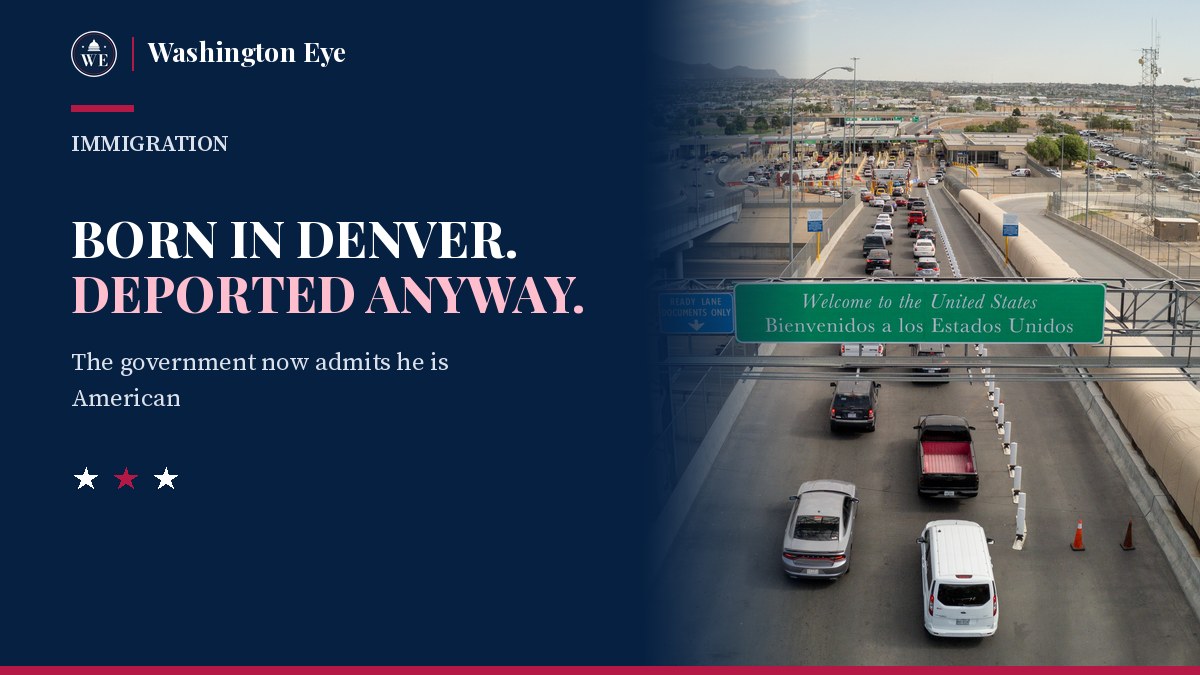
Brian José Morales García was born in Denver. For seven months, the United States government said otherwise. On Friday, in a federal courtroom in Austin, it finally put the truth in writing, in the same filing in which it asked a judge to make sure he could never collect a cent for what happened to him.
"Plaintiff is a dual citizen of the United States and Mexico," Justin Simmons, the US attorney for the Western District of Texas, wrote in a motion to dismiss filed on 20 November. The admission is a sharp reversal. In April, days after Mr Morales García was removed to Mexico, a spokesperson for US Customs and Border Protection told a Texas news site, in capital letters, that "CBP did NOT arrest a U.S. citizen." Agents, the statement said, had determined through record checks that he was in the country illegally, and he had "admitted he is a Mexican national."
Both things cannot be true. One of them is now conceded in a court filing signed by a federal prosecutor. The question left on the table is the one that will decide whether this becomes a footnote or a turning point: when the government deports one of its own citizens, who pays?
The story begins on 3 April on a road near Fredericksburg, in the Texas Hill Country. Mr Morales García, then 25, was a passenger in a pickup truck with his boss and coworkers, on the way to install an air conditioning system. He had recently started the job in Austin after failing to find steady work in Colorado, where his brother lives. State and local officers pulled the truck over. Mr Morales García speaks Spanish and was not carrying identification.
That last detail matters more than it should. Americans are not required to carry proof of citizenship as they go about their day. According to his lawsuit, he told the officers he was born in Colorado and that his birth certificate and Social Security card were at his home in Austin. They did not believe him. They called federal immigration agents. He was taken to the Gillespie County jail and then handed to Border Patrol.
There, court filings say, a Border Patrol agent named Robert Gil Jr. ran checks and found a Mexican civil registration record listing his birthplace as Zacatecas, Mexico. The agent also recorded that Mr Morales García said he was born there, after being warned that giving false information could bring criminal charges, and noted that he spoke only Spanish.
Mr Morales García tells it differently. He has said he told agents he had entered the United States legally through the port of entry at El Paso and had the papers to prove it. "They told me I could go to prison, so I just told them I entered illegally," he said in an earlier interview. His lawsuit says he signed papers agreeing to a rapid return because he feared a long detention and believed leaving was his only realistic option. It also says family and friends tried to bring documents proving his citizenship before he was removed, and were turned away.
On 7 April, four days after the traffic stop, he was in Mexico.
The paper trail of his life is not mysterious. His mother, María del Socorro García, has said she moved from Mexico to Denver in 1999, where she had two sons, Brian and his younger brother, Miguel. In 2002 she took the boys back to Mexico so they could meet their grandfather, who was struggling with diabetes, and the family stayed. In January 2025, a family friend drove Brian from Aguascalientes to Ciudad Juárez and across the bridge into El Paso. He has said he showed border officers his birth certificate and they let him through. He wanted to work, he said, to help provide for his wife, who was three months pregnant at the time.
Children born on American soil are American citizens, whatever their parents' status and wherever they grow up. Many of them, raised in Mexico, also hold Mexican nationality. A Mexican record does not cancel a Colorado birth certificate. Nothing in the public record so far explains why the Colorado document carried less weight than the Mexican one in the hours that counted.
His lawyers filed suit on 1 May in federal court in Austin against Immigration and Customs Enforcement, the Texas Department of Public Safety and the Gillespie County Sheriff's Office, among others. The complaint attached a redacted copy of his birth certificate and of his Social Security card. It seeks an unspecified sum in damages. By late August, the government and his lawyers had reached an agreement that allowed him back. Friday's filing confirms he "was permitted entry" on 30 August after officials reviewed "information concerning plaintiff's place of birth." A preliminary injunction hearing set for September was cancelled.
He is back in Austin and working. He is not reassured. "Am I supposed to just accept that if I get pulled over again, it'll be the same thing?" he said in September. "Will it be the same treatment?"
Here is the twist that makes this case bigger than one man. The government has not apologised and has not offered compensation. Instead, the same motion that calls him a citizen argues that he has no right to sue.
The federal defendants, who include the homeland security secretary, Markwayne Mullin, the ICE leadership and the head of Customs and Border Protection, make two main arguments. The first is sovereign immunity: the United States cannot be sued unless Congress has agreed to it, and the government says Mr Morales García has not shown that it waived that protection for his constitutional claims against officials in their official capacities. The second targets the individual agents. It rests on a 1971 Supreme Court decision, Bivens, which first allowed people to sue federal officers personally for violating their constitutional rights. The government argues that courts have refused to stretch that remedy to claims arising from civil immigration enforcement. It also says Mr Morales García went to Mexico voluntarily.
That second argument is stronger than it might sound to a layman. Over the past decade the Supreme Court has all but frozen Bivens. In 2022, in Egbert v. Boule, it ruled six to three that a man could not sue a Border Patrol agent for damages over an encounter on his own property near the Canadian border, and said that in almost every new context, the decision to create a damages remedy belongs to Congress, not the courts. Lower courts have taken the hint. For people hurt by federal immigration officers, the personal lawsuit has become close to a dead letter.
The other main route, the Federal Tort Claims Act, lets people sue the United States itself for certain wrongs by its employees, such as false imprisonment, but it comes with conditions and exceptions that the government routinely invokes. A separate motion to dismiss, filed the same day on behalf of a man identified in the docket as Philips Bryan, argues that he was never named as a defendant and is not alleged to have personally taken part in the detention. The state and county officers who made the stop and called in federal agents are also defendants, under the civil rights law that covers state and local officials. Judge Robert Pitman, who is hearing the case, has not ruled. He has ordered a status report by 4 December.
Kate Lincoln-Goldfinch, his lawyer, read the filing as a gift. The government, she said, should "underline it right there" in admitting he is a citizen. Her team will oppose dismissal and wants to hold people accountable both at the agency level and among the individuals whose actions led to his removal. "What happened to him is an injustice that shouldn't be repeated," she said.
How often does this happen? Nobody knows, and that is part of the problem. There is no authoritative count of deported citizens. The Government Accountability Office, Congress's own watchdog, found that from 2015 to 2020 immigration agents arrested 674 potential US citizens, detained 121 and removed 70. A nonprofit newsroom investigation last year found that agents had detained more than 170 US citizens in the first nine months of President Trump's second term. Those numbers are small against the scale of enforcement. They are not small to the people in them.
Texas is where the pressure is greatest. The state is home to roughly 1.7 million undocumented immigrants, and hundreds of police agencies there have signed up to work with federal immigration agents. The Department of Public Safety is among the many state and local agencies that cooperate under the federal 287(g) programme. In practice, that means a traffic stop by an officer with little training in the fine print of nationality law can become the first step toward removal, as it did on that road outside Fredericksburg.
The case lands at an awkward moment for the administration. Its mass deportation campaign has drawn criticism from both parties and is widely seen as one factor in the heavy losses Republicans suffered in the 3 November midterms, which cost them control of Congress. The same week brought a lawsuit from Massachusetts accusing ICE of making courthouse arrests in breach of a new state law, and a call from Senate Democrats for an investigation into why ICE has been removing detainees from its online locator. A Democratic Congress that takes its seats in January will have subpoena power and appetite to match.
The defenders of tough enforcement have a fair point to make. Agents in the field work fast, often with conflicting records, and people in custody sometimes give false statements. The government's position is that Mr Morales García said he was Mexican, signed the papers and left. Courts are rightly wary of turning every disputed field decision into a damages claim against an individual officer.
But that argument answers the wrong question. The issue is not whether one agent made an honest mistake on a bad day. It is whether a system that can put a citizen across the border in four days, on the strength of a foreign record and a statement he says was frightened out of him, has any built in way to make that right afterwards. If the answer from the Justice Department is that the citizen should have no remedy at all, then the only real check left is Congress.
That is where this is heading. Lawmakers can write a damages remedy into law for wrongful detention or removal of citizens, require agents to check American birth records before any voluntary return is signed, or demand that the government finally count how many citizens it has detained and deported. None of that needs the Supreme Court to change its mind about Bivens.
Until then, the government's position in Austin can be summed up in two sentences from the same filing. He is a citizen. He cannot sue. Judge Pitman will decide whether the law really leaves it there. Mr Morales García, back at work and still wondering about the next traffic stop, is waiting to find out.