
The Supreme Court did not decide on Monday whether a border wall belongs in Big Bend National Park. It decided something narrower, and in some ways more consequential: that the bulldozers can go back to work while the lawyers keep arguing. In a short unsigned opinion, the justices lifted a Texas judge's order that had frozen border barrier and road construction across the Big Bend region since early October. Only Justice Ketanji Brown Jackson said she would have refused, and she gave no reasons.
The order is temporary in form. It stays the lower court's injunction until the government files and the Court disposes of a petition for full review. In practice it may settle the outcome on the ground long before any final judgment arrives, because a road blasted through a canyon wall cannot be unbuilt if the challengers eventually win. That gap between legal time and physical time is the real story of the Big Bend case.
The dispute turns on a provision of a 1996 immigration law that few Americans have heard of. Section 102 of the Illegal Immigration Reform and Immigrant Responsibility Act allows the Secretary of Homeland Security to build barriers and roads "to deter illegal crossings in areas of high illegal entry," and to "waive all legal requirements" necessary to ensure "expeditious construction." Congress also fenced off the courts. A challenge to a waiver may only allege a violation of the Constitution, district courts have no jurisdiction over anything else, and there is no stop at a federal appeals court on the way to the Supreme Court.
Earlier this year the administration used that power on an unusual scale. Then Homeland Security Secretary Kristi Noem issued a waiver in February, and her successor, Markwayne Mullin, followed with further waivers in May and July. Together they set aside a long list of environmental and conservation laws for construction across what Customs and Border Protection calls the Big Bend Sector. The government says the project involves 341 miles of construction, including inside the national park. The environmental group that sued says the waivers were the first time in American history that such a broad slate of laws, including the Endangered Species Act, the National Wild and Scenic Rivers Act and the law that created the National Park Service, had been swept aside inside a national park.
The plaintiffs are an unlikely coalition: a national environmental nonprofit, a local group formed to preserve a historic church in the border hamlet of Ruidosa, and Danny Miller, a river guide and landowner from Terlingua. "I've spent more than two decades guiding on the river, and if a border wall cuts off access, that's the end of my career," Mr. Miller said when the suit was filed in April. "No one comes to Big Bend to see steel walls and razor wire."
Because the statute allows only constitutional claims, the challengers needed a constitutional theory. They chose the major questions doctrine, the principle that when an agency claims power of vast economic or political significance, Congress must have said so clearly. The Court has used that idea against a Democratic administration's student loan forgiveness and against this administration's tariffs. The plaintiffs argued that waiving "myriad federal, state, local, and tribal laws across vast geography," even through parks "where border crossings are miniscule," was exactly the kind of extraordinary claim the doctrine is meant to check, and that such a violation was a constitutional one.
U.S. District Judge Kathleen Cardone agreed. She issued an injunction from the bench on Oct. 2 and explained it in a written opinion on Oct. 14. Her reasoning leaned heavily on the government's own numbers. The Big Bend Sector, she wrote, "comprises over 25% of the U.S.-Mexico border" but accounts for only a sliver of apprehensions, between 0.3 and 2.2 percent. "If the Big Bend Sector is an area of high illegal entry, so is every other sector, and the waiver authority would apply to the entire U.S.-Mexico border," she wrote. Reading the law that way, she concluded, would render the phrase "high illegal entry" meaningless.
The Supreme Court did not engage with that factual argument at all. It did not have to. Its four pages rest on a jurisdictional point. The challengers' claim, the justices wrote, however it is labeled, alleges that the Secretary "exceeded his statutory authority," and the Court has long held that such claims are not constitutional ones. The major questions doctrine, in this view, is a rule for reading statutes, like the canon of constitutional avoidance, not a free-standing constitutional right. "There is no such thing as a 'constitutional' major-questions claim," the opinion says. The government, it concluded, is "exceedingly likely to prevail."
That single sentence may outlast the border dispute. Challengers to executive power have increasingly reached for the major questions doctrine, and the doctrine's own roots in the separation of powers invited the argument that it carries constitutional weight. Monday's opinion closes that door, at least in statutes like this one that permit only constitutional claims. For a Congress that writes waiver laws and limits judicial review, the message is that the limits mean what they say.
The rest of the opinion weighed the practical harms, and here the Court sided firmly with the executive. The injunction, the justices wrote, impedes the government's "compelling interests" in border security. They credited a declaration from a border agency official that the pause was costing "nearly half a million dollars" a day in expenses that could never be recovered. And they read the waiver statute itself as a congressional judgment that speed matters more than the harms the challengers described. The government's interest, the Court said, "outweighs any aesthetic, recreational, and environmental harm."
The justices also declined to go as far as the administration wanted. Solicitor General D. John Sauer had asked the Court to summarily reverse Judge Cardone without further briefing or argument. The Court refused that request and granted only the stay. The underlying lawsuit continues, and the challengers can still press their case. But they will do so while construction proceeds.
The administration welcomed the result. James Percival, the Department of Homeland Security's general counsel, wrote on a social media platform that he had called the district court's order "as unprecedented as it is flawed" when the government filed its appeal. "We just won 8-1," he added. Officials have argued that leaving Big Bend open while the rest of the wall is completed would turn the region into a gap that smugglers would exploit. The administration says about 89,000 people have been detained trying to cross there in recent years, and with construction money from the Republican Congress it is pursuing a 2,000-mile system of steel panels, vehicle barriers and surveillance technology.
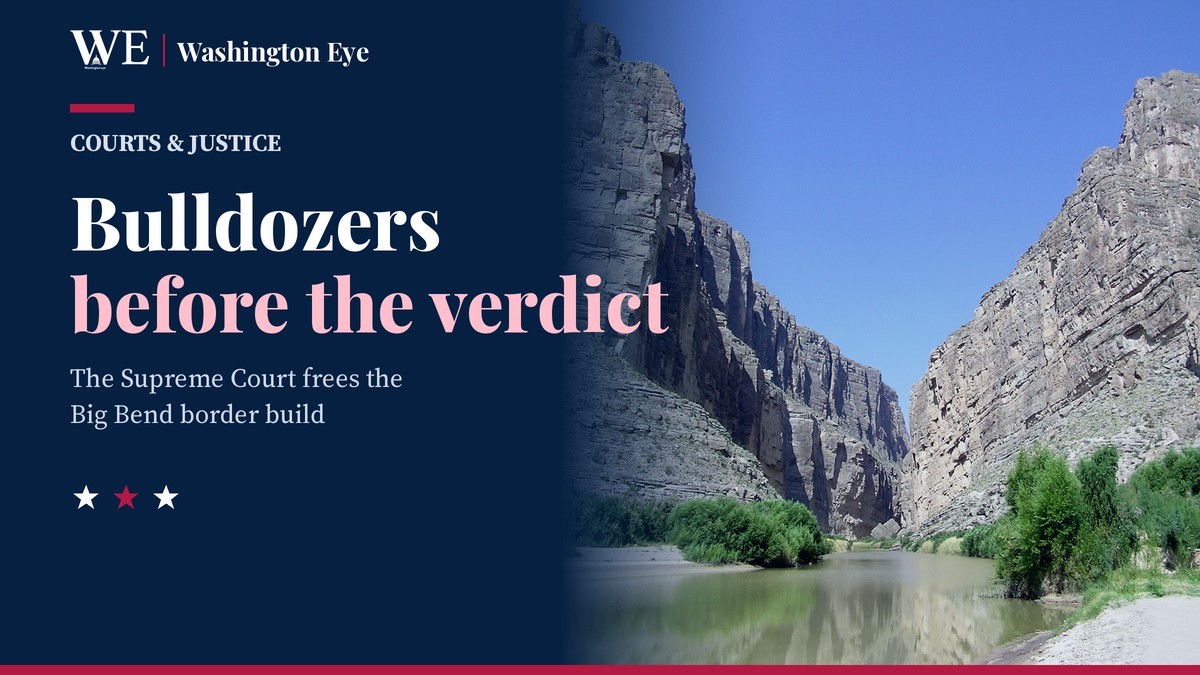
The plaintiffs were bitter. "This horrific decision clears the way for contractors to bulldoze pristine desert and dynamite canyon walls before the courts have even decided whether this destruction is legal," said Laiken Jordahl of the environmental group that brought the case. His organisation says bulldozers first cut into the park near Santa Elena Canyon on Aug. 6 and carved new routes on both sides of Mariscal Mountain, a remote area where, it says, the agency's own maps show vehicle barriers that would require extensive dynamite blasting.
What happens next on the ground is less certain than the ruling suggests. The construction has already been paused once for political reasons. After video of bulldozers in the desert drew outrage across party lines, Customs and Border Protection announced a pause on Aug. 17 that lapsed at the end of September. On Monday the agency's commissioner, Rodney Scott, signalled that the plan has changed again. "CBP has reevaluated the terrain, listened to local stakeholders, and made meaningful adjustments that will secure this critical stretch of border while preserving the unique landscape and public access for generations to come," he said, promising details soon. Border Patrol officials have said before that they are not building a continuous wall through the park itself but clearing roads for patrols and surveillance equipment.
The politics in Texas have shifted too. Opposition to the Big Bend project has never been purely partisan. On the day of the ruling, Senator John Cornyn, the state's outgoing Republican senator, argued in a newspaper column that "a border wall is not the best solution for portions of this environment" and that Big Bend "deserves border security that reflects the realities of its geography." The region's incoming Democratic congresswoman, Rep.-elect Katy Padilla Stout, put it more bluntly: "No Wall At Big Bend. No Exceptions." Representative Greg Casar, a Texas Democrat, attacked the Court directly and said that "Democrats, Republicans, Texans of all backgrounds all agree: Leave Big Bend alone."
Those voices carry new weight after last week's elections, in which Texas chose its first Democratic senator since 1988 and its first Democratic governor since 1990. More than 140 outfitters, local businesses and recreation groups have urged state leaders to protect access to the Rio Grande, warning that permanent barriers would wipe out a river economy built on a park that draws more than half a million visitors a year. A Democratic Congress arriving in January will control the purse strings for border construction, and it could write limits on spending in the park itself. The Supreme Court's order does nothing to stop that.
The geography makes the case for both sides. The Big Bend Sector is the largest of the nine sectors on the southwest border, running more than 500 miles along the Rio Grande, and it consistently records the fewest illegal crossings. Critics see that as proof the wall is unnecessary, since steep canyons, open desert and extreme heat already act as a barrier. Supporters see it as the logic of a complete system: a barrier is only as strong as its weakest stretch, and a quiet sector may stay quiet only until everything around it is sealed.
The Court has, for now, taken itself out of that argument. Its message on Monday was that Congress gave the Secretary of Homeland Security the power to decide, and gave the courts very little room to second-guess him. If Big Bend is to be spared, the opinion implies, that decision will come from the agency, which says it is rethinking its plans, or from Congress, which wrote the waiver in the first place. For the river guides of Terlingua, the question is whether either moves before the blasting resumes.