
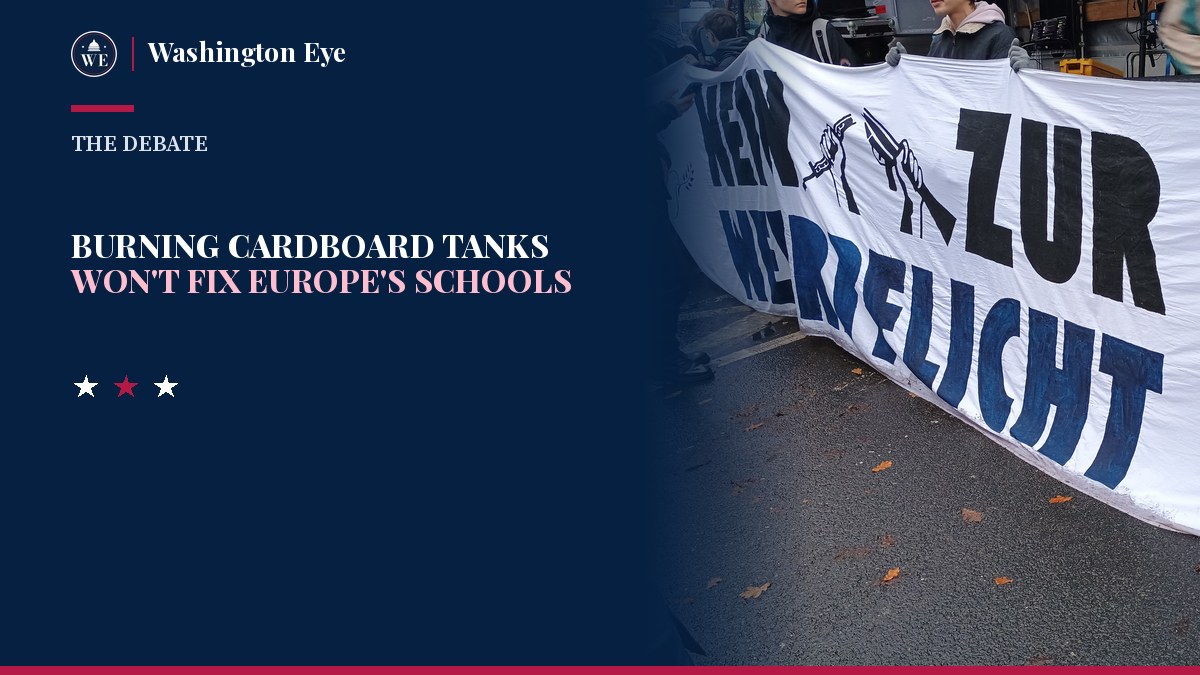
On Friday, in more than twenty European countries, young people did something that looked like theatre and was meant as a verdict. They built tanks out of cardboard and set them on fire. From Rome to Berlin, from Paris to London, students and young workers marched under a single slogan, "fight for our future, not their wars", in what the organising Youth Strike coalition called the biggest coordinated youth protest Europe has seen in years. More than fifty groups took part, and rallies were planned in about 400 cities.
The coalition published five demands. Two of them deserve a serious hearing from every government on the continent: structural investment in education and welfare, and relief from a cost of living that has put a decent flat beyond the reach of a generation. One of them deserves an equally serious answer, and that answer is no. The movement wants an end to what it calls militarisation and conscription. Europe cannot afford to give it that.
Our view is simple. The young protesters have identified the right bill and the wrong enemy. Their schools are falling apart and their rents are absurd, and governments let that happen. But the tank is not what stole their future. The tank is what may have to protect it.
Start with what the protesters get right, because it is a lot. The movement did not begin with soldiers. It began in September in France, with a teachers' strike at a high school in Créteil outside Paris. It spread to more than a thousand high schools. By 17 October at least 550,000 people were on the streets, and the largely peaceful marches were overshadowed by some of the worst rioting France has seen in years. The grievances were concrete and, frankly, shameful for a rich country. One Paris student described a hole in her classroom ceiling and asked how anyone was meant to sit a mock exam "when water is falling on your paper". A 21-year-old described his state student residence as having damp stains along the walls, "cockroaches everywhere, rats".
Paris eventually moved. On 26 October the government offered up to €4 billion in low interest loans to renovate schools, about 3,000 fully qualified replacement teachers, 15,000 extra places in higher education, a proposed cap of 28 pupils per class and a pledge to phase out the much hated Parcoursup university admissions system by 2028. Student unions say they need €10 billion. The government says the public finances cannot stretch that far. Then the students point to something awkward: the same government found €2.3 billion, spread over four years, for a new voluntary military service scheme.
That comparison is the emotional engine of this whole movement, and it is easy to see why it lands. In Italy, the country's largest trade union, the CGIL, staged a 24 hour general strike on the same Friday, its second national stoppage in a matter of weeks, with demonstrations in more than a hundred cities. Its leader, Maurizio Landini, put the case bluntly. "People have very basic problems: they struggle to make ends meet and therefore need higher wages; they need a health care system that works; young people need schools that work," he said of Prime Minister Giorgia Meloni's roughly €26 billion budget for 2027. "This budget does not address a single one of them." Among the union's demands is moving public money away from military spending and towards social services.
A university student in Italy, Laura Peritore, 24, said her generation was living under a government "cutting healthcare and education, taking away our present and trying to rob us of our future". In London, a cardboard sign at Parliament Square read: "I wasn't skipping lectures, I was working to survive." Those are not slogans dreamed up by a think tank. They are the lived arithmetic of people who were children during the financial crisis, teenagers during the pandemic and young adults during an energy shock and a housing squeeze.
So far, the protesters win the argument. Now for where they lose it.
The slogan "not their wars" assumes the wars belong to someone else. They do not. A full scale war has been grinding on in Ukraine for almost five years. This very weekend the fighting reached a port in Libya, where Ukraine said its naval drones sank a Russian corvette, while Russian strikes on a Ukrainian town killed civilians. On Monday, reports in Germany said intelligence services in NATO countries had concluded that Moscow plans to launch a satellite armed with a nuclear weapon. A Europe that disarmed in response to student marches would not be a more peaceful continent. It would be a more tempting one.
The demand to end conscription also misreads what European governments are actually doing, at least in the country where the fear runs highest. In Germany, where thousands marched in Berlin and campaign groups such as "Gen Z regelt", roughly "Gen Z takes charge", have organised in dozens of towns, compulsory military service remains suspended, as it has been since 2011. What changed on 1 January this year is that men turning 18 must fill in a questionnaire about their fitness and willingness to serve. Women may answer if they wish.
The numbers from that experiment are the most interesting data point in this whole debate, and they cut both ways. By the end of October the defence ministry had sent about 558,500 letters, around 286,800 of them to young men who are required to reply. Some 97% of those men answered, and 21% said they were interested in serving. The armed forces counted about 190,600 active soldiers on 31 October, roughly 6,400 more than a year earlier, which is above this year's target range in the law that sets out how the force must grow to between 255,000 and 270,000 by 2035. Defence Minister Boris Pistorius said that if the trend holds there will, for the foreseeable future, be no need for additional compulsory elements and no return of conscription.
In other words, when the state asked young Germans plainly, a meaningful share said yes. That is not a generation that has turned its back on defending its country.
But the same figures carry a warning. Applications for conscientious objection, a right written into Germany's constitution, reached 16,869 by the end of October, according to a church news service, compared with 3,879 in the whole of last year. That is more than four times as many in ten months. The federal office that handles them linked the jump to world events and to the questionnaires themselves. Trust, in other words, is fraying even as recruitment rises. A government that tells young people the country needs them, while their lecture halls leak, should not be surprised when some of them answer with a form that says no.
Here is the part European leaders keep getting wrong. They have allowed defence and the welfare state to be framed as a straight swap, guns or schools, and then behaved as though the protesters invented the framing. They did not. Governments did, every time a finance minister announced a new defence package in the same breath as another squeeze on universities, housing or health care. NATO allies agreed last year to aim for defence and related security spending of 5% of national output by 2035, a goal pushed hard from Washington. That target was always going to need public consent. Consent is exactly what is now in question on the streets.
For American readers this is not a distant European quarrel. Washington has spent years telling Europe to carry more of its own defence burden. The pledges are on paper. Whether they survive depends on voters, and the voters who will pay for them longest are the ones burning cardboard tanks today. If European governments cannot persuade the young that rearmament and a decent future can coexist, the next generation of European politicians will be elected on the promise to stop rearming. Moscow understands that calculation very well.
What would a better bargain look like? We would suggest three things.
First, make the trade off honest. If defence spending must rise towards the NATO goal, governments should say how it will be paid for: by taxes, by borrowing, or by cuts, and if cuts, where. Hiding the bill inside quiet reductions to school maintenance budgets is the surest way to turn a security policy into a generational grievance.
Second, ring fence the basics. A classroom with a working roof is not a luxury in a continent that can find billions for ammunition. A visible, funded programme to repair schools and student housing, announced alongside every new defence package, would do more to cool these streets than any police cordon.
Third, keep service voluntary and make it worth choosing. The German questionnaire and the new French scheme, which took its first 3,000 young volunteers this September and aims for 10,000 a year by 2030, show that asking works better than ordering. Treat young people as partners in the security of their own country, with real training, real pay and real credit towards their studies, and many will say yes.
Not everything on the protesters' list belongs in this argument. Their other demands, solidarity with Palestine, climate and social justice, and a "radical transformation of the system we live in", are a broader political programme that voters will judge on its own terms. Mixing them into a single march made Friday louder. It also made it easier for ministers to dismiss. Italy's industry minister, Adolfo Urso, called the Italian stoppage a "pre-emptive strike" because, he said, the union called it before it even knew what was in the budget.
That dismissal is a mistake too. A Portuguese organiser, Leonor Chicó, said governments "show us every day that the needs of our generation are not their priority". Europe's leaders should prove her wrong, and quickly. But they should prove it by fixing the schools, not by pretending the tanks can wait. Burning a cardboard tank makes a fine photograph. It will not mend a single ceiling, and it will not deter a single drone. Europe's young deserve a government that can do both, and they deserve to be told the truth about the cost.