
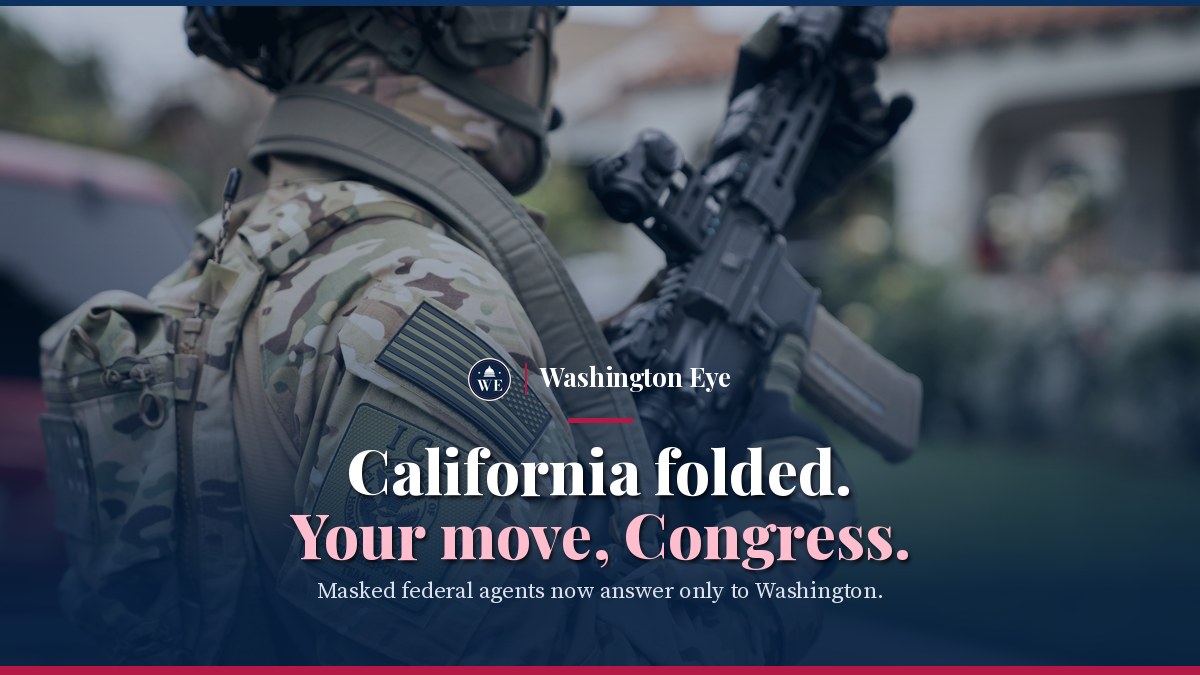
On a July morning in 2025, outside a home improvement store in south Sacramento, a man named Jose Castillo was filming federal agents at work. The agents were Border Patrol officers, their faces covered, and they detained him. His wife later said he was a United States citizen who had simply been recording what the masked officers were doing. Scenes like that one, repeated in raids across the state that summer, are why California wrote two laws telling federal agents to show their faces and their names.
This week California gave up on both of them.
On Tuesday, November 17, United States District Judge Christina A. Snyder in Los Angeles signed a two page order that permanently bars the state, Governor Gavin Newsom and Attorney General Rob Bonta from enforcing four sections of state law against the United States, federal law enforcement agencies and federal officers. The order rests on a joint stipulation: California agreed to it. The case was dismissed with prejudice, exactly one year after the Justice Department filed it. The department announced its victory on Thursday.
It is tempting for anyone who cares about accountable policing to call this a betrayal. We think that reading is wrong, and that the real lesson of California's retreat is more uncomfortable for Democrats in Washington than for Democrats in Sacramento. The state did not lose its nerve. It ran into the Constitution. The only institution that can now require a federal immigration officer to show who he is happens to be the one that has spent sixteen months ignoring the question: Congress.
What California actually lost
The two laws were signed by Newsom in September 2025, after a season of raids by agents who wore masks and displayed no badges. One, the No Secret Police Act, sharply limited face coverings for officers working in the state. The other, the No Vigilantes Act, required officers to display identification such as a name or badge number. Supporters argued that masked, anonymous agents terrified communities, made it impossible to tell a real officer from an impostor and let misconduct go unanswered. "It's problematic when Californians can't tell the difference between a law enforcement officer who is charged with protecting them and a criminal who is attempting to cause them harm," Bonta said last year.
The Trump administration sued in November 2025, arguing that the state was interfering with federal operations and exposing agents to harassment and doxxing. The courts largely agreed. In February, Snyder preliminarily blocked the mask ban as applied to federal officers because it exempted some state officers, a form of discrimination against the federal government that the doctrine of intergovernmental immunity forbids. She let the identification rule stand. The Ninth Circuit did not. It blocked that rule in April, and in a published opinion on October 14 it held that the requirement directly regulated federal operations, even though it applied to state and local police as well.
That second ruling is the one that matters. In February, the mask law's author, state Senator Scott Wiener, said in an interview that the court had recognised California's power to restrict masks on federal agents and that "we simply have to add state police back into the law to make it enforceable." Lawmakers did just that. A 2026 measure, SB 1004, dropped the exemption for state police and requires state and local agencies to develop and display mask policies. Wiener said it followed "clear guidance from a federal judge for how to move forward."
The Ninth Circuit's October reasoning closed that door. A rule that treats every officer the same can still fail if it tells federal agents how to do their jobs. Treating state police equally fixes a discrimination problem. It does not fix a direct regulation problem. California's lawyers, who told the court last week that officials "continue to dispute" the federal government's claims, evidently concluded that another year of litigation would end the same way. The order enjoins the underlying code sections without distinguishing the new wording, so even the fate of the 2026 version is unclear.
Choosing not to spend public money on an appeal the state was likely to lose is not cowardice. It is triage. But it leaves Californians with a stark result. A masked federal agent with no visible name or badge number is now breaking no state law anywhere in California.
Washington's victory lap
The Justice Department was not modest about it. "Today's permanent injunction confirms a basic constitutional principle: states do not have the authority to regulate the Federal Government or dictate how federal law enforcement officers perform their official duties," said Associate Attorney General Stanley E. Woodward Jr. Jonathan D. Guynn, the acting head of the Civil Division, went further: "The Federal Government, not the states, gets to decide what equipment federal officers may use and what measures they may take to protect themselves while performing their official duties."
Read that second sentence carefully, because it is an argument for our side as much as theirs. If the federal government decides, then the federal government is answerable. The department added that Attorney General Todd Blanche has told the Civil Division to hunt for other state and local laws that impede federal operations, and it has already gone to court over similar bans in Denver, Portland and St. Paul, while Virginia's mask law sits before the Fourth Circuit. The pattern is clear. Every city and state that tries to fill the gap will be sued, and on current precedent in the West, will lose.
So what rule now governs an immigration officer making an arrest in Los Angeles? A federal regulation, 8 CFR 287.8, requires the officer to identify himself or herself as an immigration officer, say the person is under arrest and give the reason, as soon as it is practical and safe to do so. That spoken statement is now the only identification duty that reaches these agents in the nation's largest state. No name. No number. No face, if the agent prefers.
The bill nobody has touched
There is a federal fix on paper. On July 8, 2025, Senator Alex Padilla of California introduced the VISIBLE Act, S. 2212, with fourteen Democratic cosponsors including Cory Booker, Adam Schiff, Amy Klobuchar and Elissa Slotkin. It would amend the Immigration and Nationality Act to require officers of Immigration and Customs Enforcement, Customs and Border Protection and deputised local partners to display their agency and their name or badge number during public enforcement actions, such as patrols, stops, arrests and raids. Truly covert, non public operations would be exempt.
The bill was referred to the Senate Judiciary Committee that same day. According to the official record, nothing has happened to it since. When this Congress ends on January 3, it dies.
This is the part that should sting. Democrats spent much of 2025 and 2026 denouncing masked agents in speeches, hearings and posts online. Their own legislative answer has not received a single committee vote. A Republican majority controls that calendar, but a bill nobody fights for in public, attaches to must pass legislation or forces onto the floor is a press release, not a policy.
Why this is not only a Democratic problem
Conservatives should care as well. The argument for masks is real: agents and their families have faced threats and doxxing, and the department cited cases in court. But a uniform federal standard can answer that worry far better than a patchwork of state bans did. A badge number is not a home address. Displaying an identifying number protects the officer's privacy while giving a citizen, a judge or an inspector general something to write down.
And the accountability problem is not hypothetical. This week a federal judge in Colorado, Charlotte Sweeney, found immigration officials in contempt for instantly re-arresting a man she had ordered released, writing that the agency's new policy of immediate re-detention "made a mockery of court orders." She took no further action because officials swore the practice had stopped. Courts can only police what they can see. Agents who cannot be identified are agents whose conduct is very hard to put in front of a judge at all.
A government that insists only it may set the rules for its officers takes on the duty to set good ones. The administration has won the legal argument that California may not make federal agents show their faces. It has not made the case that federal agents should not show them. Those are different questions, and the second one belongs to elected lawmakers.
Where the fight goes now
Three things are worth watching. First, whether California lawmakers try a narrower measure in 2027, perhaps limited to the state's own officers or to limits on local cooperation with federal enforcement, which courts have generally upheld. Second, how the federal court in Denver, which sits outside the Ninth Circuit and is not bound by its October opinion, handles the department's suit against that city. Third, the Fourth Circuit's ruling on Virginia, which could set up a split that only the Supreme Court can settle.
None of that, however, gets to the core issue. The Supremacy Clause has done its work. States cannot unmask federal agents. Congress can, with one sentence of statute requiring a visible name or number on every officer who makes a public arrest.
California fought this battle for a year and folded because it had no winning card left to play. Members of Congress hold the only card that still works. If they believe what they have said about masked agents on American streets, the next move is theirs. If they let the VISIBLE Act die quietly in committee in January, they will have told voters, more clearly than any court, how much they really meant it.