
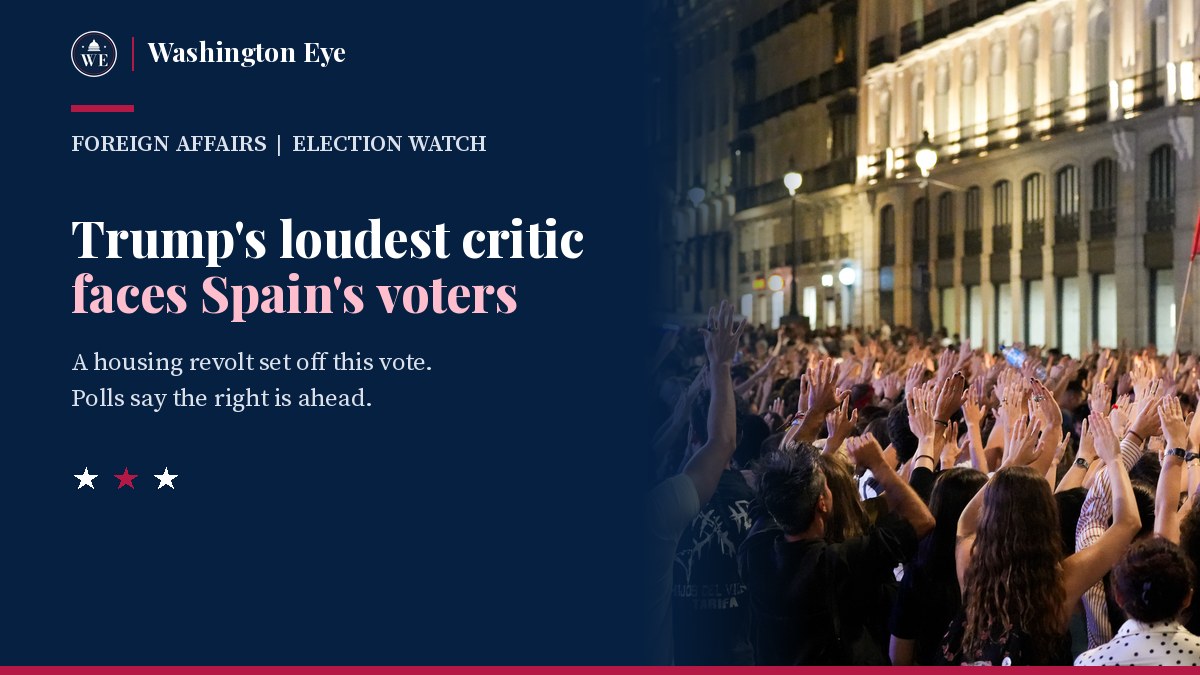
On Sunday, Spaniards vote in a general election that Pedro Sánchez chose to hold months before he had to. It is his sixth national campaign in 11 years, and he has made a career out of surviving races he was expected to lose. This time the numbers are against him, the last public polls are already a few days old, and the rest of Europe is watching to see whether the continent's most outspoken critic of President Donald Trump's foreign policy keeps his job.
Here is what set off the vote, what the final surveys say, and the five things that will decide who governs Spain next.
How a single eviction became an election
In September, an 87-year-old disabled woman named Maricarmen Abascal was evicted from the Madrid flat where she had lived for 70 years. Her rent had been raised by about 230 percent after an investment fund bought the building. The case became a national symbol of a housing market that many Spaniards say has left them behind. Protest camps went up in city centres, including the Puerta del Sol in Madrid, and tens of thousands marched.
The government answered with two emergency decrees on September 29. They would have suspended evictions of vulnerable tenants until 2030, raised taxes on flats rented to tourists, extended leases due to expire before 2028 by two years, and limited purchases of homes by investment firms. On October 2, Congress rejected both. The conservative People's Party, the hard right Vox and the Catalan separatist party Junts voted against them.
Three days later Sánchez called the election for November 29. The logic was plain. A campaign about rent and evictions is friendlier ground for the left than the issues that had dominated the year: a run of corruption cases around the prime minister's party and family, the arrival of tens of thousands of migrants in the North African enclave of Ceuta in July, and a parliament so fractured that the government has not passed a budget since 2023.
Since then the campaign has been hit by events nobody planned for. Two rail disasters nine months apart have killed 115 people, the second of them at Urda on October 28, when 69 people died. Train safety has joined housing, immigration and corruption at the top of the agenda.
What the last polls say
Spanish law bans the publication of polls in the five days before voting, so the final public numbers came out on Monday. A weighted average published by a leading Spanish newspaper put the People's Party, led by Alberto Núñez Feijóo, at 31.5 percent, the Socialists at 29 percent and Vox at about 18 percent. When the election was called, the gap between the two main parties was about six points. It has since shrunk to under 2.5.
The seat projections matter more than the vote shares. Spain's Congress has 350 seats, and 176 is a majority. Every final survey but one put the People's Party and Vox together above that line. The pollster GAD3 projected 131 seats for the People's Party, 110 for the Socialists and 63 for Vox. A daily tracking poll by 40dB, based on 7,500 interviews, gave the People's Party between 127 and 136 seats against 116 to 127 for the Socialists, with Vox on 51 to 61.
The outlier is the state-run Centre for Sociological Research, which put the Socialists first on 34.4 percent with the People's Party on 24.9 percent. Its numbers have overestimated support for the left in every election since 2018, so few analysts treat them as a forecast. The same survey did find something nobody disputes: 59.5 percent of Spaniards named housing as the country's main problem.
1. Is the left's late surge real?
The most important trend of the campaign is the narrowing. The right as a bloc, counting the People's Party, Vox and the smaller hard right list Se Acabó La Fiesta, stood at 51.2 percent in the final average, against 38.7 percent for the left. That is a big lead, but it is about three points smaller than when the race began, and the movement has been in one direction.
There is also a warning from history. In the 2023 general election, the final polls gave the right a lead of 5.4 points. The real gap at the ballot box was just 1.6 points, and Sánchez stayed in power. Polling analysts note that surveys have tended to underestimate the Socialists in national elections, even as they have underestimated the right in regional ones. One estimate gives the Socialists at least a 25 percent chance of finishing first. That is not a prediction of victory. It is a reminder that a two point race can flip.
2. How big is Vox?
Feijóo has said his preferred outcome is a People's Party government ruling alone, with Vox supporting it in parliament from outside. His party already governs with Vox in four Spanish regions, and he has not ruled out a national coalition under strict conditions.
The bigger Vox's share, the harder it becomes for Feijóo to keep it at arm's length. Its leader, Santiago Abascal, has campaigned on what he calls the "remigration" of foreigners who do not contribute to Spain and the repatriation of migrants "in an illegal situation." He has promised to use the navy to defend Spain's borders and to "send a message to the world that there is no room here for all of Africa and all of the Americas." The party has borrowed a slogan from American politics: "Make Spain Great Again."
Not every Vox claim has survived scrutiny. In Monday's eight party televised debate, its spokeswoman said the government had brought more than six million people into Spain in under five years. Fact checkers at the state broadcaster rated the claim false. National statistics show the number of foreign nationals living in Spain rose by about 2.1 million over five years.
3. Can Feijóo sell "boring"?
Feijóo, 65, ran the northwestern region of Galicia for 13 years and pitches himself as a manager rather than a performer. "It's called management: and it's what I know how to do," he has told voters. In his head to head debate with Sánchez on November 19, he drew the contrast sharply: "I don't dance at rallies and I don't do glitzy politics, but I don't steal or lie either."
His housing offer is supply first. The People's Party says it would build a million homes over the next parliamentary term, cut red tape for construction, crack down on squatting and cut taxes for young people buying their first home. The left argues that building alone will take years to bring rents down and wants direct controls on the market now. That is the real policy choice on the ballot, and it is a debate many American cities would recognise.
4. Who are the kingmakers?
If neither bloc reaches 176, Spain is back to the arithmetic that has defined the past three years. Sánchez returned to office in 2023 through deals with left wing parties and Catalan and Basque nationalists. Junts, a Catalan separatist party with just seven seats, kept that government alive and then helped sink the housing decrees that triggered this election. Its exiled leader, Carles Puigdemont, plans to return to Spain after the vote.
On the left, the alliance that won 12.3 percent as Sumar in 2023 has split into several lists. The largest successor, Frente Amplio, led by the former Barcelona mayor Ada Colau, is polling around 7 percent together with its partner coalitions, while Podemos runs separately in places. A fragmented left wastes votes under Spain's provincial seat system, which is one more reason the Socialists need a strong night of their own.
Sánchez has tried to own his weaknesses rather than dodge them. "My government has not been perfect, I've made mistakes, I've trusted people I shouldn't have," he said in the head to head debate. Those mistakes are on the record. His former transport minister José Luis Ábalos is serving a 24-year prison sentence for taking kickbacks. Senior party figure Santos Cerdán awaits trial on bribery charges, which he denies. His wife, Begoña Gómez, faces trial over allegations of influence peddling and embezzlement, and his brother David has been barred from public office for nine years for misconduct. Both deny wrongdoing.
5. The information war
Spain's election is also a test for Europe's defences against online manipulation. Researchers have tracked a pro-Russian operation known as Matryoshka, active since at least 2023 according to France's foreign digital interference watchdog, VIGINUM, that copies the look of real news organisations to spread fake reports. Its themes in Spain include attacks on support for Ukraine and on sanctions against Russia, and claims that the economy is collapsing. A fake video targeting the prime minister's wife has also circulated. With France, Italy and Poland voting in the coming months, officials across the continent are watching how much of this reaches Spanish voters, and whether it moves them.
Why it matters beyond Spain
Sánchez has been Europe's most vocal critic of the war with Iran. In March, Spain closed its airspace to American military aircraft involved in the conflict, and Madrid has refused to sign up to NATO's new target of 5 percent of national output for defence. President Trump has accused Spain of putting "American lives at risk" and has threatened to cut off trade. Sánchez has not backed down. Of a short lived ceasefire, he said he would "not applaud those who set the world on fire just because they show up with a bucket."
A government led by Feijóo would almost certainly lower the temperature with Washington, and could revisit defence spending. It might also change Spain's position inside the European Union on China. One consultant has described Madrid as the "last holdout pushing for a softer stance" toward Beijing on trade. A Sánchez win, by contrast, would keep the loudest dissenting voice in NATO at the table for another term.
The bottom line
On the evidence of the final polls, the People's Party should win the most seats and the right should have a majority. But Sánchez has been written off before, in 2019 and again in 2023, and in 2023 the count came in far closer than the surveys. Watch three numbers on Sunday night: whether the People's Party and Vox together clear 176 seats, how far Vox's share rises, and whether the Socialists beat their final polling. If the first is yes, a new era begins in Madrid, and Washington will have one fewer critic in Europe. If it is no, Spain's great survivor will have pulled off one more escape.