
On Wednesday afternoon, Beijing time, a 40 year old former Pakistan Air Force pilot floated through a hatch in orbit and into the arms of three Chinese astronauts who had prepared a cake to celebrate. Muhammad Zeeshan Ali became the first person from Pakistan to reach orbit and, more importantly for everyone else, the first foreign astronaut ever to board China's Tiangong space station. China's space agency called it the country's first foreign "space handshake".
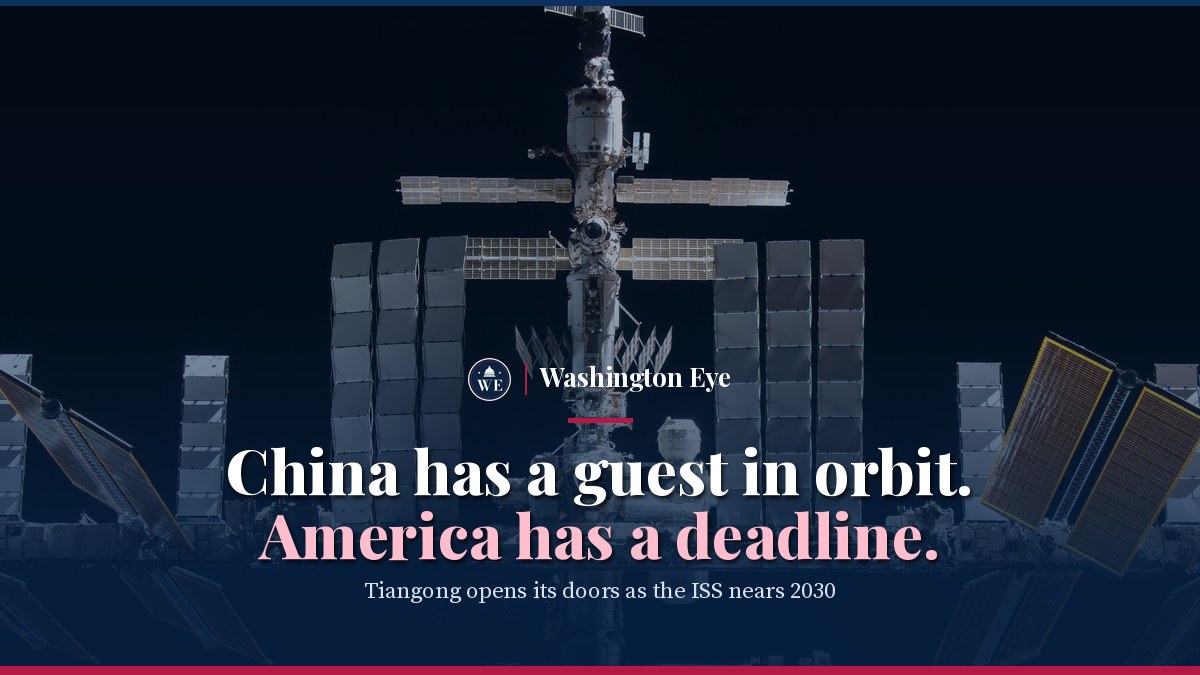
It is easy to read the moment as a Cold War style alarm bell, and plenty of people in Washington will. We think that misses the point. A single Pakistani payload specialist on a ten day visit does not threaten American leadership in space. What threatens it is a date that the United States set for itself and has not yet shown it can meet: the end of 2030, when the International Space Station is due to be steered into a remote stretch of ocean. Tiangong now has a guest list. America has a deadline. The second fact matters far more than the first.
Start with what actually happened. The Shenzhou 24 mission lifted off from the Jiuquan launch centre in north west China on a Long March 2F rocket and docked with the station about three and a half hours later. It is China's 18th crewed spaceflight and its 12th crew to Tiangong, a three module laboratory that Beijing finished assembling in late 2022. The commander, Tang Hongbo, is now the first person to visit the station three times. The flight engineer, Wu Yi, is on his first trip.
Mr Ali will stay between five and ten days, far shorter than the six month tours Chinese crews normally serve, and will return with two members of the outgoing crew. The third, Zhu Yangzhu, will stay behind to complete the first full year in orbit by a Chinese astronaut, a medical milestone Beijing needs before it sends people to the Moon. Mr Ali trained for seven months in Beijing, took intensive Chinese language classes, studied classical poetry and calligraphy and played table tennis. His experiments include self healing carbon fibre composites designed to repair small cracks in spacecraft, microalgae grown as a possible food source and quinoa seeds exposed to spaceflight. Chinese officials say four joint China and Pakistan projects in biotechnology and materials will run during the mission.
In Islamabad the reaction was euphoric. "This is not just one astronaut's journey, but the journey of 240 million Pakistanis," Prime Minister Shehbaz Sharif wrote in a post online, calling the flight "living proof of the ironclad friendship between Pakistan and China." Ahsan Iqbal, Pakistan's development minister, said at the launch site that the mission "shows the way forward how developing countries can cooperate to have capability in areas which are very critical for future economic development." President Xi Jinping told his Pakistani counterpart that Beijing was "willing to work with all countries" to "uphold the banner of the peaceful use of outer space."
None of this came out of nowhere. Chinese and Pakistani space cooperation dates back to the early 1990s. China has launched Pakistani satellites, the two governments signed a spaceflight agreement in Islamabad in February 2025, and a Pakistani built rover is due to fly on a Chinese lunar mission around 2028. What changed this week is that China has now proved it can train, fly and host a foreign crew member, and it has said plainly that it wants to do so again.
Blaine Curcio, an analyst who runs a space consultancy, put the strategic logic well in comments to a British newspaper. "Pakistan is putting a lot of trust into Beijing by having him fly into space on a Chinese built rocket," he said, adding that the flight "makes China better prepared to do it again, and also makes it clear to other countries that China is open to this type of collaboration." He expects countries such as Brazil and Egypt to ask for seats. Then came the line that should keep officials at the National Aeronautics and Space Administration awake: "I think when the ISS is retired, if there is no western replacement (government or commercial), then yes, we may eventually see European or other ISS involved countries, like Russia, send astronauts to Tiangong."
Read that conditional carefully. The risk he describes is not that China builds a better station. It is that the United States leaves an empty sky.
The International Space Station has hosted more than 290 people from 26 countries over about a quarter of a century, according to NASA. It is run by the United States, Russia, Europe, Japan and Canada, and it has been the single most effective tool of American space diplomacy ever built. A seat on it has been a reward for allies, a training ground for partner agencies and a daily demonstration that the American model of open, multinational science works. Since 2011, by contrast, American law has barred NASA from working bilaterally with China, and in 2025 the agency went further and blocked Chinese citizens from its facilities. Whatever one thinks of those restrictions, they mean the American answer to Tiangong cannot be a joint project with Beijing. It has to be a better offer.
Right now the better offer exists mostly on paper. The plan is to replace the station with one or more privately owned commercial outposts, with NASA as one customer among many. On 9 October the agency released its final request for proposals. Bids are due on 8 December and awards are expected in spring 2027, with NASA intending to back two or more companies through early development before choosing who gets certified to carry its crews. NASA Administrator Jared Isaacman has been emphatic about intent. "We've made it clear that NASA will never give up its presence in low Earth orbit," he said. He was also honest about the catch: "The opportunity is significant, but the economics ultimately have to work."
That honesty deserves a hearing in Congress, because the warning signs are already public. In June the Government Accountability Office reported that NASA was working with six companies on station designs, that its acquisition approach had changed repeatedly and was still "in flux", and that in March the agency had floated an alternative built around a government owned core module. Most strikingly, the auditors found that NASA had not yet assessed how likely a gap in American human presence in orbit would be, or how long it might last, even though its own historical data suggest commercial stations could take longer to build than planned. A 2017 law calls for an uninterrupted American capability in low Earth orbit. The auditors said NASA must decide in 2027 whether a commercial station will be ready in time or whether the old station needs to be extended, and recommended that it write down how it will make that call.
The field of bidders is also thinning. This month Blue Origin, which was selected in 2021 alongside Sierra Space to develop the Orbital Reef station, withdrew from the commercial station competition to concentrate on lunar work, according to an aviation trade publication. Getting people there is its own problem. SpaceX's Dragon is the only American spacecraft that currently carries astronauts to orbit, and SpaceX plans to retire it around 2030. Boeing's Starliner, after its troubled crewed test flight in 2024, may fly an uncrewed test by the end of this year and a crewed mission in 2028 if all goes well.
Put those facts together and the shape of the danger is clear. If the first American commercial station slips past 2030, and NASA's own history says schedules slip, there could be a stretch of months or years in which the only permanently crewed outpost in orbit flies a Chinese flag. Every partner that has relied on American hospitality for a quarter of a century would then face the question Mr Curcio raised. Some would wait. Others, especially countries that have never had a seat at the American table, would take the call from Beijing.
So what should Washington do? First, stop treating the 2027 decision as a technicality. Congress, which changes hands in January, should require NASA to publish the gap assessment the auditors asked for well before the commercial awards, and should fund a credible fallback so that the old station can keep flying if the new ones are late. A modest extension is far cheaper than ceding the only working laboratory in orbit for a single day.
Second, keep the commercial bet but give it a floor. If the economics have to work, Washington can make them work by committing to buy research time and crew time on more than one station for years, rather than leaving companies to guess. The point of the competition is resilience, and a single winner is not resilient.
Third, and most important, widen the guest list. China's message this week was aimed squarely at the developing world. The United States should answer it by offering long term seats on future American stations not only to the existing partners in Europe, Japan and Canada but to the growing ranks of countries that now run space agencies of their own. An open door costs little and is worth more than any slogan about a new space race.
There is a legitimate counter argument, and it deserves to be stated. Some will say a gap of a year or two in orbit is tolerable, that the real contest is on the Moon, and that NASA should pour its money into returning astronauts to the lunar surface, which it targets for 2028, ahead of China's goal of a crewed landing by 2030 and a lunar research base with Russia by 2035. We agree the Moon matters. But prestige in space is built in low orbit, where partners train, where science is done every day and where the habit of working together is formed. Walk away from that and the lunar flag will look lonelier than it should.
Mr Ali will be home in a week or so, a national hero with a cake, a calligraphy brush and a place in the record books. Good for him, and good for Pakistan. The question for Washington is not why he flew with China. It is where the next astronaut from a country like his will want to go in 2031, and whether the United States will still have a front door to open.