
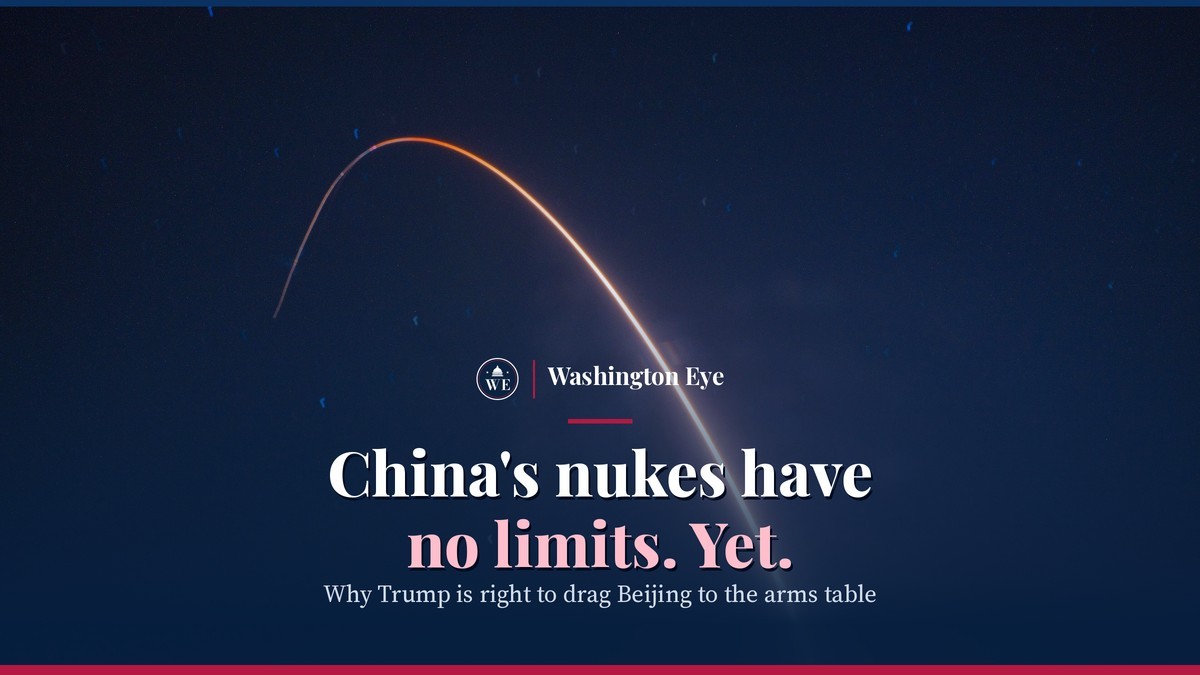
Beijing did not want this meeting, and it certainly did not want this agenda. That is the best argument for both.
On Thursday, on the sidelines of the Asia-Pacific Economic Cooperation summit in Shenzhen, President Donald Trump, President Xi Jinping and President Vladimir Putin are due to hold the first three-way meeting ever between the leaders of the United States, China and Russia. The White House announced it on Friday, the Kremlin confirmed the date on Saturday, and China's foreign ministry finally confirmed it on Monday, as Trump left Washington for a four-day trip to Asia that also takes in the Philippines.
The White House has been clear about what Trump wants to talk about. "He will discuss the reduction of nuclear weapons in the world, whose proliferation President Trump believes is very dangerous," Olivia Wales, a White House spokeswoman, told reporters. A senior administration official was blunter, and more candid about the odds. "We do not expect to get to any kind of agreement," the official said. "This is a difficult topic for China to address, but we do think it's time for China to sort of step up, you know, to the adults' table, if you will, and have adult conversations about adult things."
Critics will call that a photo opportunity dressed up as arms control. They are half right. There will be no treaty in Shenzhen. But the case for putting China's arsenal on the table, in public, with Russia in the room, is stronger than the sceptics allow, and it is a case conservatives have been making for years.
Start with the numbers, because they explain why the old model has run out of road. For half a century, nuclear arms control meant two countries. The last of those bilateral deals, New START, expired on 5 February this year. It capped the United States and Russia at 1,550 deployed strategic warheads each. Putin offered to keep observing those limits for another year. Trump turned him down, writing in a post online that rather than extend it, "we should have our Nuclear Experts work on a new, improved and modernized Treaty that can last long into the future."
The administration's reasoning was spelled out the next day at the Conference on Disarmament in Geneva. "Exactly zero Chinese nuclear weapons were covered by New START," the American statement said. "And as we sit here today, China's entire nuclear arsenal has no limits, no transparency, no declarations, and no controls."
That is not rhetoric. It is a description. In 2020 the Pentagon assessed China's stockpile of operational warheads to be in the low 200s. In testimony to the House Armed Services Committee in March, Robert Kadlec, the assistant secretary responsible for nuclear deterrence policy, said it now exceeds 600 and is on track to pass 1,000 by 2030, with most capable of reaching the American homeland. He called it "the most rapid and opaque nuclear expansion in history". Some outside estimates put the figure lower, nearer 500. Whichever number is right, the direction is the same, and nothing in any treaty constrains it.
China's answer has not changed. In February a Chinese spokesman said that "China's nuclear capabilities are of a totally different scale as those of the United States and Russia" and that Beijing "will not participate in nuclear disarmament negotiations at this stage." The gap is real. The United States and Russia each hold more than 5,000 warheads, and the two together account for nearly nine in ten of the world's total.
But the gap is also shrinking by design, and the argument that China is too small to talk is an argument for letting it grow until it no longer is. A country that has roughly tripled its stockpile in six years, built new fields of missile silos and still declines to publish a figure is not a bystander to the arms race. It is the main reason there is one again.
Edgard Kagan, a former senior White House official for East Asia in the Biden administration, explained Beijing's discomfort well. "This is something the Chinese hate," he said of nuclear talks. "They certainly don't want to do it with the United States and Russia, because it suggests that they accept the framing that they are now a major nuclear power that should be subject to similar restrictions."
That is precisely the framing Washington should insist on. China is a major nuclear power. It wants the status of one, the deterrent of one and the regional leverage of one, around Taiwan and across the western Pacific. It cannot also claim the exemptions of a minor one. Getting Xi to sit at a table where nuclear weapons are the first item, in his own city, with his closest partner beside him, is a small but real change in that conversation.
There is also a bipartisan logic here that Democrats should not dismiss simply because Trump is the one making it. It is hard to imagine a future agreement that leaves out the world's fastest-growing arsenal surviving a Senate ratification vote, and it probably should not. Secretary of State Marco Rubio set out the administration's principles in February: any new arms control must be multilateral and include China, must hold states accountable for cheating, and must sit alongside a modern deterrent. Those are not radical conditions. They are the minimum for a deal Americans can trust.
The accountability point matters as much as China's numbers. Russia suspended its participation in New START in February 2023, and Heather Williams, director of the Project on Nuclear Issues at the Center for Strategic and International Studies, counts at least nine major nuclear arms control agreements Moscow has violated since Putin came to power. The same month New START expired, a senior State Department official, Thomas DiNanno, alleged that China had conducted at least one nuclear test with an explosive yield and declared "the end of U.S. unilateral restraint." Treaties with only one side keeping the rules are not arms control. They are unilateral disarmament on a schedule.
So what should Trump actually ask for on Thursday? Here the sceptics have the better of the argument, and the White House should listen to them.
Williams, writing this month, warned that Trump's habit of talking about "denuclearization" oversells what is possible and "betrays how much the American president wants a deal," something Moscow and Beijing could use as leverage. She is right. The worst outcome in Shenzhen would not be a meeting with no agreement. It would be an American president so eager for a historic headline that he pays for it.
The better course is to ask for things that are modest, concrete and checkable. The most obvious is missile launch notification. Washington and Moscow already notify each other of launches, and so do Moscow and Beijing. The link between Washington and Beijing is the missing one. China has given some countries notice of major tests before, of an intercontinental missile in 2024 and a submarine-launched missile this year, but with less than 24 hours' warning. Even Zhou Bo, a retired Chinese army officer, has said a trilateral format might at best produce a mechanism for mutual notification of missile launches. If the floor is the ceiling, take the floor.
Other achievable steps include a joint restatement that "a nuclear war cannot be won and must never be fought," the line first agreed by Ronald Reagan and Mikhail Gorbachev and repeated by the five recognised nuclear powers in January 2022; a commitment to keep human beings in control of nuclear launch decisions, which Russia has so far declined to endorse; and, most importantly, a date for the next meeting. Williams notes that Trump and Xi have already agreed to reciprocal nuclear site visits. A standing three-way channel would make that kind of progress harder to reverse.
Then there is what Trump must not do. Putin did not propose this meeting to talk about warheads. Russia wants to use it to push a settlement of the war in Ukraine on its own terms, and a senior Kremlin aide, Yuri Ushakov, has said the Shenzhen talks would continue that effort. Russian nationalists are already calling it a new Yalta, after the 1945 conference that carved Europe into spheres of influence. "We really don't want this to turn into 'Yalta 2, 3, 4,' with a redistribution of influence," President Volodymyr Zelensky said last month.
The White House says Trump is not expected to raise Ukraine in the three-way format, and that he will not hold a separate one-on-one with Putin. That discipline needs to hold. Any hint that nuclear talks are being traded against Western support for Kyiv would hand Putin exactly what he came for and teach Beijing that the way to win concessions from Washington is to show up and wait. Arms control that rewards aggression is not worth having.
Trump should also keep his allies close. Moscow has long demanded that Britain and France be folded into any limits, and governments from Tokyo to Taipei will be watching Shenzhen for any sign that their security is on the menu. A brief, public American readout before and after the meeting, setting out what was asked and what was not, would do more for allied confidence than any communique.
None of this will satisfy those who think talking to Xi and Putin at all is a gift to both. But the alternative on offer is not a better treaty. It is no conversation, no limits and an arms race in which the fastest-growing participant has never had to answer a single question about it. Trump is right to make Beijing answer some, even if the first answers are no.
The test of Thursday is simple. If Trump leaves Shenzhen with a launch notification channel, a joint statement on nuclear risk and a date to meet again, and without a single concession on Ukraine, it will have been worth the trip. If he leaves with a grand declaration and nothing that can be checked, Beijing will have been proven right to treat the adults' table as a stage.