
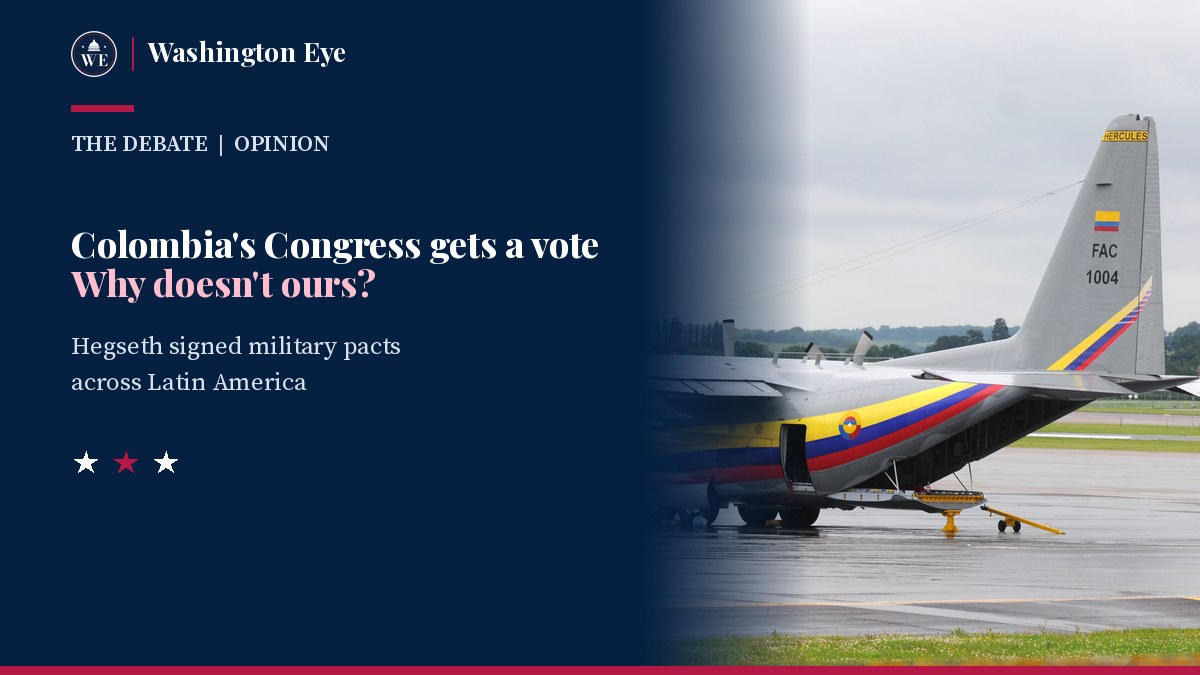
In the space of two days this week, Defense Secretary Pete Hegseth, who now uses the title secretary of war, flew into Caracas unannounced, signed a military cooperation agreement with the government that replaced Nicolas Maduro, handed Colombia's air force a C-130 Hercules transport plane in Bogota, met Ecuador's president in Quito and finished at Soto Cano Air Base in Honduras with two more signed documents. At almost every stop he repeated the same line about drug traffickers: "We will hunt you down, we will find you, and we will kill you."
One detail from the trip deserves more attention than the slogan. In Bogota, Colombia's foreign minister, Omar Bula, told reporters that any plan for joint military operations with American forces would go to his country's Congress first. "We know that any decision by the executive in this context will have to go through the Congress of the Republic," he said. "It is Colombia that decides what happens in Colombia."
Colombia's lawmakers will get a vote on whether American troops fight alongside their own. Ours have not had one on the campaign those troops are part of. That is the problem with this tour, and it is a problem whatever you think of the policy.
What was actually signed
The Caracas agreement is the headline. Military cooperation between Washington and Venezuela was cut off in 2005 by Hugo Chavez, who accused the American military office at Fuerte Tiuna, the country's largest military complex, of working against his government. Relations only got worse under Maduro, until US forces seized him in a raid on January 3 and flew him to New York, where he faces trial on drug trafficking charges he denies. His former vice president, Delcy Rodriguez, has governed as acting president since then with Washington's backing.
On Wednesday, Hegseth and Venezuela's defence minister, Gustavo Gonzalez Lopez, signed what both sides called a technical and military cooperation agreement at the Miraflores presidential palace. Hegseth said it would cover joint training, intelligence sharing, equipment and stronger Venezuelan defence and border capabilities. Rodriguez called it "extraordinarily relevant for our bilateral relations" and said it would improve training for Venezuela's armed forces, modernise their equipment and give them access to new technology "to confront shared threats." Venezuela's defence ministry stressed that its own armed forces would keep command and that cooperation would follow the Venezuelan constitution.
What neither government has done is publish the text. Officials did not say whether the deal allows American bases in Venezuela or a permanent troop presence. A major American newspaper has reported that the United States helped Venezuela's military carry out a deadly drone strike on an armed group inside the country in June, and that Washington is negotiating an agreement that could lay the groundwork for a lasting American military presence there.
Hegseth's own summary was blunt. Venezuela, he said, had "gone from our most aggressive regional threat to a compliant security partner" in less than a year. He called himself "the first United States Secretary of War this century to set foot in Venezuela" and framed the pact as part of the Americas Counter Cartel Coalition, the Pentagon's regional alliance against drug groups.
In Honduras on Thursday, he signed a memorandum of understanding on cyber defence, which he said would help protect the country's critical systems and electrical grid, and a joint statement on "national defense zones" along Honduras's borders, modelled on the zones the administration has set up on the American southern border. In Colombia the deliverable was hardware: the C-130 is the first of several, and Colombia's defence minister, Jorge Eduardo Mora, told his Congress, "I think two more are coming." It replaces a Hercules donated by the United States in 2020 that crashed on take-off at Puerto Leguizamo in March, killing 69 people.
The case for the tour is not weak
It would be easy to wave all of this away as a defence secretary under pressure at home seeking friendlier crowds abroad. That would be unfair to the substance.
The governments Hegseth visited want this help, and they have reasons. The day before he landed in Honduras, 12 people, including women and children, were killed in a massacre in the department of Yoro, which he blamed on a gang that Honduras has designated a terrorist group. Colombia's foreign minister described his country as being "in the clutches of organised crime." In recent days, armed groups there bombed power lines in Huila, cutting electricity to more than 17,000 customers, and set off a car bomb at a toll station. The Joint Task Force at Soto Cano has worked with Honduras since 1982. None of this is invented.
The Venezuela deal also has a strategic logic that critics should admit. A country that spent two decades hosting Washington's rivals and, by long-standing accusation, sheltering Colombian guerrilla groups is now asking for American training and equipment. If that holds, it is a large shift in the hemisphere's balance, and it was not achieved by a long occupation.
So we are not arguing that the partnerships are wrong. We are arguing that they are being built on the wrong foundation.
Every capital is asking its lawmakers except one
Look at how the other governments on this trip are handling the same question. Colombia's constitution, in Article 173, gives its Senate the power to permit the transit of foreign troops, and the government of President Abelardo de la Espriella, a firm Trump ally, says it will ask Congress to approve joint operations. In September, Ivan Cepeda, the opposition senator who lost the presidential run-off by less than a percentage point, threatened legal action over a US Marine helicopter flight that he said had gone ahead without Senate approval. De la Espriella, denying a report that he had turned down the American plan, insisted in a post online that "any decision will be taken respecting our Constitution, national sovereignty and the corresponding legal procedures." Even in Caracas, the defence ministry felt the need to say the deal would follow Venezuela's constitution.
Hegseth himself said in Bogota that American and Colombian forces would respect each country's laws, constitution and Congress. That is the right standard. It should apply in Washington too.
At home, the record is thinner. The lethal strikes on suspected drug boats in the Caribbean and the eastern Pacific, now past 230 deaths by one wire service's count, have never been authorised by a vote of Congress. Rights groups say the administration has offered little public proof that the vessels were carrying drugs, and many legal experts consider the strikes unlawful. When House Democrats introduced a war powers resolution in September to stop them, they noted that the campaign "was never authorized by Congress." Earlier efforts went nowhere: the House rejected a similar measure 210 to 216 last December, and the Senate narrowly blocked a Venezuela war powers resolution in January.
That is Congress choosing not to act, which is its right. But declining to stop a campaign is not the same as authorising one, and the campaign keeps growing. It began with boats. It now includes reported American help with a drone strike inside Venezuela, Reaper drones moved to Colombia and Ecuador, at least 20 American military flights to an isolated base on Ecuador's Pacific coast that satellite imagery shows under construction, a signed pact with Caracas and a push for joint ground and air operations in Colombia. Brian Finucane, a former State Department lawyer who specialises in the laws of war, told a major American newspaper that Colombia showed the administration would not have "a free hand to do strikes willy-nilly in the territory of other states." Colombia's Congress may be the brake. Ours should be too.
Members are not even being briefed
The strongest evidence that the current arrangement is not working comes from a Republican. Senator Joni Ernst of Iowa, a combat veteran who is retiring and who voted to confirm Hegseth, said on Thursday that "there is very little transparency right now with what is being discussed between the White House and the Department of War." She was speaking about the war with Iran, but the complaint is general. "As Congress, we would expect that we would be read into some of those conversations, and unfortunately, we have not been read into those conversations," she said.
If a senior member of the Armed Services Committee from the president's own party cannot get a proper briefing on a war, there is little reason to think the rest of Congress has seen the terms signed in Caracas or Comayagua before the cameras did.
What Congress should do in January
House Republicans blocked an effort to impeach Hegseth earlier this month. Democrats take control of both chambers in January, and Ernst predicted the issue will come back. We think impeachment is the wrong place to start. It turns a question about the constitution into a question about one man, and it lets everyone avoid the harder vote.
The better path has three parts. First, the new Congress should demand the full text of the Venezuela agreement, the Honduras documents and any draft Colombia operations deal. A 1972 law, the Case-Zablocki Act, already requires the executive branch to send Congress the international agreements it signs. Lawmakers should use it, and publish what they can.
Second, the administration should be made to say, in public, what legal authority it relies on for lethal force against drug groups on land and at sea in Latin America. If the answer is the president's own power as commander in chief, Congress should say whether it agrees.
Third, and most important, there should be a vote: a real authorisation for the use of force against named cartel groups, with limits on geography, time and reporting, or a clear refusal. If Hegseth's case is as strong as he says, it should pass. Supporters of the policy ought to want that vote most of all, because a campaign that rests on a vote outlasts the officials who started it.
Hegseth told his audience in Caracas that his presence there would have seemed "almost unimaginable" a year ago. He is right about that. What should be unimaginable is that a Colombian senator can demand a say over a single helicopter flight while American lawmakers have still not voted on a military campaign that now stretches from the Pacific to the Caribbean.