
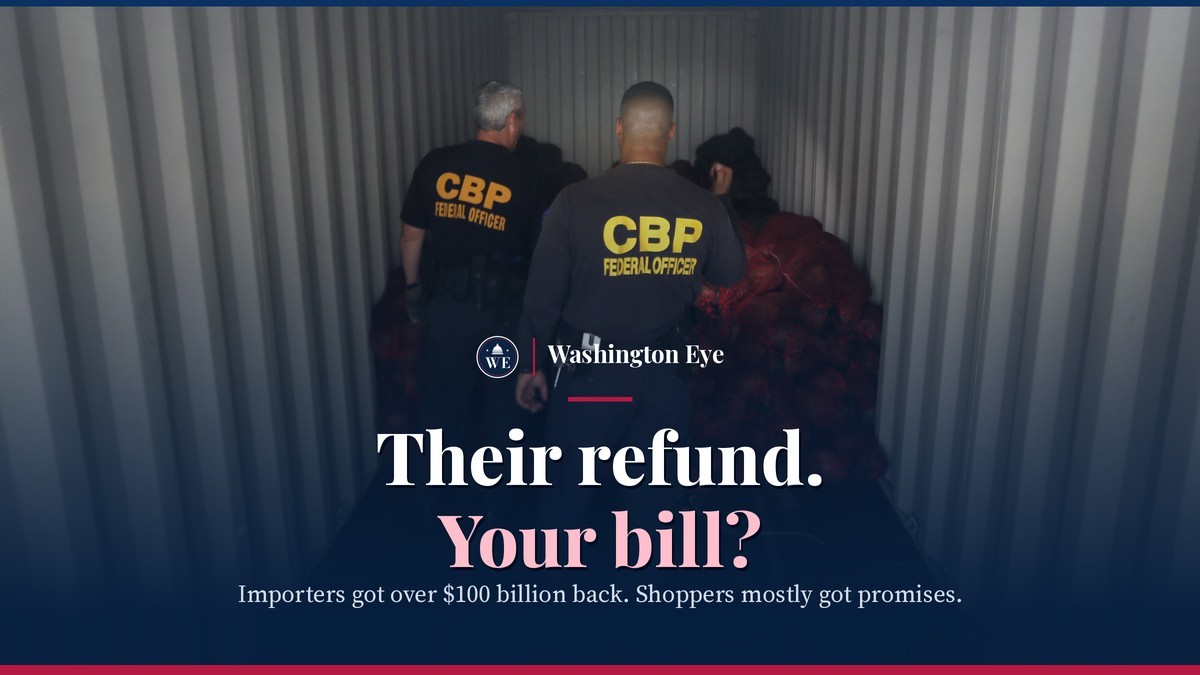
When the Supreme Court struck down President Donald Trump's emergency tariffs in February, the ruling settled one question and opened another. The justices said the 1977 International Emergency Economic Powers Act never gave the president power to impose sweeping import taxes. The majority opinion did not address what should happen to the roughly $166 billion that had already been collected. Nine months later, much of that money has gone back to the companies that paid it. Very little of it has reached the people at the end of the supply chain who paid higher prices at the checkout.
That gap is now a political fight. On Wednesday, seven Democratic senators wrote to the Federal Trade Commission asking it to investigate whether large corporations broke federal law by keeping tariff refunds after raising prices to cover the tariffs in the first place. "By increasing consumer prices, ostensibly due to tariff costs, and then refusing to provide refunds to consumers when they are later reimbursed for those tariff costs, corporations may be in violation of the FTC Act," they wrote, in a letter first shared with a national newspaper.
The signatories were Elizabeth Warren and Ed Markey of Massachusetts, Sheldon Whitehouse of Rhode Island, Tammy Baldwin of Wisconsin, Richard Blumenthal of Connecticut, Elissa Slotkin of Michigan and Cory Booker of New Jersey. The letter lands eight days after an election in which Democrats won control of both chambers, and Ms Warren is expected to chair the Senate Banking Committee from January. A complaint that could once be filed away is about to come with subpoena power behind it.
How the money moved
The mechanics explain why consumers were always going to be last in line. Tariffs are paid by the importer of record, the company that brings goods across the border, not by the shopper. When the Supreme Court ruled 6 to 3 on 20 February that the emergency law did not authorise the duties, the legal remedy was a refund to whoever had paid them. Judge Richard Eaton of the Court of International Trade, who now hears every tariff refund case, ruled in March that "all importers of record" were "entitled to benefit" from the decision.
Customs and Border Protection then built an online system to process the claims, began accepting them in April and started paying in May. By August, according to court filings, more than $100 billion had been returned, and another tally put the figure above $115 billion. Judge Eaton noted in a later order that "most of the refunds that have been processed so far have gone to large importers, not small." Interest was accruing at an estimated $650 million a month as of March, which means the longer the process runs, the larger the cheques become.
The administration has fought to keep the circle of recipients narrow. In June it appealed the judge's universal refund order, arguing that he had exceeded his authority and that only importers who sued should be paid. "CBP has no authority to reliquidate or refund money without a court order," the Justice Department said in its filing. A separate class action on behalf of more than 330,000 importers, certified on 8 October, asked the court on Tuesday to order full refunds with interest for every member, including small businesses that never filed their own suits. The government has until 13 November to answer the complaint and until 9 December to respond to that motion.
Who got what
Corporate earnings calls over the summer gave the clearest picture of where the money went, and the answers varied widely. Walmart's chief financial officer, John David Rainey, said the company had received "substantially all of" the $2.9 billion it was eligible for and was investing it in "customer experience and price leadership," pointing to price rollbacks on thousands of items. Target reported $994 million in pre-tax refunds in a quarter in which its operating income doubled from a year earlier to $2.6 billion, and said it planned to keep lowering prices.
Others were more direct about using the money elsewhere. Home Depot said it received $730 million, of which $685 million went to offset its cost of goods, improving its margins. TJX, the parent of several discount chains, received $331 million and said $112 million would fund incentives and bonuses for store associates, with the rest supporting "future growth." Apple received about $2.2 billion; its leadership pledged to reinvest the money in American manufacturing and has said the company largely absorbed tariff costs rather than raising prices.
Amazon received $600 million in the second quarter. Its finance chief, Brian Olsavsky, said the company had "largely absorbed" its own tariff costs and would refund customers where it had passed charges on. "Otherwise, like other large retailers, we'll utilize refunds to continue to invest in low prices for customers," he said. Costco's chief executive has promised to return the value to members through "lower prices and better values," a pledge its lawyers repeated in a court filing in August, when the company said it had received about a third of what it was owed.
Only a few firms have sent money straight back. The two big parcel carriers, which often acted as the importer of record for packages and billed customers separate tariff charges, set up online tools for refunds. One said in June it would return $800 million to customers; the other has begun paying eligible shippers and consumers, with interest, as funds arrive from the government.
The case for making companies pay up
The Democratic argument rests on a simple sequence. Firms raised prices and said tariffs were the reason. Shoppers paid. The tariffs were then declared unlawful and the companies got the money back. If the original price rise was justified by a cost that has now been reimbursed, the senators argue, keeping the reimbursement looks less like normal business and more like charging customers for a cost that no longer exists. "It is important that the FTC establish a precedent here that will prevent giant corporations from trying to rip off consumers on tariff-related matters," they wrote.
There is evidence that consumers carried a real share of the burden. The Tax Foundation, a nonpartisan research group, estimates that the tariffs Mr Trump imposed cost the average household about $1,000 in 2025, and that roughly $700 of that came from the duties the Supreme Court later struck down. In a May 2025 earnings call, Walmart's then chief executive, Doug McMillon, said the retailer would try to keep prices low but, given the "magnitude" of the tariffs, "we aren't able to absorb all the pressure given the reality of narrow retail margins."
Those lawsuits are multiplying. Customers have filed proposed class actions against both parcel carriers, against Costco and against the eyewear maker EssilorLuxottica, arguing that money collected through higher prices or surcharges belongs to the people who paid it. The Costco complaint argues that a promise of better value for members in general is "not a commitment to compensate the specific individuals who paid elevated prices."
Why it is harder than it sounds
The companies and many lawyers see the problem differently, and their objections are not trivial. Most retailers never itemised tariffs on a receipt. They blended the cost into shelf prices alongside fuel, wages, rent and, this year, energy costs driven higher by the war with Iran. Proving that a particular price on a particular day was raised because of a particular duty is difficult, and tracing which shopper bought which item is close to impossible for a chain with hundreds of millions of transactions.
There is also the basic principle of a market economy. "There isn't really a legal obligation to reduce prices, if costs decrease later, in our free market," Jonathan Shub, a class-action lawyer, said in a radio interview earlier this year. Some firms, such as Apple and Amazon, say they absorbed much of the cost and so owe customers nothing. Others argue that broad price cuts are a fairer way to return value than a refund system that would cost money to run and reach only shoppers who kept their receipts. One economist was sceptical of how long those cuts would last, describing one retailer's rollbacks to a radio programme as an end of summer promotion.
The FTC route has its own limits. The commission's power to police "unfair or deceptive acts or practices" is broad, but the senators are asking it to treat the failure to share a refund as deceptive. That would be a novel theory, and a letter from lawmakers in the minority does not compel the agency to act. What changes in January is not the law but the leverage: hearings, document requests and public pressure on companies whose own executives have described their tariff windfalls on the record.
The bigger fight behind the refunds
The refund question is also a preview of the trade battle to come. The administration has rebuilt much of its tariff wall using other statutes, including a 50 percent duty on a wide range of Canadian goods and tariffs of 10 or 12.5 percent on imports from 60 trading partners. The Tax Foundation estimates those replacement tariffs will cost the average household about $820 this year. Consumer prices rose 0.4 percent in October, more than economists expected, and a national poll released on Tuesday found 62 percent of Americans support repealing the tariffs.
Ms Warren has accused the administration of dragging its feet. "After the Supreme Court ruled President Trump's tariffs were illegal, the Administration should have done everything in its power to quickly return that money to the Americans who paid it," she wrote in a June letter. "Instead, it has slow-walked the refund process while searching for new ways to keep money that never belonged to the government in the first place." Senator Ron Wyden of Oregon, expected to lead the Finance Committee, has said Democrats will try to repeal specific tariffs, starting with those on Canada.
For now, the scorecard is lopsided. Large importers have recovered tens of billions of dollars, with interest. Small importers are still waiting on a court fight over whether they qualify. And the government has sent no refunds directly to consumers. Whether the next Congress can change that, or whether shoppers will have to settle for a round of price cuts and a promise of better value, may decide how the tariff era is remembered by the people who paid for it at the till.