
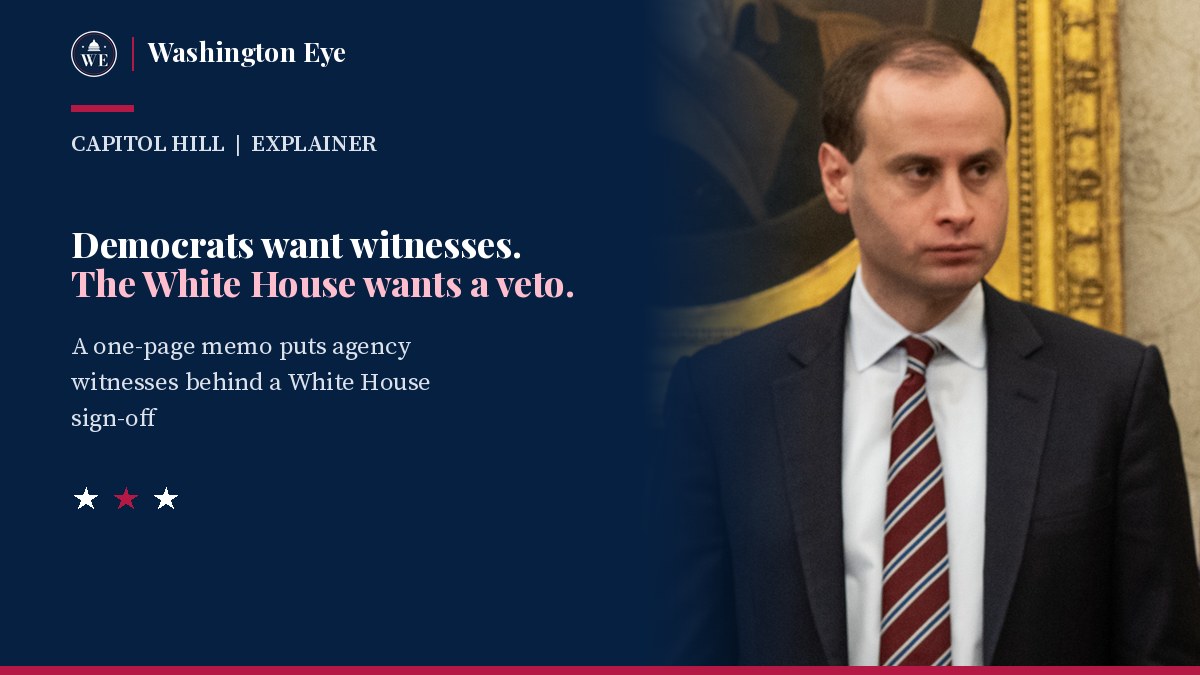
The fight over who gets to question the Trump administration next year has started before the new Congress has even been sworn in. On Monday, White House Counsel Will Scharf sent a one-page memo to the general counsels of every executive department and agency with a simple instruction: no one who works for the government may agree to appear before a congressional committee until the White House has signed off.
"We will remain disciplined in pursuing the work and service the American people deserve by ensuring that all Executive Departments and Agencies follow the established White House consultation process," Mr. Scharf wrote, spelling that process out as "prior notification and approval" from the White House Office of Legislative Affairs and the White House Counsel's Office "before any agency personnel may agree to appear before any congressional committee." He added that further guidance on dealing with Congress would follow.
The timing is not subtle. Democrats won majorities in both the House and the Senate in this month's midterm elections, and from January they will control every committee gavel and every subpoena pen on Capitol Hill. Their leaders have promised the most aggressive oversight campaign of President Donald Trump's second term. The memo is the clearest sign yet of how the White House intends to meet it.
Here is what the memo does, what it does not do, and why the next two years may turn on the gap between the two.
At its core, the memo is about control of the witness list. Most congressional testimony begins with an invitation, not a subpoena. A committee asks an agency to send an official, and the agency agrees, negotiates or declines. Under Mr. Scharf's instruction, that decision no longer rests with the agency. It moves to two offices inside the White House, which will decide whether a request is, in the administration's words, reasonable.
The memo applies to "any agency personnel," a phrase broad enough to reach cabinet secretaries, political appointees and career civil servants alike. It presents the arrangement as an existing practice rather than a new rule, describing it as "established." What it does not say is just as important. As written, it leaves open how agencies should respond when a committee stops asking and starts compelling, by issuing a subpoena.
A White House official explained the thinking in a statement shared with reporters. "The Trump Administration will not be extorted, intimidated, or threatened into submission by politically motivated baseless investigations," the official said. "We are ready to engage with Congress, this process ensures reasonable requests are respected, but baseless political attempts to undermine our mission will not be accepted." The official also said agencies could fulfil "legitimate congressional oversight requests while keeping Cabinet officials focused on their foremost responsibility."
As evidence of what it called excessive demands, the White House pointed to four letters House Democrats have already sent to federal agencies, including the Department of Homeland Security, asking them to preserve documents.
The memo is the second shot in a week. On November 9, Mr. Scharf sent a three page letter to Representative Robert Garcia of California, the senior Democrat on the House Oversight and Government Reform Committee, who is expected to become its chairman in January.
The letter set out to "remind" Mr. Garcia of "the foundational limits that the Constitution imposes on congressional investigations and subpoenas, which you and members of the new Congress have evinced a clear intent to transgress." It accused Democrats of "abusive and capricious threats" and went further than most such warnings. "Threats to executive branch officials designed to deter them from public service, or process designed merely to abuse or instill fear in the recipient may cross the line into blatant criminality," Mr. Scharf wrote. "And issuing unlawful subpoenas with the intention of depriving citizens of their constitutional rights and privileges may warrant further investigation."
Mr. Scharf grounded his argument in Supreme Court precedent, quoting the court's statement that investigations "conducted solely for the personal aggrandizement of the investigators or to 'punish' those investigated are indefensible," and insisting that congressional inquiries "must further a legitimate legislative task."
The letter did not come out of nowhere. On election night, as projections showed his party would take the House, Mr. Garcia addressed administration officials with two words: "Lawyer up." The next day, Representative Analilia Mejia of New Jersey wrote that Democrats would "toss out subpoenas like Mardi Gras beads." The White House has cited remarks like these as proof that the coming investigations are about punishment rather than legislation.
A federal prosecutor has joined the pressure campaign from another direction. Aaron Reitz, a US attorney in Texas, has sent letters to Senators Elizabeth Warren, Richard Blumenthal and Elissa Slotkin warning that their talk of investigations could amount to an intent to deprive citizens of their constitutional rights.
Mr. Garcia has not backed down. "It appears Donald Trump has something to hide," he said in a statement after receiving the letter. "Let's be clear: Congress' authority comes from Article I of the Constitution, not from the permission of the White House. Congress has wide latitude to conduct investigations and oversight, an authority inherent in the power to legislate." He added that Democrats "will not be deterred by baseless threats from a weaponized DOJ or from the President's lawyers."
Responding to the new memo in a video posted online on Monday, he said the White House was "so upset that we're going to do real oversight," promising that Democrats would focus both on affordability, "lowering the price of gas, groceries, the rent," and on "real accountability."
The agenda he has sketched is long. It includes allegations of financial misconduct involving the Trump family, claims of kickbacks tied to Homeland Security contracts, immigration enforcement abuses, what Democrats call a "cover-up" of the Epstein files, and questions about whether donations to the president's new White House ballroom bought donors any favours. Mr. Garcia has also talked about calling members of the Trump family as witnesses.
Both sides have law on their side, and that is why this fight is unlikely to be settled quickly.
The Supreme Court has long held that Congress's power to investigate is real and broad. In McGrain v. Daugherty in 1927, it ruled that the power of inquiry is an essential part of the power to legislate. But the court has also drawn limits. In Watkins v. United States in 1957, it warned that Congress has no general authority to expose people's private affairs for the sake of exposure. And in Trump v. Mazars in 2020, a case that arose from House subpoenas for Mr. Trump's own financial records during his first term, it set out a test for subpoenas aimed at a president's personal papers, asking courts to weigh whether the information was truly needed for legislation. The White House is leaning on those limits. Democrats are leaning on the core power.
Federal law also speaks directly to the question of employees talking to Congress. A statute dating to 1912, known as the Lloyd-La Follette Act, says that the right of federal employees "to petition Congress or a Member of Congress, or to furnish information to either House of Congress, or to a committee or Member thereof, may not be interfered with or denied." Congress has reinforced that every year through its spending bills. Section 713 of the current appropriations law bars paying the salary of any official who "prohibits or prevents, or attempts or threatens to prohibit or prevent" another federal employee from communicating directly with a member or committee of Congress.
Critics of the memo are likely to argue that a blanket approval requirement sits uneasily with those laws, especially if it is used to stop career staff or potential whistleblowers from speaking. Supporters will answer that the memo governs official appearances on behalf of an agency, which the executive branch has always managed, and that it does not bar any employee from contacting Congress privately. How the White House applies it in practice will matter far more than its wording.
History suggests that the side seeking testimony often wins in court, but slowly. During Mr. Trump's first term, the House Judiciary Committee subpoenaed former White House Counsel Don McGahn in 2019. The administration told him not to appear, the committee sued, and the case wound through the courts for about two years. In the end, Mr. McGahn sat for a closed door, transcribed interview in June 2021, under a negotiated deal, after Mr. Trump had left office.
That timeline is the real strategic backdrop to Monday's memo. A Congress lasts two years. If every disputed witness turns into a court case of similar length, a White House that never formally defies the law can still run out the clock. Democrats know this, which is why they are likely to reach for other tools: public hearings that highlight empty witness chairs, contempt votes, and pressure through the spending bills the administration needs Congress to pass.
One legal expert, speaking to a television network after the Garcia letter, called it "an opening salvo" in what will become a public argument over whether Congress is using its power legitimately, and predicted the dispute was unlikely to end in court, "especially on a criminal charge." That may be the most realistic reading of the moment. Neither the threat of prosecution nor the threat of subpoenas has yet been tested. Both are, for now, signals.
Several questions will decide how this plays out once the new Congress convenes in January. The first is what the promised further guidance says about subpoenas, and whether the White House will direct officials to ignore them or merely to negotiate. The second is whether the approval rule is applied to career employees who want to speak, or only to officials sent to represent an agency. The third is whether any Republicans in Congress, who will soon be in the minority and may one day need the same oversight powers against a Democratic president, push back on the principle.
The last is the voters. Mr. Garcia has framed oversight as part of an affordability message: the Trump family getting richer while groceries cost more. The White House has framed it as harassment of public servants. Each side is betting the public will see the coming fight its way. A single page sent to agency lawyers on a Monday afternoon has made sure that fight begins on the White House's terms.