
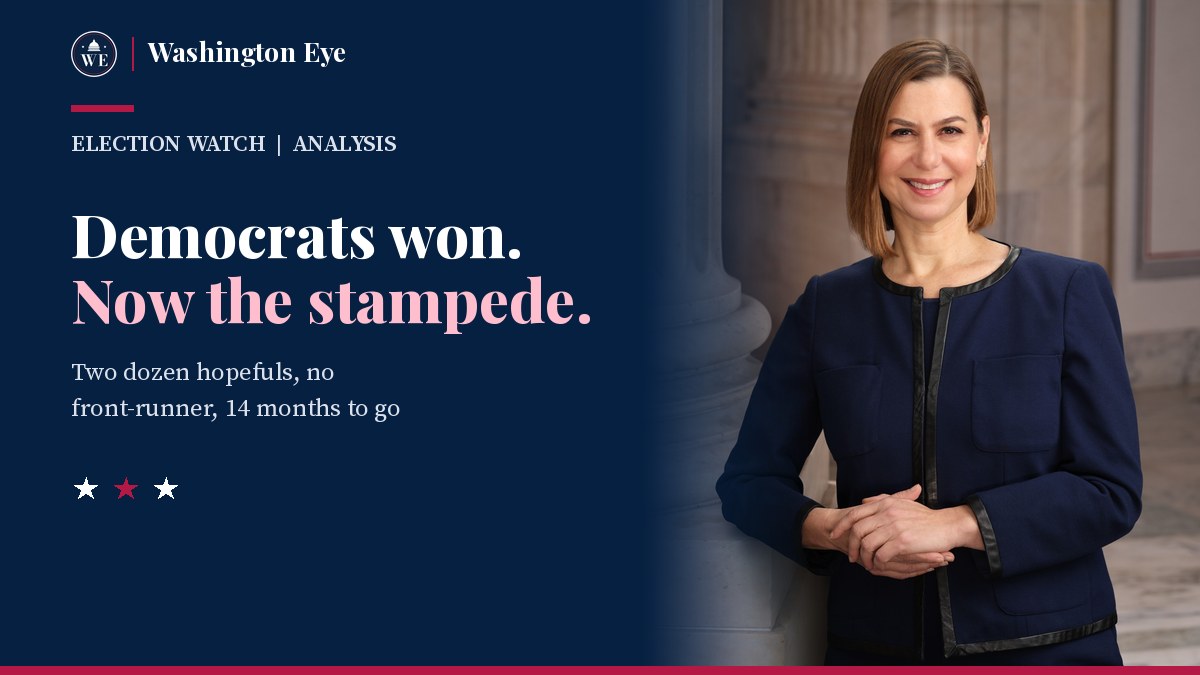
Two weeks ago, Democrats won the kind of midterm that parties dream about. They picked up at least 43 House seats and seven Senate seats, according to one nonpartisan tally of the results, and they will run both chambers of Congress from January. The next fight started almost before the ballots were counted, and it is not with Republicans. It is with each other.
More than two dozen Democrats are now preparing to run for president in 2028, according to Jim Messina, who managed Barack Obama's 2012 re-election campaign. He said he has spoken with "over two dozen campaigns" that are actively considering a bid and have already begun raising money and hiring staff. "I think you're going to start having Democrats announce exploratory committees next week or the next couple of weeks, probably after Thanksgiving," he said on a podcast.
Not one of them has formally entered the race. But the shape of the contest is already visible, and so is its biggest risk. A party that has just been handed a second chance by voters is about to hold what one reporter at a Denver gathering last week called likely the largest field of presidential candidates in American history. Republicans have seen this film before. They know how it can end.
The cattle call in Denver
The unofficial starting gun went off last week at a conference called "What's Next," hosted in Denver by a new centrist group, Majority Democrats, which is led by Representative Jake Auchincloss of Massachusetts. At least a dozen possible 2028 candidates spoke or worked the room, among them Senator Elissa Slotkin of Michigan, Senator Ruben Gallego of Arizona, Governor Josh Shapiro of Pennsylvania, former transportation secretary Pete Buttigieg, Senator Cory Booker of New Jersey, Representative Ro Khanna of California and Senator Raphael Warnock of Georgia. Former New Orleans mayor Mitch Landrieu said he was considering a run too.
Others stayed away but made sure they were represented. Governor JB Pritzker of Illinois and Governor Wes Moore of Maryland sent top aides. Senator Mark Kelly of Arizona skipped Denver to tour the aircraft carrier he once flew from as a Navy pilot, then visited the space shuttle he flew as an astronaut. "I just don't have a typical background," he said in an interview, conceding that it could cut both ways. Governor Gavin Newsom of California, speaking abroad, gave his most specific timeline yet: he will decide in late January.
A few names have already left the field. Senator Chris Van Hollen of Maryland told reporters in Denver he was "no longer pursuing" a presidential bid, hours after announcing he would challenge Chuck Schumer for Senate Democratic leader. Everyone else is keeping the door open. Shapiro said he had decided "to be a loud voice in this process," and that any decision would be made with his family. Buttigieg said he would not have "any news to make about that anytime soon." Khanna said the midterm results had "made it more likely than not" that he would run, and allies have set up a draft committee for him. Slotkin said she would decide by early 2027.
The veteran Democratic strategist David Axelrod summed up the mood. "This is the first election I can remember where the field is wide open and there's no front-runner," he said. "We have a whole new cast of characters."
"Accept a big primary"
Some Democrats see the crowd as a sign of health. Slotkin was blunt about it. "There's a lot of people who have basically been running for the past two years, right?" she said in an interview. "We should accept a big primary. I think that we should not try to whittle it down." She added that at least a dozen potential candidates had already called her to ask about Michigan.
There is a case for that view. A long contest forces candidates to build organisations, test their messages in front of real voters and prove they can raise money without leaning on the party. A nominee who survives a hard primary is usually better prepared for a general election than one who was crowned.
But from the right, the scene in Denver looked familiar for another reason. In 2016, Republicans fielded 17 major candidates. The party establishment assumed the field would sort itself out, that the strongest conventional candidate would rise as others dropped away. Instead, a crowded stage split the anti-Trump vote again and again. Donald Trump won three of the four early contests with roughly a third of the vote, and by the time the field narrowed it was too late to stop him. The lesson Republican strategists took from that year is simple: a big field does not choose the strongest nominee. It chooses the candidate with the most loyal plurality.
Democrats have one important protection that Republicans lacked. Under the party's delegate rules, delegates are shared out in proportion to the vote, but only candidates who reach 15 percent in a state or district qualify. That blunts the winner-take-all effect that helped Trump turn modest pluralities into big delegate leads. It also has a cost. With two dozen candidates, many contenders could fall below the line in early states, leaving delegates concentrated among a few leaders on thin shares of the vote, and leaving the rest fighting on in the hope of a breakthrough. Proportional rules tend to make contests longer, not cleaner.
A calendar built for a long fight
The map those candidates will run on is already set. In August, the Democratic National Committee approved a six-state early window: South Carolina on January 22, 2028, followed by Nevada on February 1, New Hampshire on February 8, New Mexico on February 15, Michigan on February 22 and Virginia on February 29. Iowa is gone from the early lineup altogether. New Hampshire, which has a state law requiring it to go first, has once again been told to wait its turn, and its longtime party chair called the calendar "disappointing."
The party says the order is designed to "battle-test" candidates across a diverse range of voters and in genuine battleground states. That is a reasonable goal. It also means six different electorates in six weeks, from Black voters in South Carolina to union households in Nevada to suburban swing voters in Virginia. In a field of two dozen, a different candidate could win each state. Voting begins in 14 months.
The early-state leaders are already being courted. Don Scott, the speaker of the Virginia House of Delegates, said he had heard from seven prospective candidates. "If you want to be president, you gotta come to the mother of presidents," he said. "They're going to have to touch some of that dirt in Virginia."
The argument Democrats have not had yet
The deeper risk for Democrats is not the number of candidates. It is what a crowded field does to an argument the party has postponed. The midterms were won on cost of living and on voters' anger at the president. Van Hollen himself put it in a way conservatives would recognise. "Voters fired Trump and his policies of corruption, the war and high costs, but they haven't fully hired the Democrats," he said. Auchincloss made the same point from the stage: "Voters did not tell Democrats we get it. They told us we get a chance."
That is an honest reading, and it cuts against the euphoria. A wave built on rejecting the other side is not a mandate for any one programme. Newsom said as much. "We tend to wildly over-read midterm elections in this country," he warned.
The Denver event showed where the fault lines will open. It was largely bankrolled by the hedge fund manager Stephen Mandel and his wife, Susan, who have reportedly put $20 million into moving the party toward younger moderates. Leading progressives such as Senators Bernie Sanders and Elizabeth Warren and New York City's mayor, Zohran Mamdani, were absent. Speakers talked about "universal health care" rather than Medicare for All, and about banning robocalls and gerrymandering rather than the party's divisions over immigration enforcement or Israel.
Khanna was the exception, and he made sure he was heard. "I'm all for a big tent, but not a shallow one," he said. "A big tent cannot mean that we water down principle for political expediency. It cannot mean that we make room for organized money and compromise our purpose to appease donors."
In a small field, that tension can be managed. In a field of two dozen, it becomes a business model. Every candidate needs a way to stand out to activists and small donors in the first weeks of 2028, and the cheapest way to stand out is to draw the sharpest contrast with the rest of the party. That is how a primary built around affordability can turn into a primary built around purity tests on health care, immigration and foreign policy, the issues Republicans have used against Democrats with suburban and working-class voters in past cycles.
What Republicans should take from it
None of this means Democrats are about to throw away their advantage. Two years is a long time, and the party's bench is deep. Messina himself expects the field to shrink as candidates confront the cost of a national campaign. He also identified the trap he wants Democrats to avoid. With Trump still in office through the campaign, he asked, "do the Democrats take the bait and talk about Donald Trump every day, or do you stay focused on your message?"
Republicans, who are working through their own succession question after losing both chambers, should watch closely. Their path back in 2028 does not depend only on who replaces Trump at the top of their ticket. It depends on whether Democrats spend the next 14 months persuading voters they have a plan for prices and paychecks, or spend them persuading their own activists that each candidate is the truest believer on the stage.
A big win buys a party time. A big primary decides how it spends it. Democrats have about two weeks of quiet left before the exploratory committees start arriving. After that, the stampede begins.