
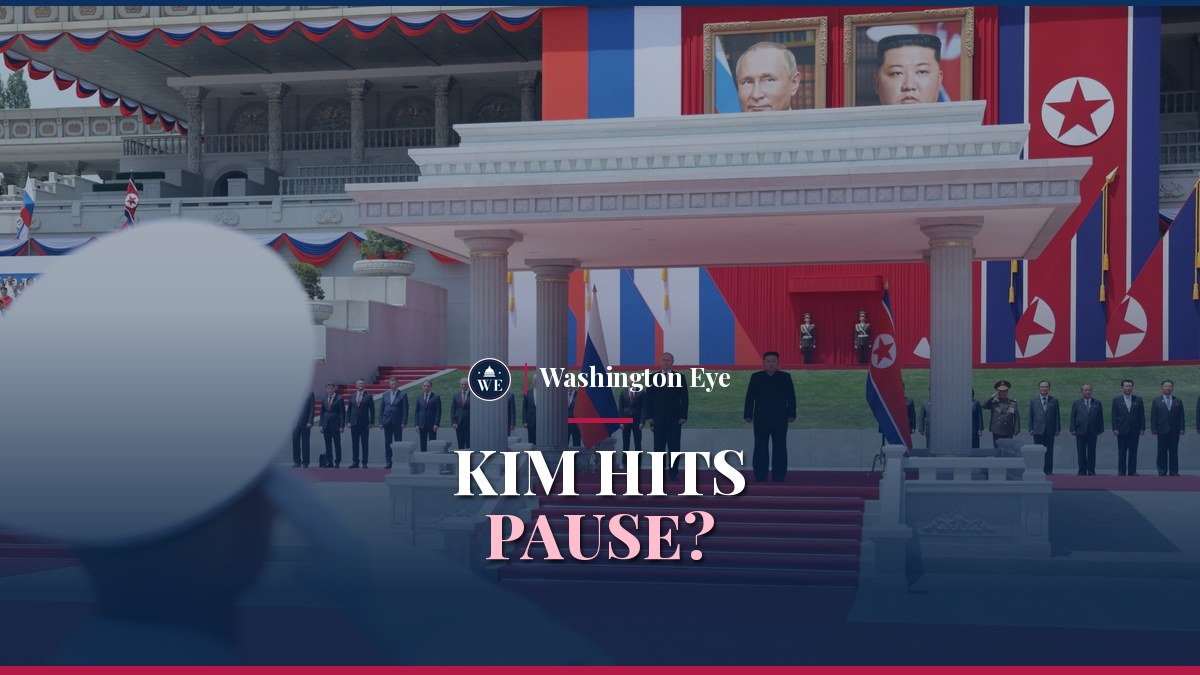
For three years North Korea has been one of the quiet engines of Russia's war in Ukraine. It has shipped artillery shells by the million, sent ballistic missiles that have hit Ukrainian cities and power plants, and dispatched thousands of soldiers to fight and die in Russia's Kursk region. So when Ukraine's military intelligence agency announced on Thursday that Pyongyang had suddenly frozen much of that help, it was a claim worth taking seriously, and worth treating with care.
According to the agency, known by its Ukrainian initials HUR, Kim Jong Un personally ordered a temporary suspension of military aid to Moscow after a diplomatic quarrel over Russia's approach to South Korea. Nobody outside Ukrainian intelligence has confirmed it. Moscow and Pyongyang have said nothing. Here is what is actually known, what is not, and why it matters well beyond the front line.
What exactly does Ukraine say North Korea has stopped?
HUR lists three measures. First, Russian military transport aircraft are barred from North Korean airspace. Second, deliveries of KN-23 short range ballistic missiles have been halted, along with an upcoming shipment of artillery ammunition. Third, Pyongyang is sitting on a Russian request to expand its military presence in Russia from about 8,500 personnel to 50,000.
Just as important is what HUR says has not stopped. Units of North Korea's 11th Corps are still serving in Kursk, according to the agency, and a North Korean missile unit has been operating in Russia's Voronezh region since the middle of the summer. HUR itself describes the picture as a slowdown in cooperation, not a breakdown of the alliance.
Why would Kim pick a fight with his most useful partner?
The trigger, in HUR's telling, was a single diplomatic remark. In October, Russian Deputy Foreign Minister Andrey Rudenko, who oversees Moscow's relations with Asia, reportedly said Russia would help ease tensions between Seoul and Pyongyang. In late October, according to the agency, North Korea's foreign minister, Choe Son Hui, demanded that Moscow clarify its policy toward South Korea. She then announced the pause, HUR says, on a decision made by Kim himself.
The public record is murkier. On October 20, Mr Rudenko did publicly say Moscow would welcome steps toward normalising relations with South Korea. He also said Russia had received signals that Seoul wanted to restore ties once the war in Ukraine was over, and that the two sides were discussing a resumption of direct flights. Those comments were about Moscow and Seoul, not about mediating between the two Koreas. A wire service that examined the claim said it could not confirm any public statement by Mr Rudenko about defusing tensions on the peninsula, nor any public remark by Ms Choe announcing a suspension. HUR did not say how it obtained its information.
Even so, the reported grievance fits a familiar pattern. North Korea treats any sign that an ally is warming to South Korea as a betrayal, and Russia and South Korea have more to talk about than their politics suggest. Seoul joined Western sanctions and export controls after the 2022 invasion, yet trade has not dried up. In the first eight months of this year, South Korea imported 18 million metric tons of Russian coal, a rise of 34% on 2025.
How much does Russia actually depend on North Korea?
A great deal. The two countries signed a mutual defence pact in June 2024, when Vladimir Putin visited Pyongyang, and North Korean troops later helped Russia push Ukrainian forces out of Kursk. Pyongyang officially acknowledged their combat role in April 2025. Officials estimate that about 14,000 North Korean soldiers were sent to Kursk. HUR puts the contingent's casualties at 7,058, including 2,251 killed.
The weapons matter even more. HUR has previously said North Korea supplies between 25% and 40% of the ammunition used by Russian forces, and that Russia has received more than 100 KN-23 and KN-24 ballistic missiles since June 2023. On November 17, Ukrainian President Volodymyr Zelensky said Russia was receiving dozens of North Korean ballistic missiles every month, and earlier this month he said KN-23 missiles had been fired at a Ukrainian energy facility. For North Korea, heavily sanctioned and short of cash, the trade has been a rare source of hard currency.
Is there any evidence the relationship is cooling?
Some, though none of it proves a freeze. Over the summer, Kyiv warned that 30,000 to 50,000 more North Korean troops could be on their way to Russia. That surge has not materialised, and analysts have been debating why: whether the warning was wrong, whether Moscow no longer needed the help, or whether Pyongyang was quietly holding back.
Andrii Kovalenko, a Ukrainian official who tracks Russian information operations, has suggested that fighting inside occupied Ukrainian territory, such as the Donetsk region, may be a red line for North Korea, which was comfortable defending Russian soil in Kursk but not attacking Ukrainian land. He described Pyongyang's approach as a "containment strategy" that keeps the benefits of the alliance while limiting its exposure to the war's outcome. HUR adds its own list of frictions, including language barriers and poor coordination between the two armies, on top of the heavy losses.
And the evidence against?
It is substantial. Only last week Mr Putin received Jo Yong Won, one of Mr Kim's closest aides, at the Kremlin, hardly the gesture of a relationship in crisis. Mr Zelensky's own warning about dozens of missiles a month came barely a week before HUR's announcement. North Korean troops remain in Kursk, by HUR's own account. And Ukraine has an obvious interest in advertising cracks in the coalition supplying its enemy.
None of that makes the report false. Intelligence services sometimes publish accurate findings precisely because they are useful. It does mean the safest reading is the narrow one: a temporary, partial pause driven by a diplomatic spat, layered on top of a relationship that was already settling into a lower gear.
Why should Americans care?
Because the North Korean pipeline is one of the few variables that can change the arithmetic of the war quickly. Ukraine's cities and energy system remain under regular missile attack. Fewer KN-23s would mean fewer of the fast ballistic missiles that Ukraine's air defences find hardest to stop. A sustained freeze would also strip Moscow of a supplier at the moment Washington is trying to push it toward a settlement.
It also matters for President Trump's own ambitions on the peninsula. Mr Trump left Asia on November 19 without the meeting with Mr Kim he had repeatedly floated, after a three way summit in Shenzhen with Mr Xi and Mr Putin whose joint declaration on nuclear risks did not mention North Korea. "The relationship is there, but we didn't meet," he said afterwards. "We'll have that meeting at some point." A major American newspaper has since reported that North Korean conditions stood in the way of a summit; a Trump administration official denied there had been a push for one.
If Mr Kim really is willing to squeeze Moscow over a perceived slight, it shows a leader acutely sensitive to being treated as a junior partner, by Russia or by anyone. That cuts both ways for Washington. It suggests the Russia alliance is not unconditional, which creates room for diplomacy. It also suggests that Pyongyang will punish any partner that appears to talk over its head with Seoul, a warning for an American president who likes to make deals leader to leader.
What should we watch next?
Three things. First, whether Ukraine reports fewer KN-23 strikes over the coming weeks; the missiles leave distinctive debris, and Kyiv has been quick to identify them. Second, whether Moscow sends a senior envoy to Pyongyang to smooth things over, or whether Mr Kim's long promised visit to Russia finally materialises. Third, whether South Korea, which has said only that military cooperation violating United Nations Security Council resolutions must cease, shifts its tone toward Moscow.
Until then, treat Thursday's claim as what it is: a single intelligence report from a party to the war, plausible in parts, unconfirmed in all of them, and a reminder that even Russia's most transactional alliance has a temper.