
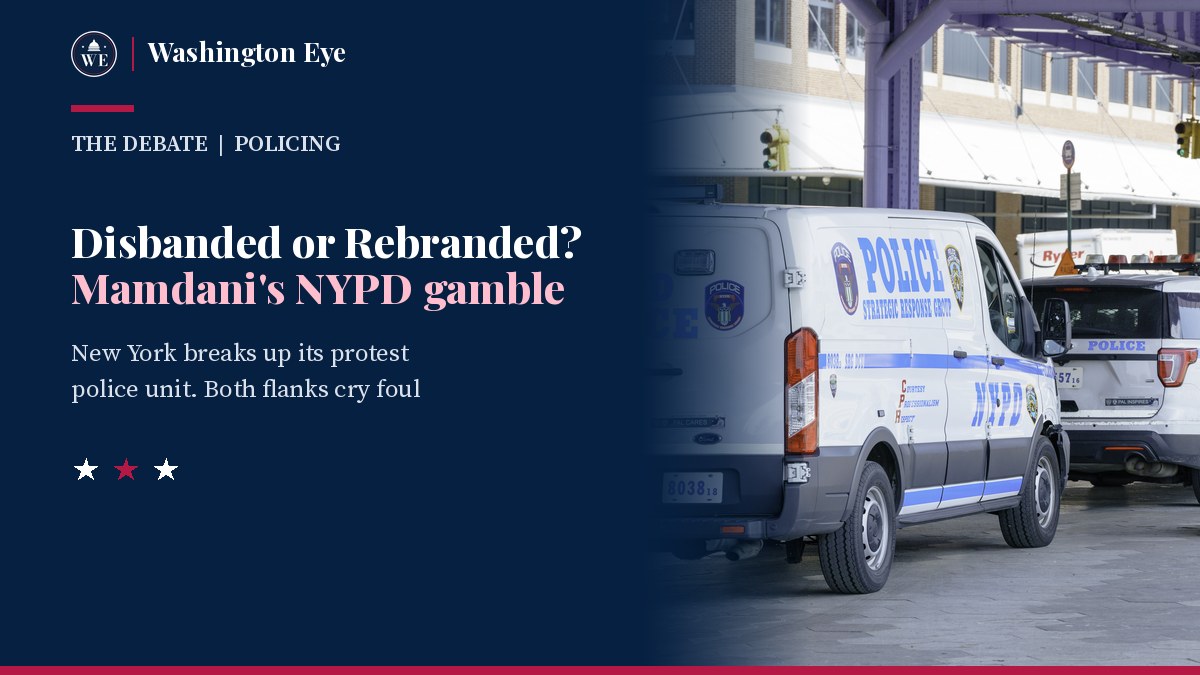
For more than a decade, the most argued-about police unit in New York City has been the one that shows up when crowds do. On Monday, Mayor Zohran Mamdani announced that it will be gone by mid-February. The Strategic Response Group, the NYPD's tactical force for protests, mass mobilizations and counterterrorism support, is being broken up, and its jobs are being split among new units with new names.
Police unions call the decision reckless. Some of the activists who campaigned against the unit for years call it a rebrand. And the police commissioner standing beside the mayor has told New Yorkers that, in many crowd situations, they will see "the very same response that they are accustomed to." All three things can be true at once, which is exactly why the move deserves a closer look than the usual left versus right shouting match allows.
Below, we set out what is actually changing, then make the strongest case on each side.
What Mamdani actually announced
The plan, rolled out by Mamdani and Commissioner Jessica Tisch, separates two missions that the Strategic Response Group has carried together since it was created in 2015: guarding the city against terrorist attacks, and managing protests and large gatherings.
Counterterrorism duties move under the NYPD's Intelligence and Counterterrorism Bureau. Protest response is being rebuilt in several layers. A new civilian-led Community Dialogue and De-escalation Division, housed in the Mayor's Office of Community Safety, is meant to lead the city's engagement with demonstrations, with no weapons and no arrest powers. Until it is up and running, a 30-officer First Amendment Support Team inside the department's Community Affairs Bureau, trained in communication and de-escalation, takes the lead. Reports differ on how soon the civilian division will be ready, and one account says it is not expected to be operational before 2028.
The piece of the plan that matters most to critics on the left is a new Patrol Support Division inside the Patrol Services Bureau. Its officers will receive crowd management training and will handle some of the protest functions the old unit performed, including mass arrests when commanders decide they are needed.
The order also sets limits on tactics. Pepper spray is no longer allowed as a crowd-control tool, long-range acoustic devices must stay below 90 decibels, and existing restrictions on tear gas, kettling (encircling a crowd to contain it) and long guns at protests are being formalized. The roughly 500 to 600 officers now assigned to the unit, depending on whose count is used, will be reassigned.
"New Yorkers exercising their constitutional right to protest should not be met with the same police response as a terrorism threat," Mamdani said. Tisch, a holdover from the previous administration whose credibility with rank-and-file officers is a large part of why the plan is politically survivable, framed it differently. "I would never support changes that diminish the NYPD's ability to protect New Yorkers, or that put our officers in a position where they lack the resources necessary to confront a serious threat," she said. "These changes will make us a stronger, more effective department."
How the unit got here
The Strategic Response Group was established in May 2015 under then-Commissioner William Bratton, folding eight borough task forces into a single citywide command. A department report the following year described more than 650 uniformed personnel trained in disorder control, hazardous materials response and the use of M4 rifles, with a mission that ran from active-shooter incidents to bank robberies, parades and demonstrations. That breadth was the point. It was also, critics say, the problem: the same officers trained for a terrorist attack were the ones sent to march alongside protesters.
The unit's reputation hardened during the 2020 racial justice protests, when it was accused of unlawfully detaining more than 100 demonstrators. A 2023 settlement with the state attorney general, the Legal Aid Society and the New York Civil Liberties Union created a four-tier system for protest policing. Under that system, peaceful marches are supposed to be handled by protest liaisons and patrol officers drawn from outside the Strategic Response Group, with the tactical unit brought in only when there is a risk of crime, probable cause for arrests, or a decision to disperse.
Tisch told a City Council budget hearing in March that the unit responded to just 6 percent of protests in 2025, and only when criminal activity was involved. Supporters of the unit cite that figure as proof the system was already working. Opponents say the unit's record during the protests it did attend, including repeated campus clearances in 2024, is the whole story.
The case for disbanding it
The argument for Mamdani's plan starts with a principle that is hard to dismiss: a protest is not an attack. A city that treats both with the same unit, the same equipment and the same training is sending a message to people exercising a constitutional right, whatever its intentions.
Donna Lieberman, executive director of the New York Civil Liberties Union, called the decision "good news for New Yorkers. Good news for public safety. Good news for the First Amendment." She has pointed to the unit's complaint record with the Civilian Complaint Review Board, saying the numbers "were off the wall compared to the rest of the entire police department."
The practical case is just as strong. Splitting counterterrorism from crowd control does not remove a single trained counterterrorism officer from the city; it puts them under the bureau that already runs the department's intelligence work, where their focus is not divided by the next march across a bridge. Mamdani has said there will "absolutely" be no reduction in police response times to mass incidents. The tactical limits mostly codify rules the department was already operating under after the 2023 settlement, which suggests the city is not throwing away tools so much as writing down how rarely they should be used.
There is also a democratic argument. Mamdani campaigned on this promise in 2025 and won. Delivering it, in a form his own police commissioner is willing to sign, is how campaign pledges are supposed to work.
The case against: a gift to disorder
The strongest objection from police leaders and Republicans is that the city is fixing something that was not broken, and doing it for political reasons.
"Why change it? It doesn't need to be changed. It's working," said Scott Munro, president of the Detectives' Endowment Association. Patrick Hendry, president of the Police Benevolent Association, went further: "Mayor Mamdani is showing his true colors: he is willing to put your safety at risk to appease his radical base." John Chell, a former NYPD chief of department, accused the administration of "gaslighting New Yorkers for clicks" and said the approach "gets people hurt, damages property, and disrupts people's lives."
The substance behind the anger is this. When a demonstration turns violent, the city needs a large number of officers who have trained together, know the equipment and can move as one. Breaking that capacity into a civilian division, a small liaison team and a new patrol unit risks slower, less coordinated responses at the moment when coordination matters most. A former detective who now teaches at a criminal justice college warned that the change risked "opening a Pandora's box" for people who want to cause harm. City Council Member Phil Wong has argued the unit is an important public safety resource and has proposed a separate, permanent unit to deal with street takeovers.
Outgoing Representative Mike Lawler, a New York Republican, cast the decision as political payback, arguing in a post online that the mayor was "disbanding the very NYPD unit tasked with stopping those radicals." Critics on this side also note that the city's large protests in recent years, including those tied to the war in Gaza, raised concerns among Jewish New Yorkers about harassment, and that weakening protest policing now sends the wrong signal.
The case against: a rebrand, not a reform
The more surprising criticism comes from the other direction. Several groups that spent years demanding the unit's abolition say the plan keeps the substance and changes the label.
"The campaign promise was not to change the name of a police unit, it was to disband a unit," said Linda Tigani, executive director of the city's Commission on Racial Equity. The Justice Committee, a police accountability group, warned that specialized units tend to grow "the scope, budget, and headcount" over time, and said the new Patrol Support Division could become "a reshuffling of NYPD violence through the creation of a new specialized unit." One advocate, speaking anonymously to a local political outlet, said the group came to believe that an arrest-capable unit was a condition of Tisch's support. City Hall disputed that account, saying advocates were told about the division in advance and that the plan was built on their demands.
These critics have a point that Tisch herself has sharpened. "Nothing would change about the way that the NYPD responds to crowd control conditions," she said in a television interview, citing the crowds after the Knicks' championship. If the commissioner is right, then the left's fear and the unions' fear cannot both be correct. Either the city has weakened protest policing, or it has mostly reorganized it.
The Legal Aid Society, which helped win the 2023 settlement, welcomed the move but said the restructuring "will require vigilant oversight to ensure that the SRG's tactics are not repeated."
Where the real fight now moves
The decisive questions are no longer in the mayor's order. They are in what happens next.
The first is the City Council. Mamdani has endorsed the CURB Act, sponsored by Council Member Chi Ossé, which would bar the Strategic Response Group and any successor from responding to protests and ban kettling, tear gas, pepper spray, bicycles and long-range acoustic devices in protest policing. Council Speaker Julie Menin is reported to oppose the bill, and the chair of the Public Safety Committee, Oswald Feliz, is reported to be unwilling to give it a hearing. A spokesperson for the speaker said the administration "has the authority to implement any changes it wants" without legislation. That matters, because a mayoral order can be undone by the next mayor. A law cannot be undone so easily.
The second is the Patrol Support Division itself: who is eligible to join it, how large it becomes, and how often it is sent to demonstrations. Public reporting on those numbers would settle the rebrand argument better than any press conference.
The third is the first big test. Sooner or later a demonstration will turn into a confrontation. How the new structure performs that night will decide whether this is remembered as a careful reform or a reckless experiment.
Our take
Both camps of critics are reacting to the label more than the details. The plan neither abolishes the city's ability to manage disorder, as the unions suggest, nor leaves the old unit untouched, as some activists claim. It separates counterterrorism from protest policing, writes long-standing limits into rules, and keeps an arrest capability under tighter control. Whether that compromise holds depends on transparency the city has not yet promised and a law the Council has not yet agreed to consider. New Yorkers on all sides should demand both.