
"Here we go again!" With those words on Thursday morning, President Donald Trump reached for the two levers he trusts most, immigration and tariffs, and pulled them together. In a post online he warned that "huge CARAVANS" were "beginning their illegal march through Mexico" and declared that unless Mexico stopped them, "the Tariffs on Mexico will be IMMEDIATELY DOUBLED." He added that Mexico, Texas's incoming governor, the Border Patrol and Immigration and Customs Enforcement had all "been so informed." "There will be no leniency!" he wrote.
It was a familiar performance, and it landed with a familiar jolt. The Mexican peso slipped to its lows of the session within hours. The post did not say which tariffs would double, from when, or under what law. As of the latest public reporting, no executive order, proclamation or trade notice had followed. The threat existed only as a post.
Look closely and the warning has a problem of arithmetic, a problem of law and a problem of facts on the ground. Together they suggest the post was aimed less at Mexico City than at an audience at home, nine days after voters handed Democrats control of both chambers of Congress.
Start with the arithmetic. Most trade between the two countries moves under the United States-Mexico-Canada Agreement, the pact Mr Trump negotiated in his first term. Goods that meet its rules of origin enter the United States duty free. Double zero and you still have zero. The duties that do bite are narrower: tariffs of 50 per cent on Mexican steel and aluminium, and 25 per cent on Mexican-made cars and light trucks, with various adjustments and exemptions. Accounts differ on the rate now charged on Mexican goods that fall outside the pact, but on any reading it covers a minority of the trade. A literal doubling would therefore hammer metals and autos, sectors in which factories on both sides of the border are already wired together, while leaving the bulk of the relationship untouched. Hitting everything would require a brand new tariff, not a doubling of an old one.
Then there is the law. On 20 February the Supreme Court ruled that the International Emergency Economic Powers Act, the statute Mr Trump had used in 2025 to slap tariffs on Mexico, Canada and China over drugs and migration, does not authorise tariffs at all. Writing for the Court, Chief Justice John Roberts noted that "all agree that the President enjoys no inherent authority to impose tariffs during peacetime." That ruling killed the 25 per cent emergency duty that had applied to Mexican goods outside the trade pact. What remains are older statutes that come with procedures attached. Section 232 tariffs rest on national security findings about particular products. Section 301 duties follow an investigation by the US Trade Representative. Section 122 allows a temporary across-the-board surcharge, but only up to 15 per cent and for no more than 150 days. None of these was written to punish a neighbour over the movement of people, and none can be switched on by a post.
That does not mean the threat is empty. The administration could try to raise the steel, aluminium and auto duties it already imposes under Section 232, and it has shown a willingness to stretch statutes before. But any move would invite fresh litigation from importers, who have already challenged the existing Section 301 duties at the Court of International Trade. Within weeks it would also face a Congress run by Democrats who campaigned in large part on prices.
The third problem is the caravan itself. A group calling itself Dios con Nosotros, or God With Us, set out on Tuesday evening from Tapachula, a city near Mexico's border with Guatemala. A Chiapas state government source put its size at about 1,500 people; other estimates ranged from 1,000 to 2,000. Most are from Honduras, El Salvador and Venezuela, and local reporters found families with small children, some carried on their parents' shoulders. Several told reporters that last week's Democratic victories had given them new hope. Some had been deported from the United States in earlier months and wanted to try again. To escape daytime heat that reaches the high 30s Celsius, the marchers have been walking at night along the coastal highway. Their first goal is Mexico City, where they hope to ask the federal government for papers.
On Thursday morning President Claudia Sheinbaum used her daily news conference to rebut the premise of Mr Trump's post. "Since President Trump came into office, no migrant caravan has reached the northern border," she said. She described two groups now in southern Mexico. One, she said, had started with 500 or 600 people and had dwindled to fewer than 100. The other, the larger Honduran group, would receive the same treatment. Mexican officials, she said, tell each person in the caravan that there is no way into the United States. "If their goal is to reach the United States, they will not be able to achieve it because there is no such possibility," she said. Most then go home, and Mexico helps them do so. Asked whether her government would use force, she said there would be "no acts of repression."
Human rights groups in Chiapas tell a harsher version of the same story. The Fray Matías de Córdova Human Rights Centre, which monitors caravans entering through Tapachula, said the group that arrived in early October had broken apart not because of dialogue with migration officials but because of physical exhaustion and what it called "detentions and deceptions" by the authorities. Earlier groups in September and October walked about 250 kilometres along the Chiapas coast before being broken up near the state line with Oaxaca. On Tuesday, security forces stopped a separate group of about 100 migrants who had just crossed the Suchiate River from Guatemala, detaining dozens. A medical charity working along the route said it treated 72 people from the current caravan in a single day for respiratory infections, blistered feet, sunburn and dehydration.
In other words, Mexico has been doing for nearly two years what Mr Trump is now demanding that it start doing. Washington's own policies did the rest. On his first day back in office Mr Trump suspended the refugee admissions programme and shut down the phone application migrants had used to book asylum appointments at the border. Illegal crossings fell sharply. Shelters on the Mexican side emptied. The real bottleneck is now in Tapachula itself, where local organisations estimate that between 20,000 and 50,000 people are stranded, waiting for documents with little work, healthcare or schooling.
The administration's case is that pressure works, and that any sign of softening invites a new surge. "This illegal migrant caravan will NOT be allowed to enter our country. Full stop," Homeland Security Secretary Markwayne Mullin wrote in a post online. There is precedent on the president's side. In May 2019, Mr Trump announced a 5 per cent tariff on all Mexican goods unless Mexico curbed migration. Within about a week the two governments struck a deal, Mexico deployed troops to its borders, and the tariff never took effect. To the president's allies, that episode proved the method works.
But 2026 is not 2019. Then, Mexico paid no tariffs and had something to lose. Today it already pays steep duties on its most important industrial exports, and the two governments are in the middle of talks meant to bring those duties down. In July Mr Trump declined to extend the trade pact at its scheduled review, leaving it in force but subject to yearly reviews rather than a fresh extension. Negotiations since then have stalled over steel and aluminium. People familiar with the talks have said they cooled in October after Commerce Secretary Howard Lutnick tried to take control of them and objected to Mexican demands for lower duties on metals. A tariff threat tied to migration muddles those talks further, and it arrives just as Ms Sheinbaum prepares to travel to China for next week's Asia-Pacific summit, where her economy secretary, Marcelo Ebrard, will push for closer trade and investment ties. Ms Sheinbaum has said Mexico is not seeking a free trade agreement with Beijing, citing its commitments to the United States and Canada. Washington is giving her reasons to keep her options open all the same.
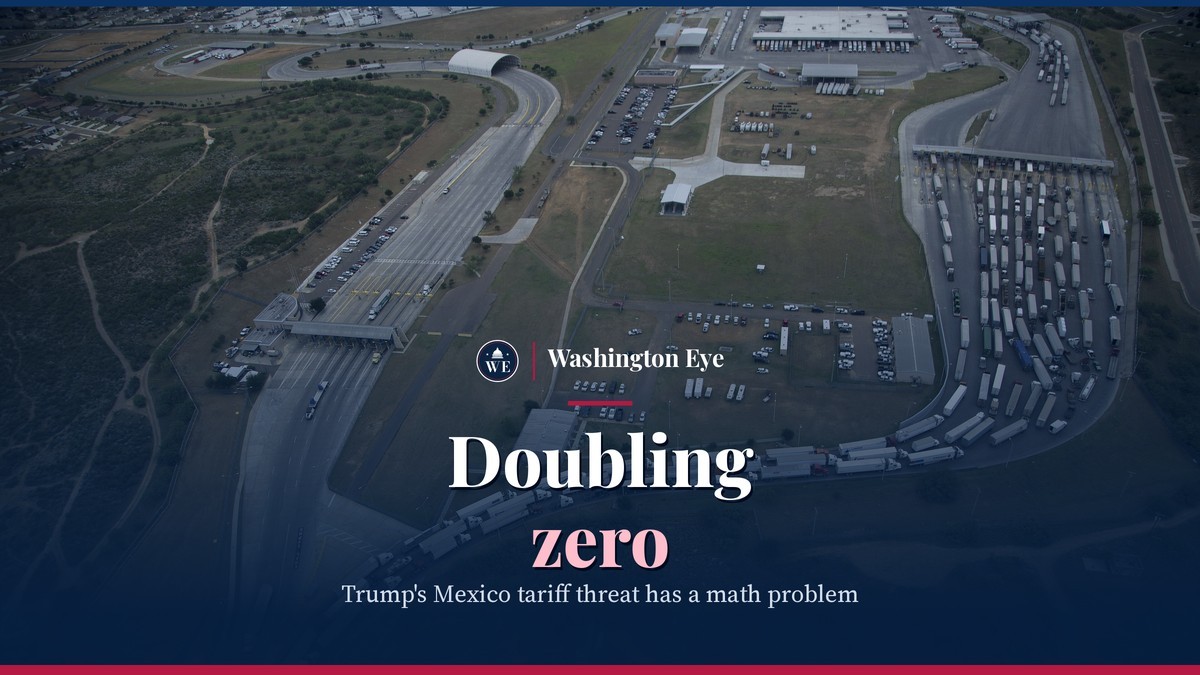
The people most exposed to the threat are not in Mexico City. They are in Texas. The state traded $301.8 billion in goods with Mexico last year and handles roughly three quarters of all land trade between the two countries, according to an economist at the Dallas branch of the Federal Reserve. In September alone, two-way trade between the United States and Mexico reached about $96.3 billion, and $38.9 billion of it moved through the single port of Laredo. Nationally, the United States imported $534.3 billion in goods from Mexico last year and sold it $337.3 billion, according to Census Bureau figures. Tariffs are paid by the American companies that import those goods, and many pass part of the cost on. Auto parts that cross the border several times before ending up in a finished vehicle would be taxed at each step.
It is hard to miss the politics. Exit polls from last week's elections suggested that the immigration crackdown was not the main reason voters turned to Democrats, while high prices were a major concern. Mr Trump himself conceded in a television interview that his deportation campaign might have been "too tough" for some voters, and floated an immigration deal with the incoming Democratic majorities. Then he named Stephen Miller, the architect of his crackdown, as White House chief of staff. Thursday's post fits the second impulse, not the first. It opened by insisting that "I WAS NOT ON THE BALLOT" and blamed the caravan on "the perceived loss by the Republicans." It also took a swipe at "the very liberal new governor of Texas," Gina Hinojosa, the Democrat who unseated Greg Abbott last week. She has said she supports border security but has called the state's Operation Lone Star deployment "political theater." She takes office in January, and the president appears to want the fight early.
Tariffs that raise the price of cars and steel are an odd response to an election in which prices were the top complaint. A caravan that Mexico is already wearing down on its southern highways is an odd reason to impose them. What the post does accomplish is to change the subject from last week's results to a familiar image of people walking north, and to cast the incoming Democratic majorities, and a Democratic governor in Austin, as the cause.
Three things will show whether this is policy or theatre. The first is paper: a proclamation or trade notice that names the goods, the rate and the legal authority. The second is Mexico's reply, which so far has disputed the premise rather than offered a new crackdown. The third is the road north of Huixtla, where the marchers rested on Thursday. If the caravan thins out in Chiapas, as the last two did, the president may claim victory without signing anything. If he does sign something, American importers, Texas truckers and car buyers will learn what doubling means. It will not mean zero.