
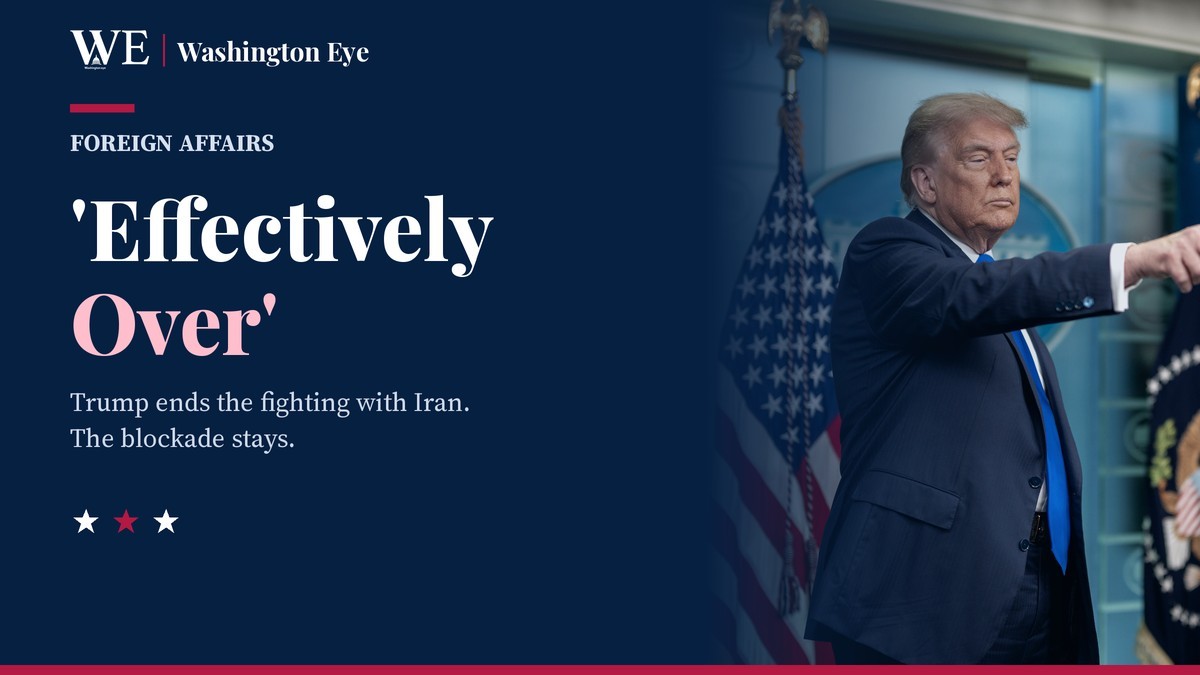
President Donald Trump walked into the White House briefing room on Monday evening without warning and offered the clearest statement yet of where he believes the conflict with Iran stands. "Iran militarily is effectively over," he told reporters. "We're just keeping it the status quo." A few hours earlier he had met Qatar's prime minister and foreign minister, Sheikh Mohammed bin Abdulrahman bin Jassim Al Thani, together with Vice President JD Vance. By the time he left the podium, the president had signalled that a resumption of American bombing was unlikely, that the naval blockade of Iranian ports would stay, and that he still wanted what he called a long-term solution to Iran's nuclear programme.
Those three messages do not add up to peace. They add up to something Washington has rarely tried to sustain for long: a war that the commander in chief describes as finished on the battlefield while its most powerful economic weapon keeps running at full strength. Understanding why Mr Trump chose that formula, and what it means for Tehran, the Gulf, oil markets and a Congress that has just changed hands, is the real story of this week.
The president's case rests on a simple claim. In his telling, the United States has already won the military contest. He said Iran had been "decapitated" and that America's neighbours in the region are "a lot safer than they were six months ago." In a post on his social media platform he called a renewed round of strikes "quite unlikely" and wrote, "We are seeing positive momentum toward an end to this Conflict, and will ensure that America's interests are at all times protected." He had already told a television interviewer over the weekend that a return to fighting was "highly unlikely."
Yet he refused the obvious next step. Asked why he did not simply declare the conflict over and move on, Mr Trump pointed to the Gulf. "We have some great allies there, and we have to make sure they're not hurt, and they would be hurt," he said. He described Iran as still being "the bully of the Middle East a little bit." And he kept a threat on the table, telling reporters that the United States was "locked and loaded, ready to go for any reason that changes."
The most striking part of the briefing was the reason Mr Trump gave for keeping the pressure on. He said he was acting "at the behest of countries that are their neighbours," and named them: Qatar, Saudi Arabia, the United Arab Emirates, Bahrain and Kuwait. Those governments, he said, "would prefer the status quo, that we remain as is. In other words, a continuation of the greatest naval blockade in the history of our country."
That framing matters for two reasons. First, it shifts some of the political ownership of the policy onto regional partners at a moment when the war has become a liability at home. Second, it tells Tehran that any deal will have to satisfy not only Washington but also the Gulf capitals that live next to Iran and have borne the risk of its missiles, drones and attacks on shipping. Sheikh Mohammed struck an optimistic note after the meeting. "We discussed the situation in the region and ways to progress the US-Iran talks," he wrote on a social media platform. "Grateful for the positive discussions on reaching a deal and bringing peace to the region."
Qatar has become the central channel between the two sides, with Pakistan also in regular contact, according to Iran's foreign ministry. The plan now on the table is a compressed version of an earlier seven-day proposal. As described in published accounts of the mediation, the first day would see the United States lift its naval blockade and release some frozen Iranian funds, while Iran formally invited inspectors from the International Atomic Energy Agency to visit nuclear sites damaged during the war. On the second day, the Strait of Hormuz would reopen, followed by fresh negotiations focused on Iran's stockpile of highly enriched uranium.
Tehran insists that the sequence must start with Washington. Foreign ministry spokesman Esmaeil Baghaei said Iran would meet its commitments if the United States lifted sanctions, the blockade and other measures imposed during the conflict, and on Tuesday he defended the plan as the most reasonable offer available. The administration's public answer so far has been blunt. Secretary of State Marco Rubio described Iran's conditions on Sunday as "outrageous and ridiculous, and really not realistic."
The gap is not small. Washington wants the nuclear file addressed first and has shown no sign of releasing the blockade before it sees concrete steps on enriched uranium. Iran wants the blockade and sanctions lifted first and treats inspections as the price it is willing to pay in return. Mr Trump's insistence that Iran's nuclear programme be "defanged," combined with his description of the blockade as the status quo, suggests he believes time is on his side.
The blockade is the instrument that makes "effectively over" possible. The United States first imposed it on Iranian ports on 13 April and reimposed it on 14 July. On Saturday, US Central Command announced Task Force Iron Gate, a team of about 20 military and civilian personnel based in Tampa, Florida. Its job is to work with other agencies to disrupt the flow of advanced weapons, dual-use technology, sanctioned materials and illicit revenue across Iran's land borders and the Caspian Sea.
In plain terms, the administration is trying to close the routes that a blockade at sea cannot reach. If the strategy works, Iran's economy is squeezed further without a single new airstrike. If it does not, Washington will have committed itself to an open-ended enforcement mission with no clear end date and no congressional authorisation that matches its scale. That tension sits at the heart of the coming fight on Capitol Hill.
Defense Secretary Pete Hegseth, who calls himself the secretary of war, backed the president's reading of the battlefield late on Monday. "Iran is devastated. Iran is in the weakest position that it's been in a very, very long time," he told reporters who cover the Pentagon. "The president has the upper hand on any path that he chooses to take." He said the department was ready for whatever the president ordered.
Mr Hegseth's confidence comes as he faces the most serious threat to his tenure. On Monday, Republican Representative Thomas Massie of Kentucky filed eight articles of impeachment against him, based largely on the Iran war and also citing military actions in Yemen and Venezuela. A House vote could come by midweek. Mr Hegseth has said he expects enough Republicans to defeat the effort and planned a press conference on Tuesday, his first in more than 180 days.
The timing of Mr Trump's declaration is hard to separate from that fight. If the war is "effectively over," the argument that Congress must act urgently to rein it in loses some force. But the opposite case is just as available to the president's critics. A war that is over should not need an indefinite blockade, a new task force and a standing threat to resume bombing. Supporters of the impeachment resolution, and Democrats preparing for their new majorities in January, can ask a simple question: if the fighting has ended, what exactly is the legal basis for the operations that continue?
Last week's midterm elections changed the backdrop. Democrats are on track to hold roughly 260 House seats next year and as many as 56 in the Senate, and many Republicans returning to Washington this week have openly blamed the war for their losses. Mr Hegseth himself has said the war was necessary even if it was unpopular. A president who wants to keep his options open in the Gulf has every incentive to lower the temperature before a hostile Congress arrives with subpoena power and control of the purse.
The first verdict came from traders rather than diplomats. The global Brent benchmark settled down 5.85 per cent on Monday, sliding to its lowest level since 31 August, as Mr Trump's tone eased fears of a new round of strikes. Early on Tuesday Brent edged lower again to about $92.33 a barrel, while the main American benchmark, West Texas Intermediate, traded near $86.50.
The drop is a bet on calm, not proof of it, and analysts noted that attacks on shipping around the Strait of Hormuz have not stopped. The market is pricing a lower risk of escalation, not a return to normal. For American households, the difference between those two outcomes is the difference between gasoline prices that stop rising and gasoline prices that actually fall. The latter depends on the strait reopening, which in turn depends on the deal that neither side has yet accepted.
Mr Trump has given himself room to move in either direction. If Tehran softens its terms, he can present a deal as the natural end of a war he has already declared won. If talks stall, he can point to the blockade and Task Force Iron Gate as proof that pressure continues, and to "locked and loaded" as proof that force remains available. The Gulf states, by his account, want exactly this middle path: no new bombing, no relief for Iran until it moves.
The risks are real on both sides. Senior American and Gulf officials have cast doubt on the chances of an imminent agreement, and an open-ended blockade invites incidents at sea that could restart the fighting by accident. Iran's leaders, for their part, may conclude that a weakened American president facing impeachment votes and a Democratic Congress will eventually blink, and hold out for better terms.
Three things will show which reading is right. The first is whether Washington formally answers the two-day proposal, even with a counter-offer. The second is whether Iran issues a real invitation to nuclear inspectors without waiting for the blockade to lift. The third is how the House votes on Mr Hegseth this week, because a strong rebuke from lawmakers would tell Tehran that American patience is thinner than the president suggests.
For now, Monday's message from the briefing room is best read literally. The bombing has paused. The blockade has not. And the war that Mr Trump calls "effectively over" will only truly end when someone in Washington or Tehran agrees to go first.