
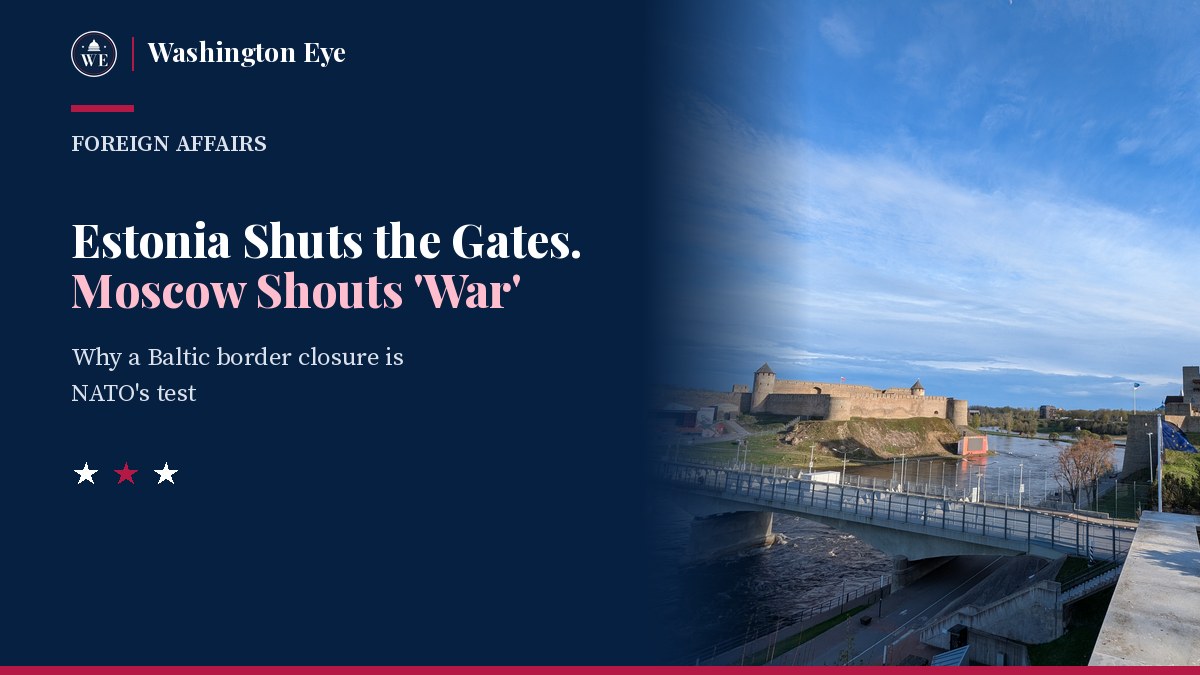
At seven o'clock on the morning of 1 December, the barriers will come down on the bridge in Narva. The low concrete span over the Narva River links a medieval Estonian castle on one bank to a Russian fortress on the other, and for decades it has carried people back and forth between Estonia and Russia. Under a decision taken by Estonia's government on 20 November, it will close to people and cars for at least six months, along with every other road crossing on the 294 kilometre frontier.
Three days after the decision was announced, Moscow answered in the language of war. Russia's Foreign Ministry summoned Estonia's chargé d'affaires and, in a written statement, said the diplomat had again been told that "such provocative and extremely dangerous actions are on the verge of triggering open war with Russia."
That is an extraordinary phrase to aim at a member of NATO, and it lands in a week when the war in Ukraine is spilling across the map. Here is what Estonia is actually doing, what Russia is claiming, and why a border closure in a small Baltic state is a question for Washington as much as for Tallinn.
What exactly is closing?
The government's order covers all five road checkpoints with Russia: Narva-1 and Narva-2 in the northeast, and Koidula, Luhamaa and Saatse in the southeast. From 1 December, people and vehicles will no longer be able to cross at any of them. Rail freight will keep moving under the restrictions already in place and strict customs controls. After six months, the cabinet will decide whether to extend, loosen or lift the measure.
Estonian officials have told their own citizens who are now in Russia to plan their return well in advance. Once the road crossings shut, anyone travelling between the two countries will have to go the long way round, through routes that remain open in other countries and that the government itself warns "may be longer and more costly than before."
Why is Estonia doing this now?
The trigger was fire. On the night of 13 to 14 November, someone tried to set alight the premises of Threod Systems, an Estonian defence company in Viimsi, just outside Tallinn. Estonia's Internal Security Service says the attack was organised on the orders of Russia's military intelligence agency, the GRU. Eight residents of neighbouring Latvia were detained on suspicion of helping to prepare it. It was the second attack on an Estonian defence firm this year, following one on Milrem Robotics in September, and the security service says both were commissioned by Russian intelligence. Moscow denies any involvement.
Prime Minister Kristen Michal framed the closure as a consequence, not a gesture. "Russia's hostile actions have consequences," he said. "We have said before that if the attacks continue, we will take further steps to protect our security. That is what we are doing now. Estonia is acting calmly and deliberately, but decisively. We will not allow Russia to exploit our openness against us."
The government argues that the checkpoints themselves have become a security weakness. Interior Minister Igor Taro told reporters that "Russian security services are intimidating and trying to recruit our citizens who are travelling through our border checkpoint," adding: "This is something we cannot tolerate anymore." Officials say closing the crossings will make recruitment and influence operations harder and help stop sanctions evasion. Michal also warned that Russia is building narratives aimed at Estonia's next parliamentary elections, and said the country's security agencies have recorded more than ten Russian attacks over the years.
Foreign Minister Margus Tsahkna put the blame squarely on Moscow, saying Russia bears responsibility for the closure and that the decision reflects a pattern of attacks against Estonia and Europe that have grown more severe, not one incident alone.
What is Russia accusing Estonia of?
The Russian statement went well beyond the border. It accused Tallinn of "tacitly" letting Ukrainian drones use Estonian airspace to strike northwestern Russia, of trying to obstruct Russian cargo ships in the Baltic Sea, of banning the transit of Russian and Belarusian grain, a policy Estonia introduced at the start of October, of seeking to ban the Russian language and of threatening to close the Russian Orthodox Church. It called Estonian measures "Russophobic," said the closure "will inevitably backfire" on Tallinn and its allies, and said Russia "reserves the right to take comprehensive political and diplomatic measures" to protect its interests and "the legitimate rights of its citizens."
Estonia flatly rejected the drone charge. "While we generally do not comment on or engage with Russian propaganda narratives, in this case we can reiterate that Estonia has never allowed, and will never allow, its territory to be used for military operations by another country," its Foreign Ministry said. Ukrainian drones have strayed into NATO airspace before; Kyiv blames Russian signal jamming, and allied governments say Moscow is responsible for such incursions.
Tsahkna went further, listing what he described as Russia's own conduct: "Russian missiles have reached Polish territory, Danish security services have identified an assassination plot in Denmark orchestrated by Russian intelligence services, merchant vessels in the Black Sea are under constant threat from Russian attacks, and in Estonia, an arson attack targeting a defence industry company, planned on the orders of Russian military intelligence, was foiled."
Should "open war" be taken literally?
Not as a statement of intent, but not as noise either. The wording carries history. Estonia is home to a large ethnic Russian population, and the city of Narva is overwhelmingly Russian speaking. When Moscow moved into eastern Ukraine in 2014, it justified its actions with claims that Russian speakers there were being persecuted. Accusations about language and the church, packaged with a pledge to defend "the legitimate rights" of Russia's citizens, are a familiar part of that script, and Estonians hear them that way.
The rhetoric also arrives in a dense cluster of incidents. Last week three Russian cruise missiles came down in eastern Poland. On Monday night a Russian surveillance drone briefly crossed into Polish airspace during an attack on western Ukraine, and a Polish deputy defence minister said he assumed it was deliberate. On Saturday a sanctioned Russian cargo ship was hit in the Gulf of Finland by what was presumed to be a Ukrainian drone, prompting Finland's prime minister, Petteri Orpo, to warn that the war is "spilling over" into his country's neighbourhood. The next day, Ukrainian sea drones sank the Russian corvette Merkury in the Libyan port of Benghazi. On Tuesday, Vladimir Putin said Russian retaliation for Ukraine's strikes on oil refineries was "inevitable."
In that setting, a threat of "open war" against a frontline NATO state is best read as pressure: an attempt to make allies ask whether Estonia is worth the trouble.
Is Estonia alone?
No, and Tallinn is keen to say so. Finland's land border with Russia has been shut since December 2023, and Latvia, Lithuania and Poland have all sharply restricted crossings on their eastern frontiers in recent years. NATO Secretary General Mark Rutte, speaking in Berlin, said the alliance was watching events in Estonia alongside the missile incursion into Poland and had options to respond. "When it comes to the military domain, we will always make assessments of our deterrence and defence and make updates where necessary," he said.
Economically, the cost to Estonia as a whole looks manageable. The government says its goods exports to Russia have fallen to around a third of their 2021 level, and exports of Estonian made goods to around a fifth.
Who pays at home?
The pain is local, and it is concentrated in places that have the closest ties to Russia. The government itself says Narva and Setomaa will feel it most, along with Ida-Viru County and the southeast, especially people with relatives, jobs or property across the river.
Narva's mayor, Jaan Toots, says he learned of the specific decision from the news. He has raised three objections. If the threat is serious enough to close the Russian border, he argues, controls should also return on the Latvian border, since recent illegal crossings involved people coming from that side. He wants humanitarian crossings so residents can visit elderly relatives or attend funerals. And he fears for jobs in a city where many border guards and customs officers are local, and for hotels and restaurants that serve visitors from Finland, Latvia and beyond. Asked about a planned shelter for people queuing at the checkpoint, he replied: "Everything is on hold now."
Even Estonia's president, Ülle Madise, urged caution before the decision was finalised. In a public radio interview she asked the government to weigh the consequences and not to let emotion drive policy, noting that the attacks on defence plants could have happened with the border closed, and that Latvia and Poland had kept crossings open. She said Estonia should keep allowing crossings for diplomatic and humanitarian reasons, while not ruling out tighter controls.
Why should Americans care?
Because Estonia is the kind of place where an alliance promise stops being abstract. Under Article 5 of the North Atlantic Treaty, the United States is committed to treat an armed attack on Estonia as an attack on all members. Moscow's strategy, as many European officials describe it, is to operate below that line: arson, recruitment, drones, jamming and threats that never quite amount to an armed attack but slowly test whether allies will stand together. Each incident that passes without a shared answer makes the next one cheaper.
That puts weight on Washington's tone. President Trump has in the past played down Russian incursions into allied airspace as mistakes, while his envoys pursue a wider deal on European security, and the Kremlin has said a new round of talks with the United States and Ukraine could take place in Abu Dhabi. A Baltic state that feels exposed may act more sharply on its own; one that feels backed can afford to stay calm.
What to watch
First, 1 December itself: whether the closure takes effect smoothly, how long the last queues at Narva become, and whether Russia responds with anything beyond words, from trade or rail restrictions to pressure at sea in the Gulf of Finland. Second, whether Tallinn creates a humanitarian exception of the kind Narva's leaders and the president have asked for, which would soften the domestic cost without reopening the door. Third, whether NATO's promised assessments produce visible changes in air defence and patrols on the eastern flank. And fourth, what Washington says. A clear American line now would do more to keep "open war" a figure of speech than anything said in Moscow or Tallinn.