
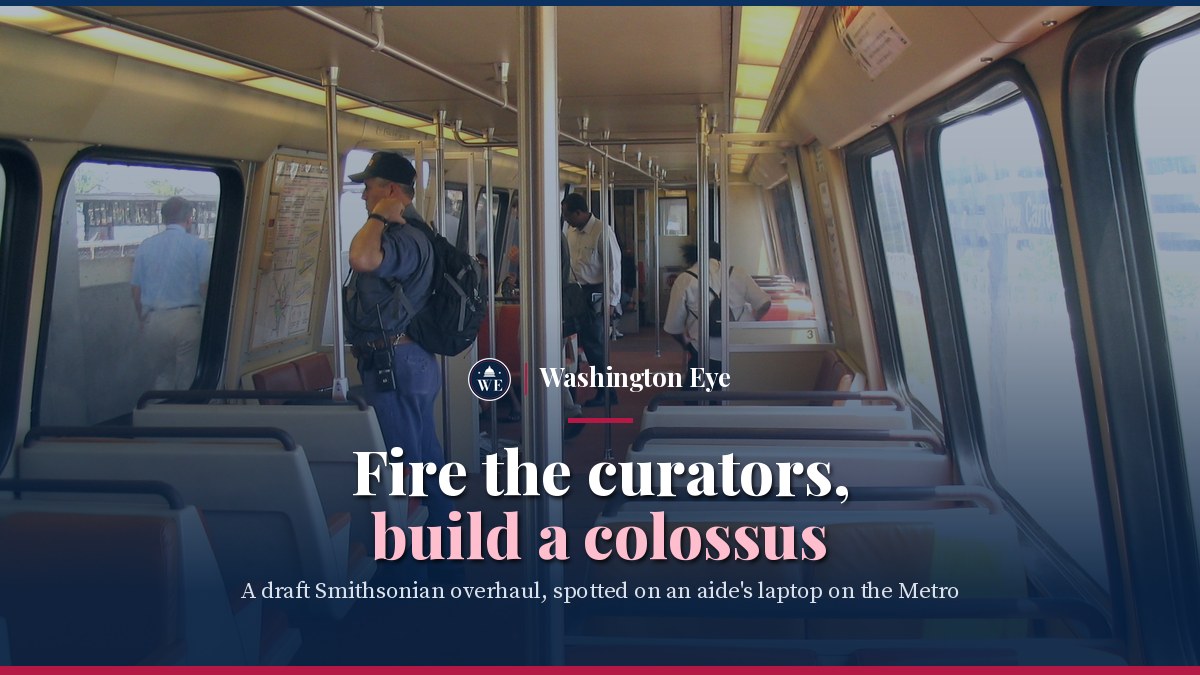
In the last week of October, while political Washington was counting down to the midterm elections, a commuter on an Orange Line train heading in from the Northern Virginia suburbs glanced at the laptop of the man in the next seat. On the screen was a document titled "Smithsonian Institution Renewal Plan." The commuter took a few photographs over his shoulder and sent them to a nonprofit investigative newsroom, which published them on Monday.
What the pictures show is a 25 item to do list for the National Museum of American History, the Smithsonian's flagship museum of the national story. It reads less like a set of suggestions than a takeover plan: fire the director, fire about a dozen senior administrators and curators, rewrite the rules for exhibits, rewrite the school curriculum, and put a giant statue of George Washington at the front door.
Nobody in government has confirmed that the plan is real policy. The White House has not answered questions about it. The man with the laptop, whom the newsroom identified as a young adviser on the White House Domestic Policy Council, has not responded either. But the list fits neatly into a campaign the administration has run against the museum since the summer, and it lands at a fragile moment for the Smithsonian. Here is what the document says, who actually controls the institution, and why the real fight may now move to Congress.
What is on the list
The headline item is personnel. The draft calls for removing Anthea Hartig, the museum's director, whom the White House has accused of spreading "radical activist ideology," along with roughly a dozen other top officials and curators. No president had tried to remove a Smithsonian executive until last year, when President Donald Trump moved to fire the director of the National Portrait Gallery. The institution resisted that order, but the director, Kim Sajet, chose to leave anyway.
The second cluster is about what visitors see. The plan proposes a new permanent exhibition celebrating America's Western civilizational inheritance, a show on "Great Families of American History," and a "Colossus Statue" of Washington at the museum entrance, an idea the president floated online in September. It would issue new interpretive guidelines for every exhibit and end the museum's reliance on a diversity style guide. It would review the Smithsonian's traveling exhibitions and halt one now on the road, "The Bias Inside Us."
The third cluster is money and schools. The draft orders a review of Smithsonian grants to what it calls "woke third parties," naming the American Alliance of Museums, a national association of museums. And it would overhaul the museum's online lessons for schoolchildren to "realign educational materials with patriotism, not ideology." A module on immigration called "Becoming US" would go. In its place would come a curriculum on the founders, with working titles such as "Architects of Liberty" or "Profiles in Liberty."
The document was plainly unfinished. A sheet of paper on the staffer's knee carried handwritten extras, including "announce exciting cool exhibit on D-Day" and "no X rated exhibitions policy." The second note almost certainly refers to a gay history display that featured a chrome and rubber harness, an object that drew heavy fire in the White House report and at two congressional hearings this year.
Where the list comes from
None of this arrived out of nowhere. In March 2025, Mr Trump signed an executive order telling Vice President JD Vance to use his seat on the Smithsonian's governing board to remove what the order called "improper ideology" from the institution. On July 4 this year, timed to the 250th anniversary of independence, the Domestic Policy Council released a 162 page report accusing the history museum of "ideological capture" and "extreme political activism that seeks to transform our country."
The report's examples were chosen to travel well. It singled out an exhibit that speculated whether Benjamin Franklin had used enslaved members of his household in his experiments with electricity, and a staff training manual that tied museums to "white supremacy, hetero-patriarchy" and colonial theft. Its central charge was more modest than its tone. The museum, it said, should not hide slavery or Jim Crow, but it should "tell the whole story of a nation, including the good and the bad," so visitors understand how the country became what it is.
An executive order followed, requiring warning signs outside the museum about the report's findings, worth about $84,000. The signs have still not gone up. In September, the Interior Department threatened to cut off other federal agencies' cooperation on Smithsonian exhibits unless changes were made. The same month, Lonnie Bunch, the Smithsonian's secretary, announced that he would retire at the end of the year. A presidential aide had earlier called him a "rabid partisan."
The renewal plan, in other words, looks like the missing second act. For months the administration had told the country what was wrong with the museum. The list on the train is the first sign of what it might actually do about it.
Who really runs the Smithsonian
Here the story gets more complicated than a simple order from the West Wing. The Smithsonian is not a cabinet department. It is an independent institution created by Congress and governed by a 17 member Board of Regents: the chief justice of the United States, the vice president, six members of Congress split evenly between the parties, and nine private citizens. The president has no direct power to hire or fire its museum directors.
That structure is the institution's main shield, and it is wearing thin. Six of the nine citizen seats are vacant. The regents choose replacement candidates, but none have been forwarded to Congress for appointment, and the president could veto any replacements Congress approves. With 11 regents left, Mr Bunch still appears to have a majority behind him. The search for his successor, though, is under way at the same moment, and whoever the regents pick will inherit this fight on day one.
The White House has two practical levers. The first is money. The Smithsonian receives more than $1 billion a year from Washington, the majority of its budget. The second is pressure through the vice president's board seat, through agencies such as Interior, and through public campaigns like the July report. Notably, the money lever has already failed once. The Republican controlled Congress refused the president's proposed 12 percent cut to the Smithsonian for the 2026 fiscal year.
The institution answers back
Mr Bunch replied in a letter to staff on Tuesday that was polite in tone and firm in substance. "The intended use of this list is unclear," he wrote. "What remains clear is that the Smithsonian is an independent institution with the responsibility and privilege to present accurate information to millions of visitors through our scholarship and educational programs." He added that the institution welcomes "scrutiny of our work, and even disagreement," but will stay "free from outside influence." In a television interview aired the same week, he said the Smithsonian's purpose had been "mischaracterized."
The sharper response came from Capitol Hill. Representative Chellie Pingree of Maine, the senior Democrat on the House appropriations subcommittee that funds the Smithsonian, wrote to Roger Ferguson Jr., chairman of the Board of Regents, the same day. "I intend to investigate these matters in the 120th Congress and vigorously defend the Smithsonian's independence," she wrote, calling the reporting "extremely concerning, but not surprising." She accused the administration of trying to "illegally impound" Smithsonian funding and of releasing "a demonstrably false report" on bias in its exhibits.
That letter matters because of the calendar. Democrats won the House this month, and with their win in Tennessee they now hold their largest majority since the early 1990s. Ms Pingree expects to chair the subcommittee from January, which means the people who write the Smithsonian's checks will soon be holding hearings on the White House, not on the museum.
The case each side will make
Supporters of the plan will argue that a museum paid for mostly by taxpayers owes the public a confident, unifying account of the country, and that the museum has struggled with that mission for decades. That argument is not new. After an earlier round of criticism, a blue ribbon commission's 2002 report urged the museum to tell a more unified national story with fewer nods to political correctness. The institution went through another period of soul searching after the murder of George Floyd in 2020, when Mr Bunch and other leaders led an institution wide self examination.
Opponents will answer that the remedy matters as much as the diagnosis. Firing curators over content, writing exhibit rules in a White House policy office and replacing a lesson on immigration with hero profiles would make the Smithsonian sound like the government of the day, whoever that happens to be. The institution's independence, they argue, protects conservatives too, since a future Democratic White House could use the same playbook.
What to watch
Three things will show whether the list on the train becomes policy. The first is the Board of Regents, and whether the White House tries to fill or influence the vacant citizen seats before Democrats take the House. The second is the choice of Mr Bunch's successor, a decision that will shape how the institution handles this fight for years. The third is whether any of the 25 items quietly starts to happen, a departure here, a cancelled exhibit there, before the new Congress can respond.
For now, the most revealing detail may be how the plan surfaced. A White House that had made the Smithsonian a showcase battle in the culture war apparently drafted its next move in a crowded railcar, in full view of the people whose history museum it hopes to remake. Whatever happens next, the argument over who gets to tell America's story is no longer theoretical. It has a to do list.