
Nine members of the Kennedy family walked into federal court in Washington on Tuesday with an argument no architectural historian could make. President Donald Trump's planned 250-foot arch at Memorial Circle, they told Judge Tanya Chutkan, would block the view of John F. Kennedy's grave and its Eternal Flame from Arlington Memorial Bridge and would cast a shadow over the graves of servicemen and women, including their own family's. They argued that their harms are particular ones the existing plaintiffs might not be able to raise.
That last point is the key to the whole fight over Mr. Trump's remaking of the capital. Five days earlier, his lawyers had asked the Supreme Court to end the ballroom fight for good, relying on a ruling in which five justices doubted that a preservationist's distaste for a building was enough to get her case heard. Across four projects, one question keeps returning: when a president builds on public land without clear permission from Congress, who may ask a court to stop him?
In our view, the administration's answer would leave almost no one, which is why the more durable check may now sit with the incoming Democratic Congress.
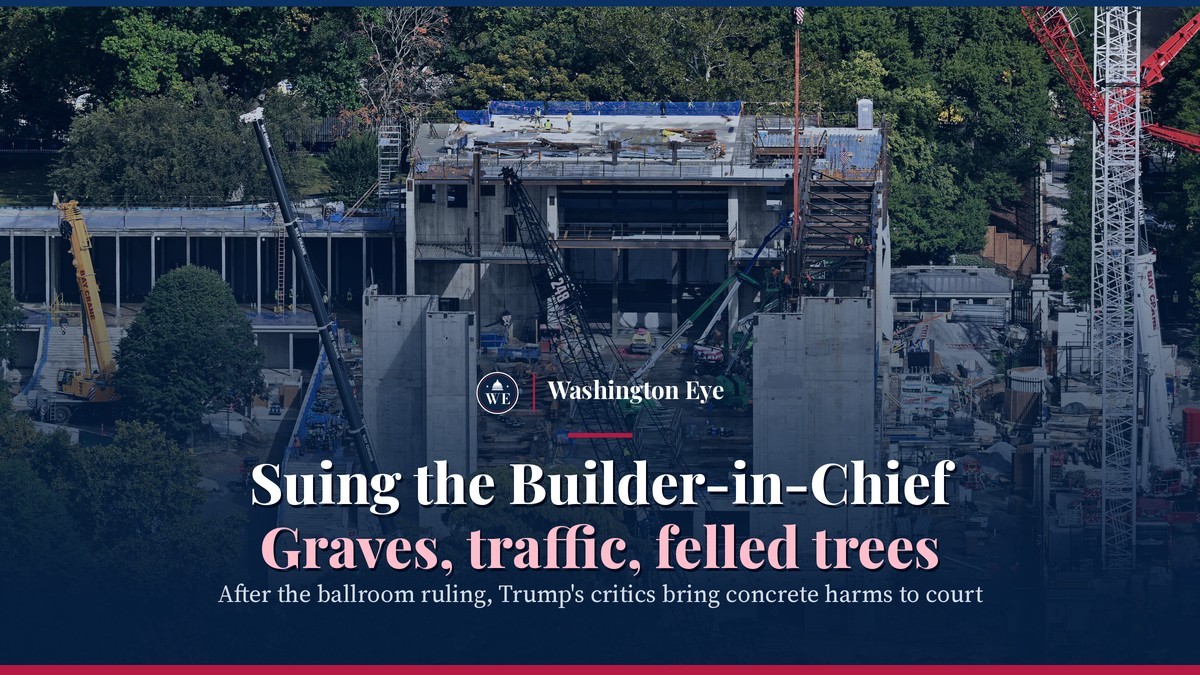
Start with the ballroom, because it set the terms. Work began in October 2025 with the East Wing's demolition. In December, the National Trust for Historic Preservation sued, asking that the work wait until two federal planning bodies had reviewed it and Congress had authorized it. To show it had a legal right to sue, known as standing, the trust relied on one member, Alison Hoagland, who lives in Washington, visits the area about once a month and said the project's scale, height and massing injured her aesthetic, cultural and historical interests.
Senior U.S. District Judge Richard Leon agreed in March to bar above-ground construction while letting underground work, such as bunkers and shelters, continue. In August, a divided appeals court panel upheld him. Judges Patricia Millett and Bradley Garcia wrote that Congress, and only Congress, has the power "to regulate the construction and demolition of White House structures," and noted that Congress had appropriated no money for the ballroom. Judge Neomi Rao dissented, arguing the trust lacked standing.
On August 31 the Supreme Court, by a vote of 5 to 4, put Judge Leon's order on hold. The unsigned majority opinion said it was not deciding whether the project was legal. It said only that the trust likely lacked standing, because Ms. Hoagland's harms were not the kind of concrete injury the Constitution requires, and that stopping the work could harm security, since officials attested that a structure of roughly the ballroom's height and mass was "crucial" to protecting a military installation below ground. Chief Justice John Roberts, joined by the court's three liberal justices, dissented. He called the construction "likely unlawful" and the majority's decision "no victory for the separation of powers."
The petition Solicitor General D. John Sauer filed on November 5 asks the justices to go further. He wants them to reverse Judge Leon outright, without new briefing or argument, or at least to hear the case on the merits. The earlier ruling, he wrote, "has all but answered the question presented," and the project, described in the filing as roughly 70 percent complete, "should be permitted to move forward outside the shadow of judicial superintendence." He described the injunction as issued at the behest of "a single passerby." The trust's response is due December 7.
The government's argument deserves a fair hearing. Courts are not meant to referee taste, and a rule letting anyone who dislikes a building halt it would invite endless litigation. The administration also calls the work a security project, and judges are rightly cautious about second-guessing such claims. Judge Rao's dissent shows this is a respectable position, not a fringe one.
But follow the logic to its end. If watching a landmark transformed is not an injury, it becomes very hard to find anyone who can enforce the laws Congress wrote to govern construction in the capital. The Chief Justice argued that a preservationist can be injured by the transformation of a building she regularly enjoys, just as the court has accepted that an environmentalist can be injured by the loss of a forest or river. Reject that, and the question of whether the president needed Congress's approval may never be answered.
The arch litigation shows challengers adapting to that risk. The first suit came from three Vietnam War veterans and an architectural historian. On October 31 the District of Columbia and Virginia, through their attorneys general, Brian Schwalb and Jay Jones, filed their own case. Their complaint is about traffic, pollution, stormwater runoff into the Potomac and interference with emergency services during a construction period of about three years, harms that fall on governments with budgets and road crews, not on people with opinions about design. The Kennedys add a loss tied to particular graves.
The legal claim beneath all three is about Congress. The challengers point to the Commemorative Works Act, which requires that such memorials be "specifically authorized by law," and to a statute barring structures on federal grounds in the District "without express authority of Congress." The administration answers that Congress authorized the arch a century ago, in the 1925 law that created Memorial Bridge.
Judge Chutkan was not persuaded, at least for now. Late on November 5, hours after the National Capital Planning Commission voted 8 to 4 to approve the arch, she issued a 14-day order blocking construction and found that the District and Virginia were likely to succeed on their claim. "The sheer improbability that a 100-year-old statute would contain authority, unknown to every previous administration, to erect a 250-foot arch at a principal location in the nation's capital indicates how far" the government "must stretch to justify this project," she wrote. At an earlier hearing she asked what harm the government would suffer "apart from the executive's desire to bedazzle the city."
The administration's case for speed is not trivial. Its lawyers said excavation and foundation work, expected to last six to eight months, could start immediately, with above-ground construction from May 2027 at the earliest. Mr. Trump has said the arch would serve a military purpose and could house drones and snipers, and the commission's chairman, Mark Paoletta, called it "a generational security opportunity." The government's response to the latest requests for a longer pause is due November 16. The plaintiffs want a ruling before the order expires at midnight on November 19.
The golf course case shows what happens when a judge suspects she has not been told the truth. The D.C. Preservation League and two golfers sued in February over plans to rebuild East Potomac Golf Links, a century-old public course, into what the administration calls a championship course capable of hosting major events. For months, Judge Ana Reyes declined to step in, saying she trusted the government's lawyers. Then hundreds of trees came down in October, and the president said on his social media platform that the course would close on November 15.
Judge Reyes issued an injunction barring further tree removal and requiring ten days' written notice before any irreparable change. On Monday night she refused to pause it while the government appeals, writing that the record showed the Interior Department had been planning "not to manage, but to destroy the historic East Potomac Golf Course" and replace it. She has also proposed appointing Jessie Liu, who served as the top federal prosecutor in Washington during Mr. Trump's first term, as a special master to examine whether Justice and Interior Department lawyers committed ethical violations. Responses are due Friday. A Georgetown law professor, David Super, said such an inquiry "can be a precursor to holding someone in contempt of court." The Interior Department has called Judge Reyes a "far Left activist judge."
Earlier, she put the core problem bluntly: "Rarely, if ever, has the United States Department of Justice urged a federal court not to believe the sitting president." When a president announces plans publicly and his lawyers describe something smaller in court, judges must decide which version is real, and challengers carry the burden of proving it.
The courts have not uniformly said no. On Monday the Supreme Court let border wall construction resume in the Big Bend region of Texas, over a noted dissent from Justice Ketanji Brown Jackson. The ballroom is still rising. Elsewhere, judges have slowed the president: in September, Judge Christopher Cooper blocked the plan to close the Kennedy Center for two years and the proposed inscriptions crediting Mr. Trump; the arch is paused and tree cutting on the golf course is barred. The pattern is less a wall of judicial resistance than a series of temporary orders, each exposed to the standing arguments the government won on the ballroom.
That is why the change in Congress matters more than any single ruling. Democrats take control of both chambers in January, and Representative Jared Huffman of California, the top Democrat on the House committee that oversees the Interior Department, has promised to use the panel's "full investigative and oversight authority." A spokesman for Representative Don Beyer of Virginia noted that the appropriations process beginning January 3 "will be controlled by Democrats." The next speaker will also choose the House general counsel, and Mr. Beyer's office argues that filings from a majority carry weight that the minority's do not.
Money is the clearest lever. Cost estimates have trickled out slowly, often in court; one figure for the golf course seawall exceeds $300 million. If the administration's theory is that old laws already authorize what it wants to build, a Congress that writes clearer laws and conditions its spending can test that theory directly.
Skye Perryman, whose group Democracy Forward represents plaintiffs in several of the suits, put it simply: the public now has "a tool that's not just in the courts." It is the better tool. Judges can rule only on what plaintiffs with the right injury bring them. Congress does not need anyone's standing to decide what gets built on the National Mall.
Supporters say Mr. Trump is restoring landmarks and, in the planning commission chairman's words, completing a project "over a century in the making" to give Arlington a monumental gateway. Some of that case may persuade. But it should be made to the lawmakers who own the land on the public's behalf, not settled by a legal doctrine that makes it nearly impossible to ask whether the president needed their permission. The next deadlines are Friday in the golf case, November 19 for the arch and December 7 for the ballroom. The bigger one is January 3.